Tear gas, shuttered shops and a government out of touch: The KRA tax revolt that could define Kenya’s road to 2027
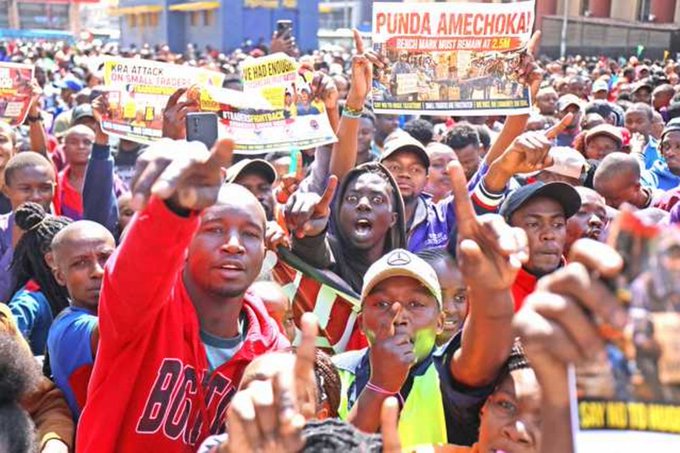
Traders are protesting new Sh3.2m KRA container tax
When hundreds of small traders march on the taxman’s headquarters and are met with tear gas, something has gone badly wrong — and with elections twelve months away, the political consequences may prove as costly as the economic ones.
By James Mwangi
Hundreds of small-scale traders shut their shops and marched on the Kenya Revenue Authority’s Times Tower headquarters in Nairobi yesterday, protesting a 28 per cent increase in the customs benchmark for consolidated cargo that they say threatens to destroy their livelihoods before a single coin reaches the government’s coffers.
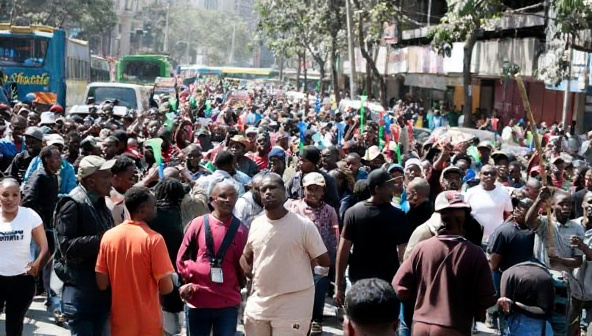
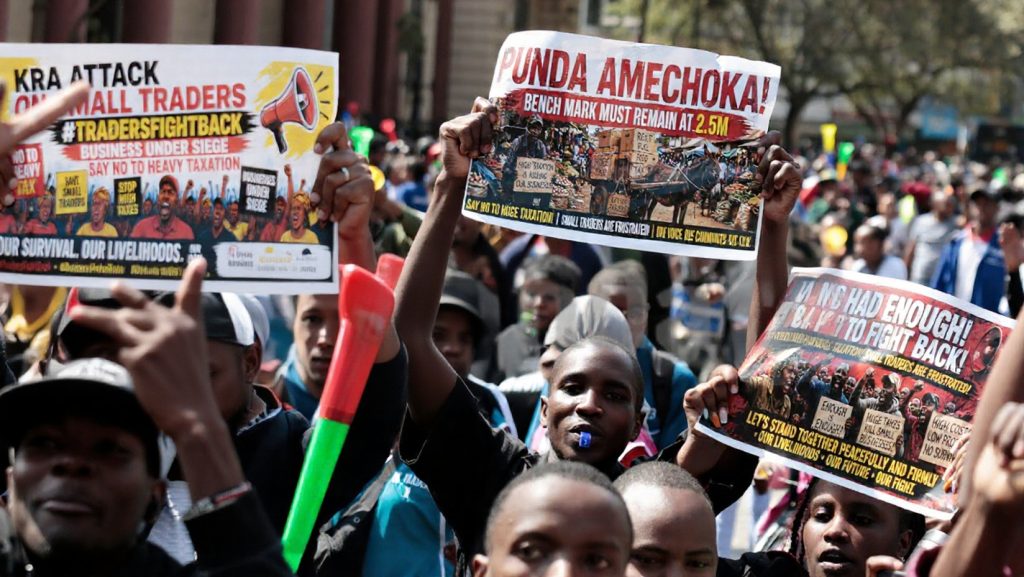
Shops along Moi Avenue, Kenyatta Avenue and Tom Mboya Street stood shuttered as traders from Kamukunji, Gikomba and Nyamakima markets took to the streets, many carrying Kenyan flags, banners and vuvuzelas, converging at the Kenya National Archives before marching toward Times Tower. Police responded with tear gas to disperse the crowd before it reached its destination — a scene that, with the August 10, 2027 general election now precisely twelve months away, carries consequences well beyond the question of customs benchmarks.
The dispute has a precise number at its centre. KRA raised the minimum customs benchmark for general containerised consolidated cargo from KSh2.5 million to KSh3.2 million, a change that took effect on 21 August 2026. The adjustment represents a KSh700,000 increase — roughly 28 per cent — in the benchmark used for consolidated cargo, the mechanism that allows small importers to pool their shipments and share the cost of a single container.
For Kenya’s vast army of micro-importers, most of whom source clothing, electronics, kitchen appliances and household goods from China through shared containers, the arithmetic is brutal. Consolidators currently charge traders roughly KSh896 per kilogramme for air cargo and KSh640 per kilogramme for sea freight. With the revised benchmark in place, importers face compounded costs involving import duty, value added tax, excise duty, the Import Declaration Levy and the Railway Development Levy. For a trader operating on thin margins in a cramped stall in Eastleigh or along Luthuli Avenue, that is not a technical adjustment. It is a potential death sentence for the business.
KRA’s position is that the benchmark is being misread. The authority insists the KSh3.2 million figure is not an automatic tax bill on every consolidated container but a risk-management reference used under a simplified clearance arrangement. “The minimum yield is not a representation of the actual tax liability for the goods contained in a container,” KRA said in a statement issued on 27 August. The authority further argued that the previous KSh2.5 million benchmark had remained unchanged for approximately six years, despite significant shifts in exchange rates, freight charges and East African Community tax laws.
KRA said the revision is also intended to address undervaluation, under-declaration, misclassification and misdescription of goods — including the practice of declaring high-end smartphones as cheaper models to reduce customs liabilities. “This is not about targeting small traders. It is about creating a level playing field where businesses compete fairly,” the authority said.
The traders are unconvinced. The Small Traders Association has vowed to sustain weekly demonstrations until KRA invites them to a proper negotiating table, arguing that the 28 per cent increase threatens the survival of micro-importers, wholesalers and retailers who rely on consolidated shipments. “These sudden punitive increases pose an immediate structural threat to the baseline survival of micro importers, local wholesale networks and everyday retail traders,” a traders’ representative said.
The Micro, Small and Medium Enterprises Alliance of Kenya has been equally forceful in its opposition. It has demanded the immediate withdrawal of the KSh3.2 million benchmark, the permanent retention of the KSh2.5 million threshold, and a formal commitment that no future increase will be implemented without meaningful prior consultation with affected traders.
The political class moved swiftly to capitalise. Kiharu MP Ndindi Nyoro, leader of the People’s Party of Kenya, took to social media on Friday to oppose the new benchmark, warning that the increase could not be allowed at a time when traders were already dealing with higher freight costs. He argued that traders in Nyamakima, Gikomba, Kamukunji, the Nairobi CBD and Eastleigh must be listened to. Nyoro’s intervention was not simply a matter of principled concern — it was a calculated positioning in a political landscape where the allegiance of Nairobi’s trading community is a prize worth fighting for.
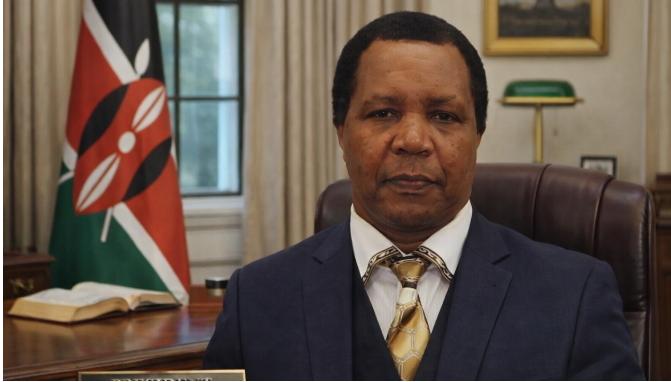
That political dimension cannot be overstated. Kenya is witnessing unusually early political activity ahead of the August 2027 general election, shaped by a rapidly growing youth population, the political fallout from the 2025 Gen Z protests and the realignment of alliances following the impeachment of former Deputy President Rigathi Gachagua and the death of former Prime Minister Raila Odinga. President William Ruto, who built his political identity on the language of the “hustler” — the small trader, the boda boda rider, the market woman — faces a profound credibility test when that same constituency is being tear-gassed outside the taxman’s offices.
Ruto has pointed to the Hustler Fund as evidence of his commitment to small businesses, noting that it has lent KSh90B to 27 million Kenyans. “Hustler was not a slogan. Hustler was a fund,” he said recently. But a government that speaks the language of the hustler while simultaneously raising import costs for the hustler’s stock-in-trade is sending a contradictory message at precisely the wrong moment.
The dispute also carries regional implications. Kenya’s Port of Mombasa serves Uganda, Rwanda, South Sudan, Burundi and eastern Democratic Republic of Congo. Regional trade experts warn that higher import costs may feed into inflation across East Africa, particularly for products that regional consumers depend on heavily. A benchmark set in Times Tower reverberates across the continent.
The latest standoff presents KRA with a delicate balancing act: raising revenue and curbing tax evasion without making formal importing prohibitively expensive for thousands of small businesses. The government invested in facilities such as the National Deconsolidation Centre at Nairobi Central Railway Station to make it easier for small traders to collect cargo transported by the Standard Gauge Railway — a gesture of support for informal traders that now sits awkwardly alongside the benchmark increase.
Speaking yesterday at the Kenya Police Service pass-out ceremony at Kiganjo, Ruto said Kenya was approaching an important moment in the life of the Republic. “Political competition is an essential feature of our democracy. Parties are at liberty to organise. Candidates must be free to campaign. Citizens must be free to assemble, listen, question, criticise, and choose,” he said. The irony of those words being delivered on the same day that traders exercising precisely those rights were being dispersed with tear gas in the capital will not have been lost on Kenya’s politically astute public.
The deeper problem here is structural and painfully familiar. KRA issues a new directive. Traders raise concerns. Protests erupt. Security forces intervene. Statements are issued. Meetings are promised. And the cycle threatens to begin again. It is not governance. It is crisis management with a press release.
With twelve months to polling day, the government needs the trading community’s votes as much as it needs their taxes. The question is whether it can find a way to collect both — or whether Friday’s tear gas will linger in the memory of Nairobi’s market stalls long after the smoke clears.
Similar Posts by The Mt Kenya Times:
- Mt Kenya Times ePAPER October 17-18, 2026
- Ruto bets billions on Kerio Valley — with one eye on 2027
- Ruto’s health ministry kills Murang’a’s digital hospitals
- Kenya bets on Mount Kenya to drive a billion-shilling tourism revival
- Do you have a wealth vision? Or are you just working until you die?
About the Author