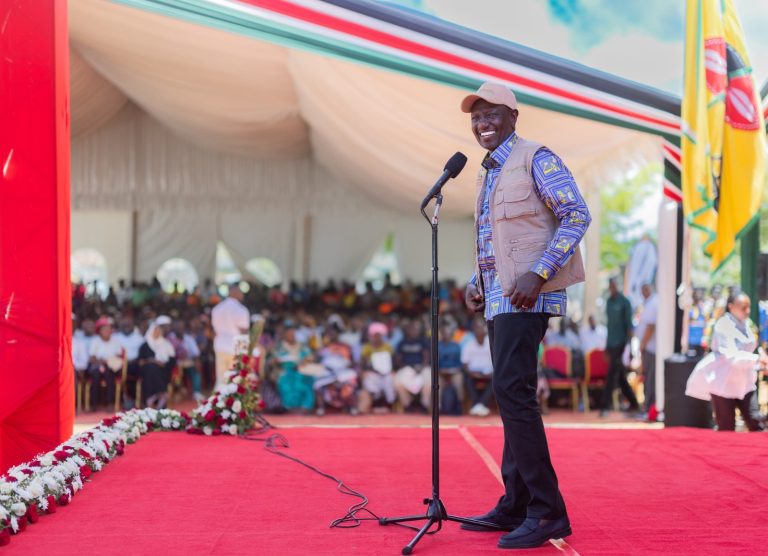
The convoy of former Deputy President Rigathi Gachagua came under attack during a political tour of Nakuru Town West
The attack on Gachagua’s convoy in Nakuru is not merely a political incident — it is a warning Kenya has heard before and cannot afford to ignore again
By Levis Wangamati
Kenya did not need another reminder of how quickly political competition can turn dangerous. It got one in Nakuru on Friday.
The convoy of former Deputy President Rigathi Gachagua came under attack during a political tour of Nakuru Town West, with stones reportedly thrown at the motorcade in the Soko Mjinga area. The Democracy for the Citizens Party said its vehicles were targeted and damaged, and alleged that Gachagua narrowly escaped harm — claims that have not been independently verified. But the more important question is not simply who threw the stones. It is what the stones represent.
When political arguments spill onto the streets, when rallies become confrontations and when supporters begin treating opponents as enemies to be silenced rather than defeated at the ballot box, democracy starts losing the very character that makes it democratic. Political competition is supposed to be a contest of ideas, policies and persuasion — settled by citizens standing in queues, marking ballots and accepting outcomes. It should never require a crowd to silence an opponent before voters have had their say.
Nakuru is not an insignificant location in this conversation. The county carries some of Kenya’s most painful political memories. The post-election violence of 2007 and 2008 left more than 1,200 people dead and over 300,000 displaced, tore communities apart and left scars that have never fully healed. International mediators were required to pull the country back from the brink. The economy contracted sharply. Tourism collapsed. Families were separated, properties destroyed and livelihoods erased. That catastrophe should have permanently altered Kenya’s political conscience, embedding in every leader and every citizen an unshakeable commitment to resolving differences through democratic means alone.
Yet Kenya continues to flirt with the same dangerous habit — treating political rivalry as justification for confrontation. The lesson of 2007 and 2008 has been recited at countless forums, memorials and political gatherings. It has been invoked in speeches, cited in policy documents and referenced in peace frameworks. But recitation is not internalisation, and the events in Nakuru suggest that for some, the lesson remains theoretical rather than lived.
The greatest danger is not that Kenya suddenly descends into widespread violence. It is that Kenyans gradually become comfortable with political violence in small doses. A disrupted meeting becomes normal. A hostile crowd becomes part of the political theatre. A blocked convoy becomes something supporters explain away. A broken windscreen becomes a footnote. Each incident, considered in isolation, is treated as manageable, unfortunate but not alarming. Yet collectively, these incidents establish a pattern — and patterns, left unaddressed, become precedents. Behaviour that should alarm a functioning democracy begins to look like ordinary politics. That is precisely how political violence takes root — not always with the worst-case scenario, but with the quiet acceptance of conduct that should have been condemned the moment it appeared.
Recent political events reinforce the concern. Human rights organisations have already issued formal warnings about the risks of political violence and intimidation ahead of the 2027 General Election. Civil society groups tracking political incidents have noted a rise in confrontational rhetoric, the disruption of political gatherings and the use of organised crowds to restrict the movement and activities of political opponents. These are not isolated observations. They form part of a documented pattern that demands serious attention from the state, political parties and the public alike.
The 2024 anti-government protests offered another cautionary lesson — demonstrations that began around opposition to the Finance Bill eventually produced deadly confrontations, widespread destruction and the storming of Parliament. Those events are not identical to what happened in Nakuru and should not be carelessly equated. But they demonstrated something Kenya must never forget: once confrontation becomes normalised, events can move beyond the control of those who started them. The individuals who lit the first fires of those protests did not intend for Parliament to be breached. Escalation has its own momentum, and by the time leaders call for calm, the situation has often already moved beyond their reach.
Friday’s incident therefore deserves more than partisan commentary. It should concern government supporters. It should concern opposition supporters. And it should concern every Kenyan who holds no party card at all, because democracy cannot be selective about violence. An attack on an opposition politician is wrong. An attack on a government politician is equally wrong. Disrupting a political meeting because one dislikes the speaker is wrong. Using political influence to intimidate opponents is wrong. The standard cannot change depending on whose convoy is under threat, whose meeting has been disrupted or whose supporters stand accused. A democracy that applies different rules to different political actors is not a democracy in any meaningful sense — it is simply organised advantage dressed in democratic language.
Political leaders carry a particular responsibility here. They cannot condemn violence only when their own side is the victim while remaining silent when their supporters stand accused of intimidation. They cannot demand tolerance for themselves while denying it to opponents. They cannot deploy inflammatory language before crowds and then express surprise when the crowd acts on it. Words matter in politics. They carry weight. They move people. And when leaders use words carelessly, the consequences are rarely confined to the platforms from which those words were delivered.
If Kenya is serious about 2027, political parties must begin treating restraint as a democratic virtue rather than a sign of weakness. The ability to campaign aggressively while maintaining discipline, to criticise opponents while respecting their right to exist in the political space, and to mobilise supporters while keeping them within the boundaries of lawful conduct — these are not limitations on political ambition. They are the foundations on which credible democratic leadership is built.
The police, too, must act without favour. Political violence cannot be managed by selectively protecting some politicians while leaving others exposed. Investigations must be credible, perpetrators identified through evidence and accountability applied regardless of political affiliation. The perception that law enforcement responds differently depending on the political identity of those involved is itself corrosive to democratic confidence. When citizens believe that justice is partisan, they begin to seek protection through other means — and those means are rarely peaceful.
Politicians making serious allegations must equally understand the weight of their words. Claims require evidence and proper investigation, not merely amplification through rallies and social media. Accusations made without substantiation can inflame tensions, mobilise angry crowds and produce consequences far more serious than the original grievance.
Friday’s events unfolded against a backdrop of intensifying political mobilisation. Gachagua had opened a Democracy for the Citizens Party regional office in Naivasha as part of a wider Nakuru tour, while publicly challenging President William Ruto to focus on him rather than retired President Uhuru Kenyatta ahead of 2027. That political temperature matters. As Kenya moves deeper into its pre-election cycle, the temptation for political actors to treat every public gathering as a test of strength will only grow. Crowds will get larger. Rhetoric will sharpen. Competition for political territory will intensify. In that environment, the incident in Nakuru is less an anomaly than an early indicator of what lies ahead if the country does not deliberately choose a different path.
Kenya does not need an election in which citizens are encouraged to fear one another because of how they intend to vote. It needs an election in which politicians fight fiercely for votes while respecting those who may choose differently. It needs political competition that is loud, passionate and consequential — but bounded by the rule of law and by the basic recognition that an opponent is not an enemy.
Democracy is not the absence of political conflict — it is the capacity to manage that conflict without turning citizens against one another. Kenya will disagree in 2027. It should. Candidates will challenge each other’s records. Parties will compete for influence across every region of the country. Supporters will celebrate victories and mourn defeats. That is politics, and it is healthy. But politics must have a boundary, and that boundary is drawn at the point where competition becomes coercion, where rivalry becomes hostility and where the desire to win overrides the obligation to preserve the democratic space in which winning is possible.
The ballot box must remain more powerful than the stone. Kenya has travelled this road before and knows its cost in lives, livelihoods and national dignity. The time to make a different choice is now — while political competition remains something the country can still shape and control, rather than later, when violence has begun controlling the politics.
Similar Posts by The Mt Kenya Times:
- Mt Kenya Times ePAPER October 1, 2026
- Museveni backs Lamu but keeps Uganda’s money at home
- Sifuna’s party wins its name — and Kenya’s opposition race begins in earnest
- Lamu’s $16B gamble: Africa’s biggest refinery divides the region
- Ruto launches KSh2.2 trillion Lamu refinery in East Africa’s biggest energy bet
About the Author