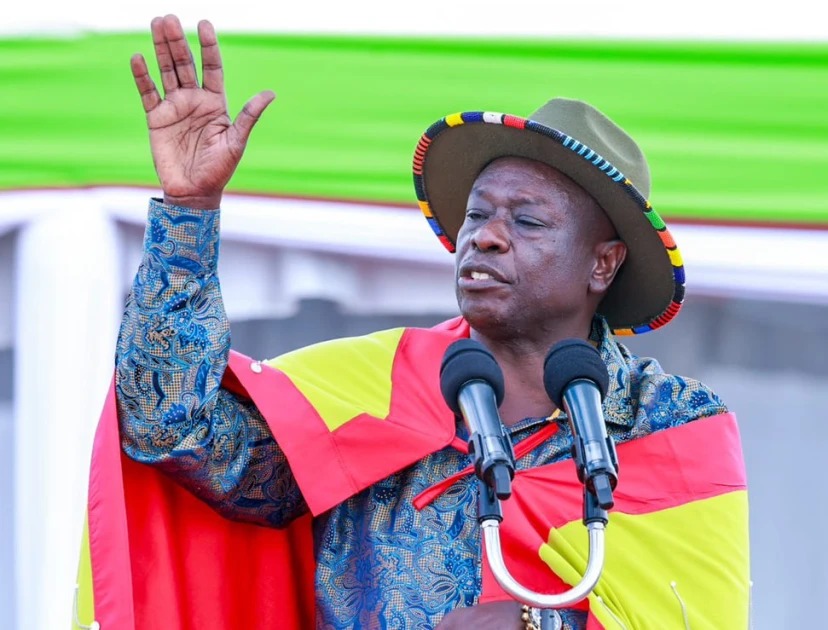
DCP leader Rigathi Gachagua
Democracy for the Citizens Party leader Rigathi Gachagua has accused President William Ruto of publicly humiliating Deputy President Kithure Kindiki at the Naivasha retreat and plotting to ease him from office — echoing the very pattern Gachagua says was used against him.
By James Mwangi
Rigathi Gachagua yesterday accused President William Ruto of deliberately humiliating Deputy President Kithure Kindiki at the recent broad-based government retreat in Naivasha, warning that the President was laying the groundwork to remove his second-in-command from office and replace him with figures drawn from the Orange Democratic Movement.
Speaking at a Democracy for the Citizens Party rally in Kipeto, Keekonyokie Ward, Kajiado West Constituency, Gachagua delivered what amounted to both a political warning and a personal testimony — one grounded in his own experience of what he described as a calculated, methodical pattern of presidential marginalisation. The man who once occupied the Deputy President’s office was telling the man who replaced him that history was repeating itself, and that he recognised every step of the choreography.
The allegations were specific and pointed. Gachagua claimed that during the Naivasha retreat, Kindiki was seated away from the main dais — not by accident, he insisted, but by design. He further alleged that Kisii Governor Simba Arati, emboldened by what Gachagua described as Ruto’s tacit encouragement, openly declared that the Deputy President’s seat belonged to the ODM, and that Kindiki was welcome to cross the floor if he wanted to keep it. The remark, Gachagua said, was made while Kindiki sat in the room.
“Even as he said this, Kindiki was seated right there and could only look down,” Gachagua said.
It was, in his telling, a moment of acute and deliberate humiliation — a sitting Deputy President forced to absorb a public challenge to his own position in silence, unable to respond, unwilling or perhaps simply unable to push back.
To understand why that image carries such resonance, it is necessary to look at what happened to Gachagua himself in the months before his impeachment in October 2024. The pattern, as those who observed it closely will attest, was strikingly similar. It did not begin with a vote in parliament. It began with a seat at the wrong table.
Long before the impeachment motion was tabled, Gachagua found himself being edged out of the inner circle in ways that were visible to those paying attention. Meetings he expected to attend were held without him. Events at which the Deputy President would ordinarily be prominent saw his presence diminished or his position on the programme quietly altered. Political allies who had been close began to create distance. The signals were being sent, and they were being read — by the public, by the press, and by Gachagua himself, who says he confronted the situation head-on in ways that Kindiki, given his particular political circumstances, simply cannot.
“When he wants to remove you, he does not tell you to go,” Gachagua said yesterday. “He begins to sideline you, then brings in others to occupy your political space, and then uses them to come after you.”
He described his own response to the early stages of that treatment in characteristically combative terms, recounting incidents during his tenure when he said attempts were made to physically marginalise him within the presidential entourage. He claimed that at a Naivasha function, presidential economic adviser David Ndii attempted to insert himself into the walking party and was physically removed. “I pushed back. I made clear I would not be sidelined,” Gachagua said. The implication was unmistakable: Kindiki, constrained by a fundamentally different political situation, does not have that option.
That distinction is structural, not personal. Gachagua was elected to the Deputy President’s office on a joint ticket with Ruto in 2022, which gave him an independent electoral mandate — a political base he could in theory appeal to separately from the presidency. Kindiki was appointed to the position by Ruto following the impeachment, which means he holds the office entirely at the President’s discretion, without the cushion of his own electoral mandate to fall back on. In any internal confrontation with the President, the leverage available to him is almost non-existent.
“Because he was given the job rather than elected to it, his role is simply to say yes sir,” Gachagua said. “He cannot push back.”
The parallel between the two deputies is uncomfortable in its precision. Both are Mount Kenya figures appointed to serve alongside a President from the Rift Valley. Both were positioned as bridges between their region and the presidency. Both have found, or are finding, that such bridges can be dismantled from one end without much warning. The difference is that Gachagua reached the end of that process and emerged on the other side with a political platform, a party and a grievance he has converted into fuel. Kindiki is, on Gachagua’s reading of events, somewhere in the middle of the same journey — though he has given no public indication that he sees it that way.
Gachagua was careful, amid the political sharp-shooting, to frame his concern for Kindiki in terms that were personal and even moral. Whatever the calculation behind it, the register was unexpected from a man addressing a political rally.
“Even if you are done with someone and no longer want them, why do you have to embarrass them in front of other men?” he said. “Does he have no dignity in his own home?”
It is a question that lingers. In Kenyan political culture, where public displays of loyalty and hierarchy carry enormous symbolic weight, the deliberate humiliation of a senior official in the presence of his peers sends a message that travels far beyond the room in which it happens. It tells the political market who is rising and who is falling. It signals to allies where to place their bets. And it places the person being humiliated in an impossible position — forced to choose between absorbing the slight in silence or responding in a way that accelerates the very outcome they are trying to avoid.
Gachagua chose to respond. It did not save him, but it defined him. The question now hanging over Kindiki is whether he will find a way to assert himself before events make the choice for him — or whether, as Gachagua clearly believes, the machinery is already too far advanced for any individual response to alter the outcome.
The 2027 general election is now the fixed point around which every political calculation in Kenya revolves. Gachagua’s DCP has positioned itself as the authentic voice of Mount Kenya, a community whose vote Ruto cannot win the next election without, and whose patience with the current arrangement, Gachagua insists, is running out. Whether Kindiki’s continued public silence reinforces that narrative or eventually contradicts it will be one of the defining sub-plots of the political period now unfolding.
In Kenya, the road from Deputy President to the political wilderness can be travelled with remarkable speed. Gachagua completed that journey in under two years. Yesterday, with the precision of a man who knows every pothole on the route, he was offering Kindiki a map.
Whether Kindiki reads it is another matter entirely.
Similar Posts by The Mt Kenya Times:
- Mt Kenya Times ePAPER September 30, 2026
- Ruto mocks UNGA critics: “That requires someone with sense”
- Media warns: Information gaps fuel 2027 disinformation risk
- Gachagua’s DCP holds strategic NEC meeting ahead of 2027 polls
- Sifuna’s unending party ownership hurdles
About the Author