The fortress of the unexamined mind: How Kenya’s schools forged compliance while Iran’s tempered sovereignty against empire
 The Mt Kenya Times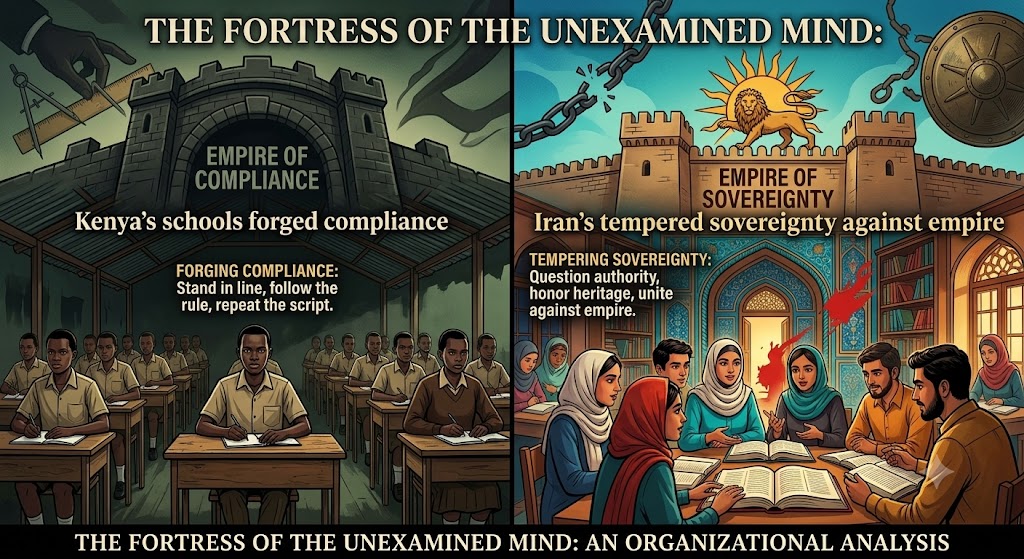
By Jerameel Kevins Owuor Odhiambo
In 1979, as Iran’s revolution sealed its borders against Western dominance, the United States began constructing the most comprehensive sanctions regime in modern history choking finance, technology, and medicine. Yet by the early 2020s, Iranian researchers were publishing nearly 80,000 scientific papers annually, ranking among the world’s top five in nanotechnology output and claiming double-digit global positions in biotechnology. Women, once largely excluded, now form majorities in many university cohorts; literacy among the young exceeds 97 percent. Domestic production covers over 90 percent of medicines. Missiles, drones, and air-defense systems emerged from laboratories that never waited for foreign blueprints. This is not miracle. It is the visible fruit of an educational philosophy that treats the mind as a fortress rather than a warehouse.
Kenya’s classrooms tell a different story. Decades after independence, the dominant inheritance remains an exam-obsessed machine that rewards the perfect regurgitation of syllabus points. Students memorize model compositions, drill past papers until the ink fades, and emerge with certificates that certify obedience more than insight. Critical thinking is named in policy documents, then strangled by marking schemes that punish deviation. The Competency-Based Curriculum promises liberation from rote learning, even so teachers still teach to the test, parents still buy revision booklets that flatten knowledge into bullet points, and the nation’s intellectual bloodstream remains thin. The result is a generation that can recite the symptoms of underdevelopment but rarely diagnoses its own mind as the primary patient.
Here lies the first lesson Kenya missed: education without a living philosophy is merely technical training dressed in academic robes. Iran’s Fundamental Reform Document of Education anchors the entire system in the transcendent theosophy of Mulla Sadra and the broader Islamic intellectual tradition reason yoked to revelation, the pursuit of perfection, the coherence of the universe, the human being as seeker of knowledge who must also purify the self. Philosophy is not an elective for specialists; it saturates the curriculum through compulsory courses on Islamic thought, the roots of the revolution, and the ethical dimensions of every discipline. The Iranian student is taught that knowledge is not neutral commodity but moral weapon. The Kenyan student is taught that knowledge is a passport to employment. One produces citizens who can endure isolation; the other produces job-seekers who collapse when the external market shifts.
Consider the correlation. When sanctions severed Iran’s access to Western technology, the philosophical insistence on self-reliance rooted in the idea that dependence is a form of spiritual and political humiliation drove reverse-engineering on a national scale. Engineers who had studied under a system that valued indigenous capacity simply refused to accept absence as destiny. They built what they needed. Kenya, by contrast, continues to import curricula, textbooks, and even the metrics of success. Its brightest minds still measure themselves against foreign rankings and foreign degrees. The correlation is brutal: a nation that trains its youth to think as consumers of knowledge will forever remain a consumer nation. A nation that trains its youth to think as producers of meaning will invent its own necessities.
The second lesson is deeper still. Philosophy does not merely decorate the curriculum; it forges psychological resilience. Iranian education, whatever its authoritarian excesses and documented failures in open critical inquiry, embeds a narrative of resistance. The student learns that the nation stands under siege not by accident but by design, and that intellectual labour is a form of defence. This narrative has sustained operations against continuous American pressure for nearly half a century. Scientists continue working under isolation; universities expand even when journals are blocked; young researchers publish despite banking restrictions. The mind has been prepared for siege. In Kenya the narrative is thinner. Education is framed as individual mobility within a global order whose rules are written elsewhere. When that order withholds visas or capital, the Kenyan graduate has no philosophical armor. The result is brain drain without corresponding domestic fortification, complaint without corresponding invention.
Data sharpens the indictment. Iran’s higher education expanded from roughly 150,000 students before the revolution to nearly four million. Scientific output rose from a marginal 0.1 percent of world production to over 2 percent. Kenya’s enrolment has grown, yet learning outcomes remain stubbornly mediocre: large percentages of secondary candidates score below the threshold that opens meaningful pathways, and employers repeatedly lament graduates who cannot analyse, synthesize, or invent under pressure. The Competency-Based Curriculum attempts to pivot toward skills and values, but the deeper architecture the philosophical foundation that would make skills serve sovereignty rather than mere employability remains missing. Without it, competency becomes another form of compliance.
Literary history offers a mirror. The Persian intellectual tradition never divorced hikmah (wisdom) from practical science; Avicenna, Suhrawardi, and Sadra treated the intellect as both analytical and illuminative. That inheritance, however imperfectly realised in modern Iranian schools, still pulses beneath the surface. Kenya inherited a colonial system designed to produce clerks and interpreters for an empire, then never fully replaced the soul of that system with one of its own. The result is an education that can produce competent technicians yet struggles to produce original thinkers capable of redesigning the national order itself.
The third lesson is the most uncomfortable. An education system that fears philosophy fears the very faculty that questions power including domestic power. Iran’s system is tightly controlled; critical thinking that challenges the theocratic core is constrained. Yet the same system has produced enough disciplined intellectual capacity to keep the state operational under extreme external assault. Kenya’s system, more open in formal terms, produces less of that capacity because it never demands the hard labour of first principles. It trains students to answer questions, not to interrogate the questions themselves. The difference is the difference between a mind that can endure blockade and a mind that waits for the blockade to be lifted by others.
Kenya need not copy Iran’s ideology. It must, however, confront the vacuum at the centre of its own educational soul. Until the Kenyan classroom teaches the young that thinking is an act of national survival, that knowledge without ethical and philosophical depth is merely sophisticated dependency, the country will continue to graduate citizens who can describe their problems eloquently while remaining incapable of inventing durable solutions. Iran’s endurance against American pressure is not primarily military or oil-based. It is the slow, stubborn product of an education that refused to treat the mind as a neutral instrument. Kenya has treated the mind as exactly that an instrument to be filled, tested, and certified. The instrument works. The fortress does not.
The choice is no longer abstract. In a world of intensifying geopolitical pressure, the nation whose schools cultivate only compliant competence will discover that competence is the first casualty of isolation. The nation whose schools cultivate philosophical depth however imperfectly, however ideologically freighted will discover that depth is the last redoubt. Kenya has spent decades perfecting the warehouse. It is time to begin building the fortress.
The writer is a social commentator
Similar Posts by The Mt Kenya Times:
- Passaris joins walk for dignity: Nairobi representative backs campaign for incontinence support
- Diaspora Times Global Sep 19 – Sep 25, 2026
- Tibet’s glacial catastrophe: Behind Beijing’s wall of silence, a climate disaster reshapes a region
- Museveni says Uganda overpaid for fuel through Kenyan middlemen as new terminal breaks ground
- Court orders throw KPL season kickoff into doubt
About the Author