When a nation’s leaders do not trust their own health system, why should the citizens?
 The Mt Kenya Times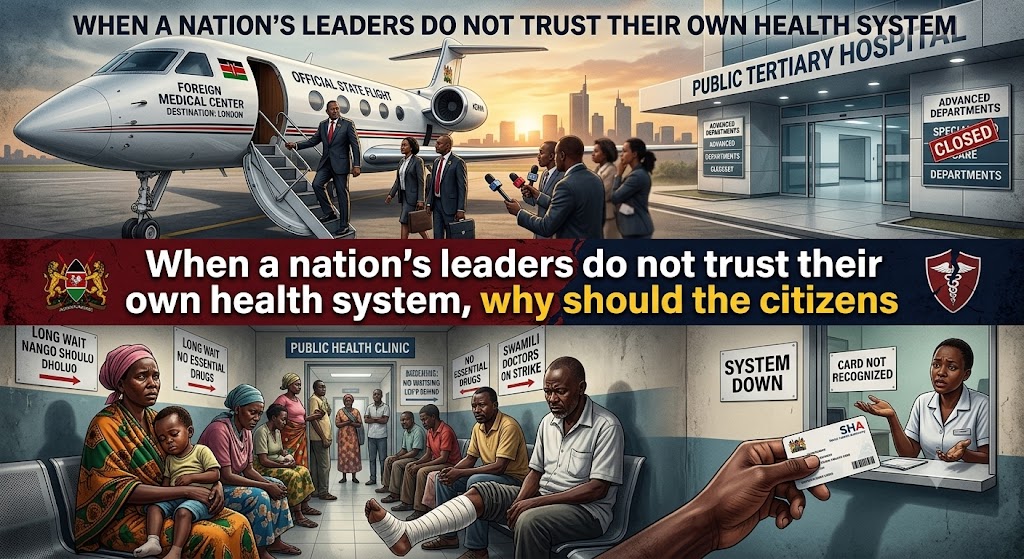
By Mr. Fredrick Kipchumba Chelimo PWD
Chairperson, Jiamini Disability network Community Based organization
Email: jiamini.network@gmail.com
Few responsibilities of government are as sacred as protecting the health of its people. Roads facilitate movement, schools impart knowledge, and security preserves order, but healthcare preserves life itself. A nation may survive poor infrastructure for years and recover from economic hardship with prudent leadership, but when its healthcare system ceases to command public confidence, the very social contract between the State and its citizens begins to fracture. That is why the promise of Universal Health Coverage under the Social Health Authority (SHA) was welcomed with hope across Kenya. It was presented not merely as another government programme, but as a historic transformation that would finally liberate ordinary Kenyans from the indignity of choosing between seeking treatment and feeding their families. It promised equity over privilege, dignity over despair, and access over exclusion. It was, in every sense, a promise of a healthier and more compassionate republic.
Today, however, beneath the optimistic speeches, colourful launches and impressive registration figures lies a painful reality confronting thousands of ordinary Kenyans. Across villages, market centres and urban settlements, citizens continue to narrate remarkably similar experiences. They arrive at health facilities expecting treatment only to encounter unavailable medicines, delayed digital verification, requests for out-of-pocket payments, referrals from one facility to another, or clinics unable to provide even the most basic laboratory services. Mothers carrying feverish children wait in queues only to leave without medicine. Elderly citizens who faithfully registered under SHA still struggle to obtain treatment for chronic illnesses. Patients are sent from dispensaries to health centres, from health centres to county hospitals, and sometimes from one county to another in search of services that should have been available much closer to home. For them, Universal Health Coverage remains an aspiration rather than an experience.
The greatest danger facing SHA is not technical failure but the growing gap between official narrative and lived reality. Governments naturally celebrate reforms, and every major policy deserves time to mature. Yet healthcare is unlike any other public service because illness does not wait for policy implementation schedules. Disease does not postpone itself while systems stabilise. Pain does not recognise administrative transition. Every day that a patient fails to obtain timely treatment is not merely a statistical inconvenience; it is a human tragedy unfolding quietly in homes across the nation.
Healthcare cannot be measured by the number of people registered in a database. Registration is only the doorway; treatment is the destination. A digital card cannot lower a child’s fever. An enrolment certificate cannot control diabetes. A policy document cannot stop a mother from bleeding during childbirth. The true measure of Universal Health Coverage is astonishingly simple: when a Kenyan walks into the nearest health facility, can that citizen receive timely diagnosis, appropriate treatment and essential medicine without financial humiliation? Until the answer to that question is consistently yes, declarations of success will continue sounding hollow to those standing in hospital queues.
The burden borne by primary healthcare facilities should concern every Kenyan. These facilities were designed to become the backbone of preventive and community-based healthcare, treating common illnesses before they become medical emergencies. When they lack medicines, diagnostic equipment, laboratory capacity or reliable reimbursement, the consequences cascade throughout the entire health system. Patients bypass local clinics and overwhelm referral hospitals with conditions that should never have reached that level. Healthcare workers become exhausted, waiting times lengthen, hospital budgets stretch beyond capacity, and public confidence steadily evaporates. A healthcare system is only as strong as its weakest clinic, not its finest referral hospital.
Perhaps the most uncomfortable question facing the nation is not whether SHA was conceived with good intentions, but whether those entrusted with its stewardship possess sufficient confidence to entrust their own health to it. If SHA is indeed the world-class healthcare revolution repeatedly described by political leaders, why do many of those same leaders continue enjoying separate, generously funded medical schemes financed by taxpayers? Why should the ordinary citizen be persuaded that one system is excellent while another, more expensive system quietly remains available for the political and administrative elite? Such contradictions inevitably breed scepticism. Confidence cannot be legislated; it must be demonstrated.
Leadership has never been about asking citizens to embrace standards that leaders themselves avoid. The greatest leaders throughout history have shared the hardships of those they governed because they understood that credibility is earned through example, not proclamation. A captain who abandons his own ship cannot inspire confidence among the crew. Likewise, no government can expect citizens to place unwavering faith in a healthcare system that its own highest office bearers appear reluctant to rely upon. If the political class sincerely believes that SHA represents the future of quality healthcare in Kenya, then nothing would restore public confidence more powerfully than voluntarily receiving the same healthcare under the same conditions as every ordinary Kenyan. Shared experience is the highest form of accountability.
This is not an argument against reform. It is an appeal for honesty, humility and urgency. Every Kenyan wants SHA to succeed because healthcare should never become another casualty of political competition. Success would mean fewer families descending into poverty because of medical bills, healthier children attending school, more productive workers contributing to the economy, and elderly citizens living with dignity rather than anxiety. Failure, on the other hand, would deepen inequality and erode one of the most fundamental obligations of government.
The Government therefore faces a defining moment. It can continue celebrating enrolment statistics while public confidence quietly diminishes, or it can confront implementation challenges with transparency, accelerate reimbursement to health facilities, strengthen medicine supply chains, improve digital reliability, equip primary healthcare facilities and invite independent public scrutiny of the system’s performance. Citizens are remarkably patient when leaders acknowledge shortcomings honestly and act decisively to correct them. What they cannot endure is being repeatedly assured that everything is working perfectly while their own experiences tell a very different story.
Healthcare is ultimately not about systems, institutions or legislation. It is about the frightened mother praying that her child survives the night. It is about the elderly pensioner hoping that life-saving medication will still be available tomorrow. It is about the young graduate injured in an accident who simply wants treatment without first proving financial worth. Behind every statistic is a human face, behind every policy is a human life, and behind every delayed reform is a family carrying invisible pain.
The measure of Universal Health Coverage will never be found in launch ceremonies, official speeches or registration dashboards. It will be found in the confidence with which an ordinary Kenyan enters the nearest health facility knowing that illness will be met not with excuses, but with competent care; not with empty shelves, but with medicine; not with uncertainty, but with dignity. Until that becomes the lived experience of every citizen, Universal Health Coverage remains not a fulfilled promise, but an unfinished covenant between the State and the people it exists to serve.
“The legitimacy of a government is measured not by the splendour of its promises, but by the quiet confidence with which its poorest citizen walks into a public hospital, certain that dignity, compassion and healing await.”
Similar Posts by The Mt Kenya Times:
- Taufiq Rafat: Voice of Pakistani English Literature
- Nomthandazo Mgcina: A young voice for education, sisterhood and youth empowerment
- Ronaldo, 41, back with Portugal as 1,000-goal milestone beckons
- Stress and depression: When the body speaks what the mouth cannot say
- When political rallies become danger zones
About the Author