The phantom of freedom: Kenya’s social justice as elite inheritance in disguise
 The Mt Kenya Times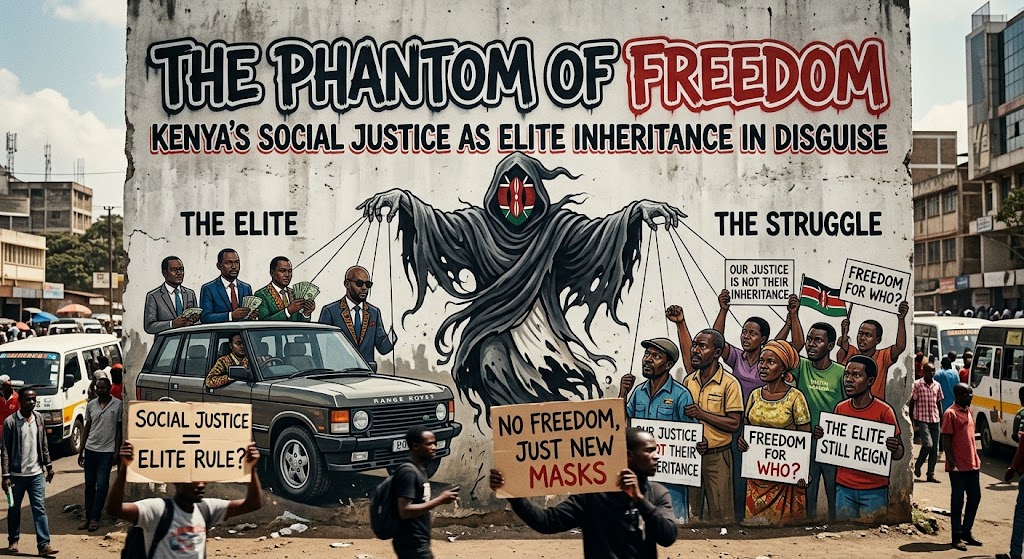
By Jerameel Kevins Owuor Odhiambo
In Kenya today, one hundred and twenty-five individuals command more wealth than forty-two point six million of their fellow citizens seventy-seven percent of the nation. Nearly half the population scrapes by in extreme poverty, a figure that has swollen by seven million souls since 2015 even as the economy posted respectable growth. The richest one percent clutch seventy-eight percent of the country’s financial wealth. Fewer than two percent of Kenyans own more than half the arable land; a microscopic zero point one percent of large-scale holders control thirty-nine percent of farmed earth while ninety-eight percent of smallholders, averaging a pitiful one point two hectares, squeeze onto the remaining forty-six percent. For every hundred shillings a man earns, a woman receives sixty-five. Only thirteen percent of women hold legal title to agricultural land. Sixty-eight percent of ordinary government revenue vanishes into debt servicing and salaries, leaving the rest of the budget to starve health, education, and social protection. These are not abstract ratios. They are the cold arithmetic of a republic that still dares to speak of justice.
This is the factual wound. Everything else is the infection that has festered around it for six decades.
The numbers do not lie; they accuse. They accuse a political class that inherited the colonial architecture of extraction and simply painted it black. When the Union Jack came down in 1963, the White Highlands did not vanish into egalitarian mist. They changed hands. The same logic that had declared African land “idle” and African labour cheap was repurposed by a new elite who spoke the language of African socialism while practising the economics of enclosure. Sessional Paper Number Ten of 1965 promised freedom from poverty, ignorance, and disease; what it delivered was a hierarchy in which some regions were declared productive and worthy of investment while the arid and semi-arid lands home to pastoralists, the historically marginalised were treated as residual afterthoughts. The Mau Mau fighters who died for land and dignity watched, from the grave, as “willing buyer, willing seller” schemes legitimized the very dispossession they had rebelled against. The rebellion was unfinished because the prize was privatized.
Consider the correlation that refuses to die. Colonial policy created two nations under one flag: a settler economy of large estates and a native economy of reserved labour. Post-independence Kenya perfected the model. Today the coast still hosts generations of squatters on ancestral soil more than sixty-five percent of residents in Kilifi, Kwale, and Lamu lack formal titles while vast tracts elsewhere lie idle under elite ownership. Food insecurity climbs; two point two million face acute hunger even as the Global Hunger Index labels the crisis “serious.” The same land that could feed the nation is locked in speculation and political patronage. Inequality is not an accidental by-product of growth; it is the deliberate outcome of a system that treats public resources as private inheritance.
Gender inequality is the quiet violence that compounds the rest. Women perform five times more unpaid care work than men. Asset ownership in male-headed households is three times greater. A woman from the poorest quintile faces a one-in-two chance of unemployment; a man from the richest faces one-in-five. Legal reforms exist on paper, yet the lived reality is that land remains a masculine fortress and the labour market a patriarchal sieve. Violence against women continues its grim ledger: hundreds of femicides, thousands of assaults that the state registers with bureaucratic fatigue rather than urgency. Social justice that ignores half the population is not justice; it is a partial amnesty for the powerful.
Youth stand at the sharpest edge of this betrayal. Unemployment and underemployment are not statistics; they are the daily amputation of possibility. A generation raised on the rhetoric of digital transformation and Vision 2030 discovers that the formal economy has no room for them, that informal hustling is the only available citizenship, and that police batons remain the state’s preferred language of dialogue when they demand better. The Gen Z protests of recent years were not mere restlessness; they were the body politic rejecting a diagnosis of chronic elite capture. The state’s response lethal force, disappearances, media blackouts revealed the true hierarchy of values: order above justice, silence above accountability.
Corruption is the solvent that dissolves every reform. Kenya’s score on the Corruption Perceptions Index hovers in the low thirties. Scandals multiply like weeds after rain: edible oil, fertilizer, health procurement, youth service funds. Billions disappear while hospitals demand cash upfront from the dying and schools ration textbooks. The public purse has become a trough. Those who feed from it speak piously of austerity for the poor while insulating themselves from consequence. The judiciary, the anti-corruption agencies, the parliamentary oversight committees each has moments of courage, yet the overall pattern is one of selective blindness. Impunity is not a bug; it is the operating system.
Regional disparities complete the map of abandonment. Ten counties Mandera, Wajir, Garissa, Turkana, West Pokot and their neighbours remain trapped in multi-dimensional poverty while Nairobi’s skyline gleams. Climate shocks, drought and flood, do not invent these inequalities; they expose them with merciless clarity. The Bottom-Up Economic Transformation Agenda and other slogans sound progressive until one notices that the structural foundations land concentration, regressive taxation, elite control of credit and contracts remain untouched. Growth without redistribution is simply the acceleration of divergence. A rising tide that lifts only the yachts is not a tide; it is a private wave machine.
Social transformation worthy of the name cannot be a technocratic adjustment. It requires the dismantling of extractive institutions and the construction of distributive ones. Land reform that goes beyond cosmetic titling to progressive taxation of idle holdings and genuine redistribution of underutilized estates. Tax systems that stop punishing consumption by the poor while offering breathing space to property owners. Public investment that prioritizes the arid lands and the urban informal settlements with the same intensity once reserved for the highlands. Gender parity enforced not as token appointments but as structural redesign of ownership, care, and decision-making. Youth employment treated as a national security imperative rather than a residual labour-market problem. And above all, an end to the culture of impunity that makes every reform reversible.
The actors who must act are not mysterious. The executive must abandon the politics of patronage and confront the concentrated power of its own allies. Parliament must pass and fund the laws that match the Constitution’s promises rather than the interests of donors to campaigns. The judiciary must treat economic and social rights as justiciable and urgent, not aspirational poetry. County governments must stop treating devolution as a new arena for elite capture. Civil society and the independent media must refuse the comfort of foundation grants that mute their critique. Faith communities must move beyond charity to prophetic confrontation of structural sin. And citizens especially the young must convert digital outrage into sustained organisation that cannot be tear-gassed into silence.
Kenya’s tragedy is not scarcity of resources or scarcity of intelligence. It is scarcity of political will to break the chain that links the colonial farm to the contemporary estate, the settler title deed to the elite title deed, the rhetoric of Uhuru to the reality of inherited privilege. Social justice is not a destination that arrives with economic growth; it is a continuous struggle against the gravity of elite self-interest. The alternative is a nation permanently divided into those who inherit the land of milk and honey and those who inherit only the dust. History has already written the first chapters of this betrayal. The next chapter is still unwritten. It will be authored either by the determined many or by the comfortable few. The choice, as always, belongs to those willing to make it costly for injustice to continue.
The writer is a social commentator.
Similar Posts by The Mt Kenya Times:
- The head teacher who turned a Trans Nzoia school into a community anchor
- SHA: Kenya’s medical monster that citizens were told to embrace
- The 500-shilling robbery: How you were robbed without losing your wallet
- Slogans are not enough: Kenya needs real answers, not catchy phrases
- Purpose, leadership & community impact — turning a crown into a platform for meaningful change
About the Author