As Kenya edges toward the 2027 General Election, citizens are left asking who is truly behind the violence disrupting the nation’s political life
By Hadassah Karangu
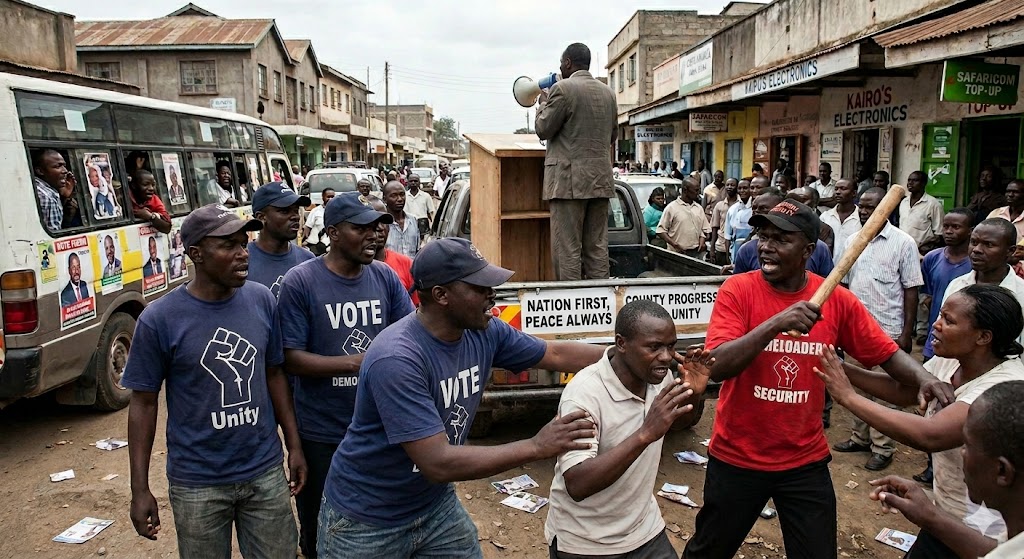
As Kenya edges closer to the 2027 General Election, a worrying trend is emerging across the country’s political landscape. Scenes of violence, disruption of public gatherings, and attacks by groups commonly referred to as “goons” have become increasingly common. While politicians trade accusations and point fingers at one another, many Kenyans are left asking a simple but important question: who is really behind these groups?
In recent months, incidents involving armed gangs disrupting protests and public meetings have sparked public outrage. Videos circulating online show groups of young men attacking demonstrators, destroying property, and spreading fear among ordinary citizens. Yet despite the public nature of these incidents, answers remain elusive.
Political leaders from different sides of the divide have been quick to blame their rivals. One camp accuses the government of sponsoring goons to silence critics, while the other claims opposition politicians are hiring criminals to create chaos and gain political sympathy. The result is a blame game that generates more heat than light.
For many Kenyans, the situation raises uncomfortable memories of the 2024 anti-government protests. During those demonstrations, arrests were made swiftly, and security agencies appeared capable of identifying suspects within hours. Today, however, investigations into recent acts of violence seem to be moving far more slowly, leading many to question whether justice is being applied equally.
This delay has fuelled public suspicion. Citizens want to know why individuals captured clearly on camera are not being arrested as quickly as expected. They want to know whether powerful interests are shielding some perpetrators from accountability. Most importantly, they want reassurance that the rule of law still applies to everyone, regardless of political affiliation.
Beyond politics lies a deeper problem. Many of the young people accused of taking part in violent activities come from communities struggling with unemployment, poverty, and limited opportunities. Politicians may be exploiting these frustrations, mobilising vulnerable youth for political battles that ultimately do little to improve their lives.
Kenya’s leaders must recognise that violence cannot become a normal feature of political competition. The country has paid a heavy price in the past whenever political tensions have been allowed to spiral out of control, and history reminds us that ordinary citizens often suffer most when leaders choose confrontation over dialogue.
As the nation prepares for the 2027 elections, transparency and accountability will be crucial. Security agencies must investigate all acts of political violence without fear or favour, while politicians must stop inciting divisions and instead focus on offering real solutions to the challenges facing citizens. Young people deserve jobs, opportunities, and hope, not recruitment into political gangs.
Kenyans are not merely asking who is to blame. They are asking whether their leaders are truly committed to protecting democracy, justice, and public safety. Until those questions are answered, the politics of blame will continue to overshadow the truth.
The country deserves better. The people deserve answers. And above all, Kenya deserves peace.
Similar Posts by The Mt Kenya Times:
- Mt Kenya Times ePAPER October 1, 2026
- Museveni backs Lamu but keeps Uganda’s money at home
- Sifuna’s party wins its name — and Kenya’s opposition race begins in earnest
- Lamu’s $16B gamble: Africa’s biggest refinery divides the region
- Ruto launches KSh2.2 trillion Lamu refinery in East Africa’s biggest energy bet
About the Author