The Role of Small-Scale Livestock Farming in Food Security in the face of Climate Change
 The Mt Kenya Times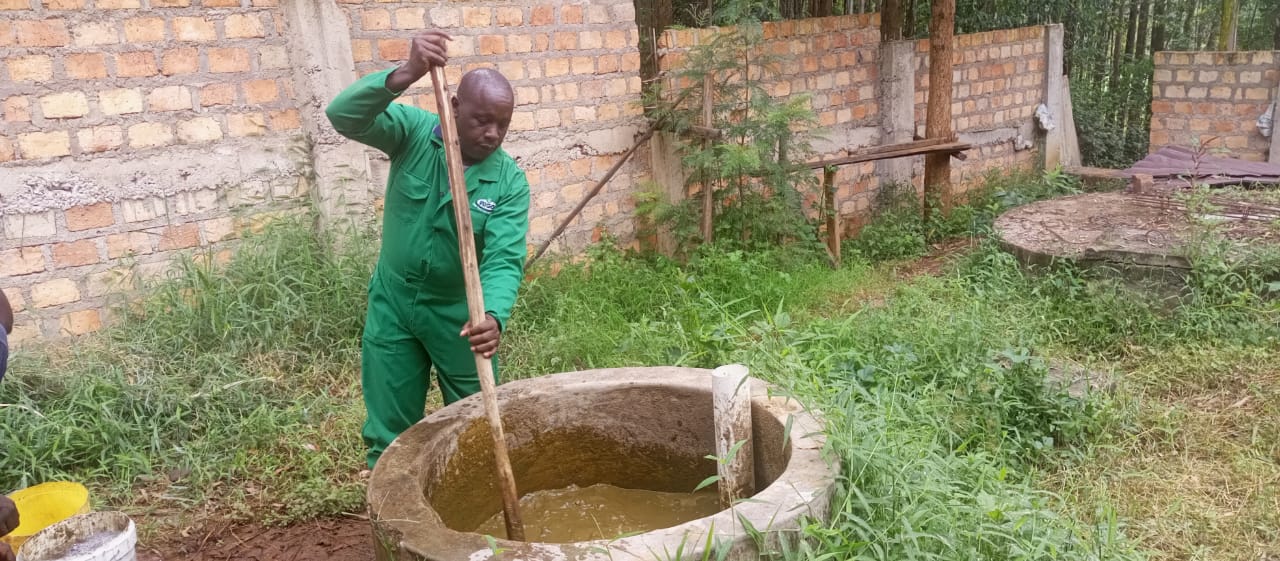
Nicholas Ondicho on his farm at Mosocho preparing Biogas photo credit/Elizabeth Angira
By Elizabeth Angira
Worth Noting:
- “I was inspired by my father, he likes livestock rearing, a homestead without an animal is not pleasing, we value animals, “he says.
- For smallholder farmers, livestock have several functions, including food, income, traction, manure, social capital, financial assets, and a means of recycling crop waste.
- The integration of livestock and crop production is fundamental to improve farm production and manure management, as strong complementarities exist between agriculture and livestock in terms of nutrient recycling, animal traction, and diversification of farms’ outputs. Integrated small scale farms are by definition less dependent on external inputs and more resilient to climate variability.
Smallholder livestock producers contribute significantly to the food security of the population, providing local markets with animal-sourced food produced in a sustainable way.
Smallholders make little use of external inputs such as fossil fuels, use manure to fertilize soils in integrated crop production and grow their own animal feed.
Everyone not only hopes to be part of a success story but also wants to be the one succeeding. That being the case, we have people taking part in various businesses. The aim is to achieve financial goals.
Nicholas Ondicho 48 years old is among the successful livestock rearing farmer in Kisii County.
Mr Ondicho Certified Public Accountant shares his story on his passion in livestock rearing.
During his free time, weekends and holidays you can find him at his home taking care of his livestock.
He ventured into livestock rearing in the year 2002 with three cross breed cows in a small scale framing but were confined as zero grazing.
In the year 2008, Mr. Ondicho changed from rearing cross breed cows to high quality cows e.g freshians, jersey and heifers, he was targeting 30 liters of milk per cow daily.
He bought his two cows from Barathon University in Eldoret costly each Ksh 185, 000.
The same year he bought another cow from Rift Valley Technical Training Institute.
Mr Ondicho says that it has been a blessing to him to have increased the stock to eight cows.
He says that he is doing livestock farming out of passion.
“I was inspired by my father, he likes livestock rearing, a homestead without an animal is not pleasing, we value animals, “he says.
For smallholder farmers, livestock have several functions, including food, income, traction, manure, social capital, financial assets, and a means of recycling crop waste.
The integration of livestock and crop production is fundamental to improve farm production and manure management, as strong complementarities exist between agriculture and livestock in terms of nutrient recycling, animal traction, and diversification of farms’ outputs. Integrated small scale farms are by definition less dependent on external inputs and more resilient to climate variability.
Data
Dairy production is one of the priority enterprises in Kisii County.
In 2021, the number of dairy cattle and crosses in the county increased to 55,014 cattle from 53,955 in the previous year, 2020.
This is mainly due to importation of dairy animals/crosses from Nandi, Bomet, Nakuru, Uasin Gishu and Nyamira counties as well as good climatic conditions that favored availability of forage materials for animals throughout the year.
The main breeds of cattle reared included Friesians and Ayrshires mostly crosses. However, there are pockets of Jersey and Guernseys too.
Over 70% of the farmers in the County practice dairy farming.
In 2021, dairy farmers faced some challenges due to the effect of the COVID 19 pandemic (Lock downs & Curfews) coupled with a dry spell in the months of January, February and July of the year.
There were no reported cases of drought related dairy cattle deaths in the Sub County.
Lack of organized milk marketing continues to affect the development of the sub sector in the Sub County.
Feeding
Nearly 5 acres of his farm has fodder crop ranging from nappier grass, sweet potato vines, desmodium, and maize to caliandra.
He says that they feed the animals with fodder mixed with molasses alongside dairy meal during milking
Mr Ondicho has a chopping machine, they cut fodder, chop it into pieces and give it to the animals and prepare silage.
They formulate their own dairy meal using maize germ, wheat pollard, cotton seed cake, and sun flower, pyrethrum by products, minerals, soya bean cake and lime.
They milk the animals using the machines, they give them dairy meal when milking, later nappier or hay with plenty of water which he has piped it from the stream which is on his farm.
Due to high cost of living, Mr. Ondicho has been forced to rationalize the animal feeds the cows takes per day.
“We have now reduced the ratio the animal feed, since it is costly, “he says.
He notes that they used to purchase Unga Limited Meals at Ksh 1850 now it’s 3500
According to him, the quantity of the milk has been reduced due to the animals they do not take the percentage of meals they used to take before the increase of the cost of animal feeds.
He says that raw animal feeds has been increased to 68% price. Which is quite economical for the farmers to afford to purchase.
Income
Despite the harsh economic times, he is currently milking 8 cows, sells his milk at Sh 60-70 though most dairy farmers are facing difficult times due to low milk prices, he has identified his market among his people and nearby centers, hotels at Kisii and Oyugis.
On a good month Mr Ondicho he makes a profit of Ksh 270,000 per month.
He has employed four workers who assist him to take care of his livestock while he is work.
Diversification
Cow dung from his livestock he applies it on his farm, he has planted maize, bananas, vegetables and napier grass.
Mr Ondicho says efforts to reduce use of harmful chemicals would help reduce the cost of production and increase the income
“I do not use inorganic fertilizer nor chemicals in my farm, the manure is good, as you can see the farm is fertile even the plants are healthy” he says.
He has turned to green energy Biogas to power his farm, he is using the gas generated using cow dung to power his farm, light his home and cooking and has cut down the cost of production.
“I no longer rely on electricity, we use biogas to cook all types of food, it is so friendly,” he says.
He cites that to make biogas, a mixture of water and cow dung is put into bio digester which is broken down to produce methane, it passes through the dairy unit then the house through pipes.
Biogas has improved health arising from avoidance of smoke, quality fertilizer and time saving.
Kisii county government
Kisii County Director of Livestock Production Kennedy Osoro says, the county government has made several initiatives to increase the productivity of dairy are in place and resulted in increasing milk production significantly.
These initiatives include subsidized Artificial Scheme, disease control, promotion of TIMPs, technical support to smallholder dairy farmer and development of milk marketing chain. Milk production estimate stood at 30.673 million liters valued at Kshs.1538 million.
In 2021, the county government set up a milk satellite depots at Marani town, Kegati town and Ogembo to enable farmers’ bulk their milk.
The National Agricultural and Rural Inclusive Growth Project (NARIGP) Programme under component 2 has expressed interest in reviving the cooperative through providing inclusion grant aimed at recruiting more members to the cooperative therefore making it strong in numbers.
Already the inclusion grant proposal of Kshs. 1 million was developed by the cooperative with assistance from sub county livestock office and has been approved at the county and national levels. Afterwards the cooperative will be allowed to develop an elaborate business proposal to NARIGP for support in acquisition of milk marketing equipment of larger capacities.
Challenges
Feeds is a challenge most farmers face and to counter that, Mr. Ondicho has planted hay on 40 acres, nappier grass and also plants yellow maize.
Lack of storage facilities, Mr. Ondicho says that there is inadequate storage to keep the milk from getting spoiled.
According to him cost price of milk has remained stagnant, despite farmers spending a lot of resources to take of the animals and buying feeds.
Mr Osoro cites that some of the challenges livestock farming face is diminishing land sizes, poor feed supplementation, Inadequate breeding stock, Long calving intervals, Overpriced milk leading to low market, Inadequate good quality fodder and Low quality livestock breeds.
Advice
Mr Ondicho says that every weekend a veterinary inspects his cows and vaccinates them often to prevent them from.
He urges farmers need to inspect their animals often and to report suspected cases of the disease because it spreads first.
Mr Osoro says that ultimately, to keep their animals free of diseases, farmers ought to adopt strict bio-security measures and advises farmers to present their animals during vaccination campaigns.
Similar Posts by The Mt Kenya Times:
- Nigeria Starts Making Its Own Next-Generation Malaria Nets
- Diaspora Times Global Oct 3 – Oct 9, 2026
- Kwale’s electricity push moves from grid to growth
- Linguistic Features Of Chromatonyms In English And Uzbek
- A Poem, a Universe: A poetry book gaze at Jumaniyoz Jabborov’s “Ko‘zgudagi sanam”
About the Author