The unfinished covenant: Operationalizing Articles 48 and 54 in Kenya’s Construction Adjudication: A call from the concrete barricades
 The Mt Kenya Times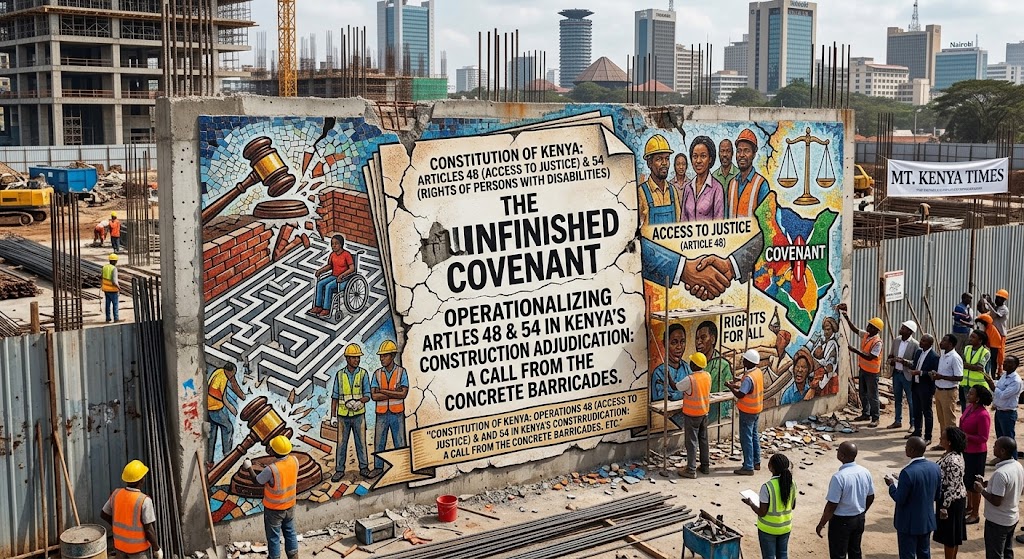
By Jerameel Kevins Owuor Odhiambo
In 2010, the people of Kenya enshrined in their Constitution a solemn promise: Article 48 declares that the State shall ensure access to justice for all persons, and that any fee required shall be reasonable and shall not impede that access. Article 54 further commands that persons with any disability shall be treated with dignity, afforded reasonable access to all places, public transport and information, and enabled to use Sign language, Braille or other appropriate means of communication. Yet fifteen years later, in the steel-and-concrete heart of the nation’s economy, the construction sector, these articles remain largely ornamental ink on parchment. Disputes over payments, delays and defects still drag through courts and arbitration chambers for years while projects stall, workers go unpaid, and the most vulnerable among the industry’s participants are systematically shut out. This is not mere administrative lag. It is a categorical betrayal of the constitutional covenant.
Construction is the bloodstream of Kenya’s development. Roads, housing estates, schools and hospitals rise or rot according to the flow of cash and the speed of resolution when that flow is interrupted. Pending bills in the roads sector alone once peaked at Sh188 billion, freezing hundreds of projects and cascading unpaid wages down the supply chain to small contractors, labourers and suppliers. Arbitration, the default contractual remedy in FIDIC and Joint Building Council forms, often takes 18 to 36 months. Court litigation can stretch longer still. Adjudication the rapid, interim determination designed precisely for construction’s cash-flow urgency exists only where parties have the foresight and bargaining power to insert it into their contracts. The proposed Construction Adjudication Bill under Sessional Paper No. 4 of 2024 remains a draft, not law. Until it is enacted and operationalized with deliberate constitutional fidelity, Articles 48 and 54 are denied their practical breath.
History sharpens the indictment. Colonial-era dispute systems privileged formal, English-language, paper-heavy procedures that already excluded the majority. Independence did not dismantle that architecture; it merely repainted it. The 2010 Constitution was meant to be the rupture a document that placed the ordinary citizen, including the disabled citizen, at the centre of justice. Instead, the construction industry has retained a two-tier reality: sophisticated multinational contractors navigate multi-tiered dispute boards with ease, while local subcontractors and persons with disabilities confront a labyrinth of fees, inaccessible venues, inaccessible documents and adjudicators untrained in reasonable accommodation. The correlation is stark and damning. Where access to justice is slow and expensive, cash flow dies. Where cash flow dies, projects stall. Where projects stall, the poor and the disabled already at the margins of formal employment bear the heaviest cost. Dignity becomes a luxury item.
Consider the lived experience. A quantity surveyor who is visually impaired cannot read the dense contractual submissions uploaded as non-accessible PDFs. A site engineer who is hard of hearing is excluded from oral hearings conducted without Sign language interpreters. A wheelchair user cannot enter the multi-storey office where the adjudication is held because the lift is out of order and no alternative venue was contemplated. These are not hypothetical hardships; they are the direct consequence of treating Article 54 as aspirational poetry rather than operational mandate. Access to justice under Article 48 is not merely the right to file a claim; it is the right to participate meaningfully. When the process itself erects barriers of format, language, physical space and cost, the State has failed its constitutional duty.
Intellectual honesty demands that we name the actors who must move. Parliament must pass the Construction Adjudication Bill with explicit provisions that embed constitutional rights. The right to refer a payment dispute to adjudication must be statutory, not contractual, so that the weaker party is not forced to bargain away speed for survival. Timelines must be tight twenty-eight days as the norm mirroring successful regimes elsewhere that have kept projects alive while justice is delivered. Enforcement of adjudicators’ decisions as High Court decrees must be automatic, subject only to limited grounds of challenge, so that the interim decision has real teeth.
The Judiciary must develop practice directions that treat construction adjudication as a constitutionally privileged process. Registries must be required to provide documents in accessible formats. Hearings must offer Sign language, Braille, and remote participation as of right, not as discretionary favour. Adjudicators must be trained and accredited not only in construction law and quantity surveying but in disability inclusion and procedural fairness that gives full effect to Article 54. The Chartered Institute of Arbitrators (Kenya Branch) and other appointing bodies must maintain panels that reflect the diversity of the nation, including persons with disabilities, so that the five-per-cent progressive principle in Article 54 finds concrete expression.
The Executive through the Attorney-General’s office, the Ministry of Public Works, and county governments must stop treating pending bills as an accounting inconvenience and recognise them as a constitutional crisis of access to justice. Every delayed payment is a denied remedy. Every stalled project is a denial of the economic and social rights that the Constitution also protects. Industry associations contractors, consultants, quantity surveyors must rewrite their standard forms to mandate adjudication as the first-tier mechanism and to require accessibility audits of every dispute process. Silence from these actors is complicity.
Original insight reveals a deeper structural failure. Construction adjudication is not merely a technical tool for cash-flow management; it is a litmus test of whether Kenya’s constitutional order can penetrate the economic engine rooms of the nation. If the sector that builds the physical infrastructure of the republic cannot itself be governed by the republic’s highest law, then the Constitution remains a document of the courts and the seminars, not of the site and the scaffold. The correlation between inaccessible dispute resolution and systemic exclusion of persons with disabilities is not accidental; it is the predictable outcome of treating constitutional rights as afterthoughts rather than design principles. Operationalizing Articles 48 and 54 requires that accessibility and speed be engineered into the process from the first notice of adjudication, not bolted on as charitable add-ons.
The emotional weight of this failure is not abstract. It is the contractor who cannot pay school fees because an unpaid certificate sits in arbitration limbo. It is the disabled site supervisor who is told, in effect, that justice is available only to those who can climb the stairs and read the fine print. It is the nation that watches its infrastructure promises rot under the weight of unresolved claims while the constitutional promise of dignity gathers dust. Strong words are required because the stakes are strong. Half-measures will no longer suffice.
The path is clear. Enact the statute. Embed accessibility as non-negotiable. Train the decision-makers. Enforce the decisions. Measure progress not by the number of seminars held but by the number of disputes resolved within weeks, by the number of persons with disabilities who can participate without barrier, and by the volume of cash that returns to the economy instead of languishing in legal purgatory. Only then will Articles 48 and 54 cease to be decorative clauses and become living instruments that speak, with force and clarity, from the construction sites of Kenya to the highest courts of the land. The covenant was made in 2010. The time for its operational redemption is now.
The writer is a social commentator.
Similar Posts by The Mt Kenya Times:
- Mt Kenya Times ePAPER October 17-18, 2026
- Ruto bets billions on Kerio Valley — with one eye on 2027
- Ruto’s health ministry kills Murang’a’s digital hospitals
- Kenya bets on Mount Kenya to drive a billion-shilling tourism revival
- Do you have a wealth vision? Or are you just working until you die?
About the Author