Mamadaliyeva Nargizabanu

Mamadaliyeva Nargizabanu,
Student of named of Berdak Karakalpak
state university Uzbek philology faculty
nargizabonu1287@gmail.com
+998 88 349 45 45
Abstract: This article explores the history of one of the famous types of Arabic writing, the nastaq letter, the styles of the calligraphers who invented it and used this type of letter.
Key words: Arabic script, nasta’liq letter, copy, ta’liq, calligrapher, Khoja Mir Ali Tabrizi, Khurasan, Koqan, Bukhara calligraphers.
Along with Islam, the Arabic language and the Arabic script entered Mowarounnahr, and the Arabic script took the place of all the types of letters that existed in this country until then. Along with the development of the Arabic script, the countries converted to Islam also gained a large area. In these countries, a lot of attention was paid to certain types of letters, and at the same time, local types of letters, which are convenient for a certain country, began to appear. They quickly find their own independent and unique look[1]. For example:
- Muhaqqaq letter-محقق
- Rayhani’s letter-ريحاني
- Suls letter-ثلث
- Naskh letter -نسخ
- Tavqe’ letter- توقيع
- Riqa’ letter-رقاع
- Ta’liq letter-قيلعت
Based on these writings, other types of letters were invented. One such type of letter is nastaliq (or khatt-ut-tali:q), which is widespread in Persian countries and Afghanistan. That is why it is also called Persian letter. This letter is characterized by a large number of strokes and a unique ogma shape. The letters of this script are written from the top to the left.
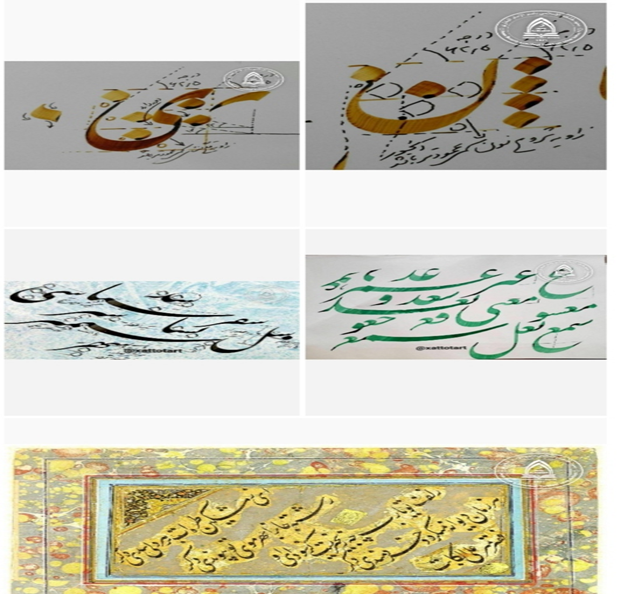 Nasta’liq calligraphy is one of the classic Arabic calligraphy styles and was created in the 14th century.
The calligrapher Khoja Mir Ali Tabrizi (1330-1405), who was honored with the title of “Qiblat ul-kuttab” (“Leader of Scribes”), is the inventor of nasta’liq calligraphy.
Sultan Ali Mashhadi says the following about him:
“Khoja Mir Ali is the inventor of nastalik letter with a small and large pen. Since the creation of the world and man, this letter has not existed. He took nastalik from naskh and taliq letters and invented it with his sharp mind and divine ability. Sugar dripped from his cane pen, because the place of the calligrapher is from the clean soil of Tabriz.” (ILMIY AXBOROTNOMA(SCIENTIFIC BULLETIN.) 2018, No. 4, pp. 20-21)
This letter is based on the “naskh” and “ta’liq” letter styles, with 5/6 curved lines and 1/6 straight lines. The letter of nasta’liq is originally “naskhi ta’liq” and was called “nasta’liq” for simplicity.
Naskh[2]. The literal meaning of “Naskh” is “to delete, cancel”. This type of letter has been widely used by calligraphers since its invention.
As the Islamic culture began to develop, the compositional arts of patterning and carving became widespread. People of Muslim art tried to bring this spirit to writing, they began to discover new types of letters and tried to give them more decorative forms. As a result, certain rules and norms were developed in calligraphy. These types of letters, unlike the previous ones, are not based on geometric shapes, but on elegant flowing shapes.
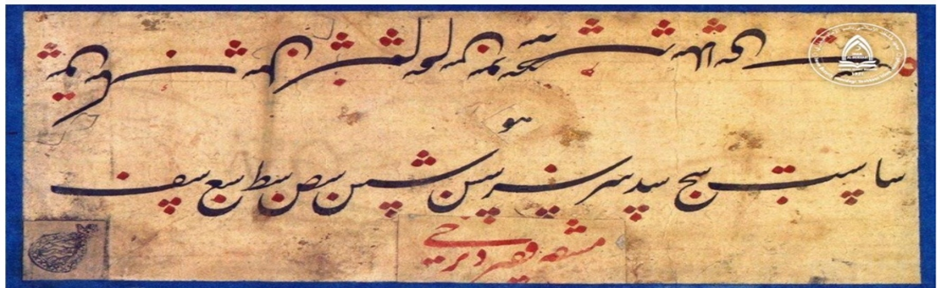 Ibn Muqla (d. 328 H.), the minister of the Abbasid state, was at the head of these good deeds. Thus, a type of writing was discovered that was very different from the previous Kufic script in terms of its structure and appearance. At the beginning of them, there was a naskh khat (in this type of khat) and earlier the manuscripts were written in Kufic script of the 1st century, but now they are written in a newly discovered naskh khat. After this type of letter appeared and became famous, all other letters were “mansukh”, that is, they were left out of use. Because the script was written quickly and fluently, and it was beautiful and elegant, it served as the main script in books printed in printing houses. It is the most common script nowadays, and this letter is used in modern press and literature.
In scientific literature and manuscripts, dust letter is written in a small pen. The texts are said to be dust because they are written in a special number very small. The inventor of gubor khat is Said Qasim, who wrote Ikhlas Surah on a grain of rice with gubor khat.
Ta’liq. “Ta’liq” means “hanging, hanging inscription”. This letter was actually a fake. Everyone turned it into different forms and chose a way out of it. This type of writing, which appeared in the 15th century, was mainly used for writing official and personal letters and for closing documents. These letters are written wider from top to left. Khoja Tajiddin Suleiman is one of the people who invented this style. The taliq letter invented by this person is a branch of the riqa’ letter. This letter belongs to essays and letters, and munshi (essay writers) wrote it at length. Some scholars pointed out that the inventor of the taliq letter was a person named Abul’ol. The graphic basis of the Taliq script invented by Abul’ol is derived from the Kufic script, which was invented for writing Persian texts. the above types of letters are called “Al-Hutut as-saba” (“Seven Letters”) in the language of calligraphy. Every person who claims to be a scribe needs to know these letters.
 Initially, Nastaliq script was used to copy prestigious manuscripts, official and personal correspondence, mainly literary samples, and to finish individual continents. Later, this script displaced the writing of “naskh” and “suls” from the art of calligraphy. Khoja Mir Ali Tabrizi is a calligrapher who invented a separate letter based on six different letters in a way typical of nastaliq letters. He lived during the time of Amir Temur (1369-1405) and trained many students. This letter spread very quickly among calligraphers, and the circle of Tabrizi’s students expanded. Among his students was his own son Mir Abdullah. One of his students, Maulana Ja’far, made a name for himself in the time of Shahrukh Mirza, and the other Mir Abdulhai lived in the time of Abu Sa’id and was an unparalleled writer in the art of reading, writing and editing.
Mir Ali Tabrizi created a pamphlet explaining the rules of the nastasliq letter. The manuscripts he copied include Kirmani’s “Khumai wa Humayun”, “Kamolnama”, “Rawzat al-Anwar” epics (copied in 1396, now kept in the British Museum), Sa’di’s “Kulliyot”, “Boston” ( 1377), Nizami and Dehlavi’s epics “Khamsa” (in the National Library of Iran) and the continents (1 copy in the National Library of Russia in St. Petersburg) have come down to us.
There are several opinions about why this type of letter is called “nastaliq”[3]:
- A) Sultanali Mashhadi stated that Mir Ali Tabrizi created this letter based on the transcription and talik writings.
- B) Before and after the time of Mir Ali Tabrizi, the main text of the books was written in the middle of the page in naskh letter, and comments or comments related to the text were written on the sides of the text in taliq letter. That is, the letters naskh and taliq are placed next to each other, and by adding the two to each other, it is also called naskhtiq. When this letter was invented, it was called “nastalyq”. It is as if this letter acquired the meaning that he copied the letter of Taliq.
- V) The name Nastaliq Khati is unique only to the lands of Movarounnahr and Khurodargohi. Because this type of writing is called “Persian letter” in other places.
This letter type is common in Central Asia, Iran, Azerbaijan, Afghanistan and India. Ja’far Boysunkuri, Azhar Tabrizi, Sultanali Mashkhadi and his students created “nasta-liq” type of calligraphy. Mir Ali Hiravi, who lived at the beginning of the 16th century, was one of the calligraphers who made a great contribution to the spread of nasta’liq calligraphy in Movarounnahr, and his students – Mirzo Yodgor, Mirzo Fathulloh Munshi, Mirzo Ismatullah Munshi, and Domla Bobobek – raised this type of calligraphy to the world level.
In the palace of the Kokand khans, samples of Mirali’s scribe’s khusnikhat are kept. Because, at the end of the volume, the Khan is described as Mir Ali and Mir Imadi of every Munshi period. In our opinion, this sample letter is presented to prove this claim.
The date of publication and the scribes of the manuscript are clear. It was written and completed by four calligraphers in the city of Koqan in the year X-1234 (1818-19 AD) by the order of Muhammad Said Amir Umar Khan. Secretaries: Tursun Muhammad, Mirza Rahimqul, Muhammad Yusuf and Baba Mir Mirza.
According to Hazrat Alisher Navoi, Sultanali Mashhadi, the “sultan of calligraphers”, elevated the nasta’liq letter to the level of great art and evaluated it as follows: “Sultan Ali Mashhadi, who passed after Mir Ali Tabrizi during the Timurid period With his years of life and extremely productive work, he gained fame as a great artist calligrapher and teacher not only in Khurasan, but in all Eastern countries that have Arabic script[4].
Here is more information about it:
“The art of husnikhat first developed in Herat, the capital of Movarounnahr, where a large school of calligraphy was established under the head of Sultan Ali Mashhadi. The distinctive feature of the school is the style of calligraphy created by Mir Ali Tabrizi in the 14th century, which was perfected here by Sultan Ali. This letter was widely used in large and small nastalik book works, and artistic and historical works began to be copied only in nastalik style[5].
It is known that Sultan Ali Mashhadi and Abdujamil were secretaries in the palace of Sultan Husayn Boykara in Herat. They read the works of Sultan Husayn Boykara and Hazrat Alisher Navoi. The treasury of the institute has book copies of Alisher Navoi’s works. And the oldest copy of Alisher Navoi’s work “Khamsa” is stored in this treasure. This copy was read in 1484 in the presence of Alisher Navoi in Herat by Abduljamil the scribe with an extremely fine handwriting. Some missing pages of this copy were filled in by Mr. Abduqadir. If we compare the letters of this teacher with the artistic letter of the secretary Abduljamil, we will see that they are written at the same level. Therefore, we can call Domla the golden calligrapher of our time[6].
In his letter to Badiuzzamon, the son of Navoi Husain Boykara, Alisher mentions the nashtliq letter while thinking about whether it is easy or difficult to write letters, and it is better to write documents in this letter than in the Turkish letter (Uyghur letter). says that it is good. The term nashtliq letter is mentioned there (Mun.794a.3-4).
While giving information about Ali Dervesh from Khurasan, Zahiriddin Muhammad Babur wrote that “he was finishing his letter of praise” (BN .17).
Among the representatives of the Bukhara school of calligraphy, the use of nastalik letters was widespread. Among those who copied books in the nastaliq and naskh letters: Muhammad Yusuf Makhdum, Shahabuddin Makhdum Faziljan son, Nazrullah Lutfi, Haji Nematullah, Qari Ahmad Kotib Bukhari, Maqsud Khoja, Mirza Abdulkarim, Mirza Qamarjan, Haji Abdusattar, Mirza Abdullah Kotib, Mirza Rahmatullah, Mirza Sadullahi Bukhari, Mir Faizullah and Mir Rahmatullah, Abdullohbek Kotib and others.[7]
Domla Bobobek or Ismatillobek admit that even today Iranians are surprised by their letters: “It is possible to write so beautifully.” Because the calligraphers of Bukhara paid great attention to writing very delicately. Today, Iranians have adopted the Nastaq letter as their national letter. In Iran, this tradition had a great position during the time of Mir Imad. But the calligraphers of Bukhara took Mir Ali Hiravi’s rules as their standard and wrote based on this, and considered him as their leader.
In the works of Darvish Muhammad (“Favoidul-khutut”), Munis Khorazmi (“Savodi talim”) and Muhammad Azim (“Miroti talim”), the study of the basics of the letter “Nasta’liq” is described.
Below are the graphics of writing a letter of encouragement and examples of famous calligraphers written in this type of letter:[8]
Murakka. Copied in Nastaliq’s letter. XVI century.
Bukhara calligrapher Mir Ali Kotib Hiravi (Fathobidi) (d. 1559).
Paper, gold water, ink paint. Size 29×18 cm. Printed on “Abri Bahar” paper. At the end of the letter is written “Faqir Mir Ali Secretary”.
The complexity of the letter of encouragement written in Domla Bobobek’s calligraphy school. Bukhara 19th century. paper, ink, watercolor.
Abjad copied in Nastaliq letter.
Domla Bobobek’s student, calligrapher Abdullohbek Kotib (d. 1914). Bukhara, XX century. Paper, ink, watercolor. Size: 21×10 cm.
Murakka. Copied in Nastaliq letter. XIX century. Bukhara calligrapher Mirzo Sarimsoqbek Dizakhi (Jizzakhi). (died ca. 1836/1837). Paper, gold water, ink paint. The size is 28×18 cm. Booked on Abri paper.
What happiness, if a friend kills a person,
A person who expresses his pain by crying.
What a pity that if someone asks for help,
A person who is close to him kills himself.
Also in Kok, the calligrapher Mirza Sharif Dabr copied Fuzuli’s divan in 1836 on the order of Muhammad Ali Khan.
In 1911, a famous calligrapher from Tashkent, Shamurod, published the khati nastaliq mufradot (pattern of letters) in the lithography method.[9]
In conclusion, it can be said that nastalik has become the most beautiful and convenient style and has gained fame in the literary world due to the fact that it combines the best aspects of both styles of calligraphy, i.e. naskh and talik.
Mir Ali Tabrizi was the inventor of the Nastaliq letter, and he had a pamphlet explaining the rules of this letter, and his manuscripts aroused great interest not only among our compatriots, but also among representatives of other countries. Copies of his copied manuscripts are in the libraries of the khan’s palace, which shows the status of the person and the superior aspects of his writings.
Another aspect is that the use of this type of letter showed the skill of the calligrapher in showing the subtle and elegant aspects of the writing in copying.
Mamadaliyeva Nargizabonu was born in 1987 in Uchkoprik district of Fergana region. Student of Uzbek Philology Faculty of Karakalpak State University named after Berdak. At this university, he took the 3rd place in the “Sultan of the property of A. Navoi gazal” competition, took the 1st place in the “My mother’s favorite dishes” competition, and is the owner of several souvenirs.
Inquisitive, passionate about creativity.
Currently, scientific articles, poems, and stories are being published. The owner of the badges “Innovative Promoter” and “Pride of Education”. Participated in a number of offline and online events and received certificates and diplomas.
She is a member of the creative association “Kosh Kanat”.
EVA is the head of the council.
[1] @oliymahad.uz: Абдуллаев Алишер: “Мовароуннаҳрда мавжуд араб ёзувидаги хат турлари.” MAQOLA
[2] @arabic.uz: Каримов Зиёдуллоҳ Ғайбуллоҳ ўғли: “Араб хатиниг турлари (2-қисм)” Мақола.
[3] @oliymahad.uz: Асроров Козимхон Олимхон ўғли: Настаълиқ хатининг шаклланиш тарихи. Мақола
[4] Ножий Зайниддин Мусарриф. Мусаввир ал-хотти ал-аробий. – Бағдод, 1968. – Б. 42.)
[5] @oliymahad.uz Xaytbayev Ravshanbek: “XATTOTLIK SAN’ATI VA MARKAZIY OSIYO XATTOTLAR MAKTABLARI.” MAQOLA
[6] Q.Munirov. “Mohir xattot.” Sharqshunoslik jurnali 8-soni 154- betlar.
[7] Z.Rajabova: “XVIII-XIX ASRLARDA BUXORODA MADANIY VA ILMIY MUHIT”. Maqola. Qo‘qon DPI. Ilmiy xabarlar. 82-bet
[8] @oliymahad.uz: Асроров Козимхон Олимхон ўғли: Настаълиқ хатининг шаклланиш тарихи. Мақола
[9] Шомурод Котиб. Муфрадот, Дозволено цензур. Санкт-Петербург, 5 июлья 1983 года, типография братев Каменскиx
Similar Posts by The Mt Kenya Times:
- Love came home to Sheema
- When strength becomes silence
- Keeping a flame alive: The Turkic world’s debt to Ganira Pashayeva
- Dr Rania Lampou: The woman who turned a classroom into the world
- The Darkness Within: A Critical Review of Joseph Conrad’s Heart of Darkness
About the Author