

A Swiss Poll International survey has placed Kirinyaga Governor Anne Waiguru ahead of Deputy President Kithure Kindiki as the preferred running mate for President William Ruto in the 2027 General Election, in findings that are already reshaping the conversation about Kenya’s next electoral contest.
By Daniel Karanja
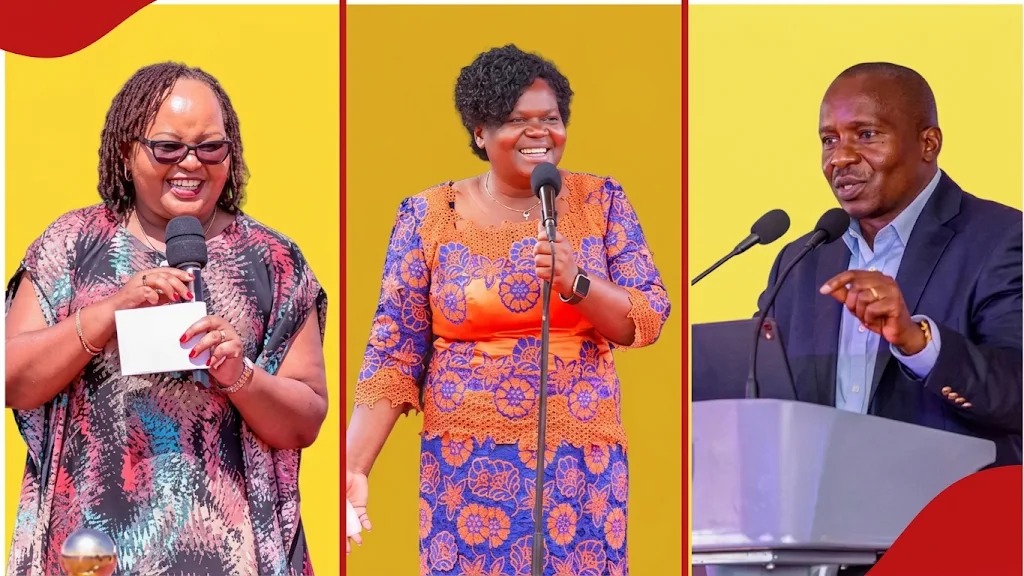
Kirinyaga Governor Anne Waiguru has emerged as the leading preferred running mate for President William Ruto in the 2027 General Election, commanding 42 per cent support in a Swiss Poll International survey that places her ahead of Deputy President Kithure Kindiki at 31 per cent and Homa Bay Governor Gladys Wanga at 13 per cent — findings that land at a moment when Kenya’s pre-election political calculations are intensifying by the week.
The poll, conducted nationally, offers the clearest public snapshot yet of how Kenyans are thinking about the question of who should stand beside Ruto on the 2027 ticket — and its results carry implications that extend well beyond a simple popularity ranking. They touch on regional arithmetic, gender politics, the future of the Deputy President’s position, and the broader strategic question of what kind of coalition Ruto needs to build if he is to retain the presidency in what is shaping up to be the most competitive Kenyan election in a generation.
Waiguru’s 42 per cent showing is striking for several reasons. She is a two-term governor of Kirinyaga County, a former Cabinet Secretary for Devolution and Planning under President Uhuru Kenyatta, and one of the most recognisable political figures in the Mount Kenya region — a vote-rich bloc whose support will be fiercely contested in 2027. Her profile combines executive experience at both national and county level with a political resilience that has seen her survive an impeachment attempt, a series of legal battles and the shifting loyalties of a region whose political direction has rarely been more uncertain. For Ruto, whose relationship with the Mount Kenya establishment has been complicated by the fallout with Kenyatta and the subsequent realignment of figures such as former Deputy President Rigathi Gachagua, the idea of a running mate who can anchor the region carries obvious strategic appeal.
Kindiki, at 31 per cent, occupies a fundamentally different position in this calculation. As the sitting Deputy President, he is not merely a potential running mate — he is already on the ticket, elevated to the position following Gachagua’s controversial impeachment in late 2024. His poll numbers reflect a figure who has had relatively little time to establish an independent public profile in the role, having spent much of his tenure navigating the institutional aftermath of his predecessor’s removal while managing a demanding security portfolio. His academic background — he is a distinguished constitutional law scholar and former Vice-Chancellor of the University of Nairobi — commands respect, but respect and electoral warmth are different currencies, and the poll suggests Waiguru currently holds more of the latter.
Wanga’s 13 per cent is the most politically nuanced figure in the survey. As governor of Homa Bay County, she represents a constituency that sits at the heart of ODM’s traditional support base in Luo Nyanza. Her appearance in a poll about Ruto’s preferred running mate reflects two possibilities that are not mutually exclusive: genuine cross-community admiration for her governance record, and the complex negotiations between Kenya Kwanza and ODM that have characterised the broad-based government arrangement. Whether Wanga’s figure represents a serious political pathway or simply a measure of her personal popularity is a question the coming months will begin to answer.
The deeper significance of this poll lies in what it reveals about the structural pressures bearing down on Ruto’s 2027 campaign. The President faces a fundamentally different electoral environment from the one he navigated in 2022. Then, he ran as an insurgent — the hustler candidate challenging the establishment, drawing energy from economic frustration and a generational desire for change. That narrative delivered him the presidency by a margin that was ultimately confirmed by the Supreme Court after a legal challenge. In 2027, he runs as an incumbent with a record to defend, in an economy that has tested ordinary Kenyans severely through the cost-of-living pressures that dominated the 2024 protest movement, and against an opposition that is — however imperfectly — moving towards the kind of unity that eluded it last time.
In that context, the choice of running mate is not a ceremonial decision. It is a strategic one that will signal to specific communities, regions and demographic groups whether Ruto’s coalition is broadening or contracting. Waiguru’s strength in the poll suggests that a significant portion of Kenyans see value in a ticket that doubles down on Mount Kenya representation — a reading that prioritises consolidating a base over reaching for new constituencies. Kindiki’s position, by contrast, represents continuity and institutional stability, virtues that carry weight in uncertain times but that may not generate the electoral excitement a competitive race demands.
What the poll cannot capture is the internal negotiation that will ultimately determine the ticket. Kenyan running mate selections are rarely decided by public preference surveys alone. They are the product of backroom conversations between regional barons, party structures, financial interests and the kind of political debts that accumulate over years of alliance-building. Waiguru’s public numbers are strong, but public numbers and private commitments are different things.
What is clear is that the 2027 ticket question is now firmly open and firmly contested. Gachagua’s departure from the Deputy President’s office removed what many assumed was a settled arrangement and introduced a fluidity into Ruto’s re-election planning that his campaign strategists will be working hard to manage. Every poll that places Waiguru ahead of Kindiki adds pressure to that management exercise and raises questions — however premature — about whether the sitting Deputy President’s position on the ticket is as secure as the institution of his office might suggest.
Kenya’s election season has, in effect, already begun. The campaigns are not yet official, the nominations are months away and the ballot is a year distant. But the choices being made now — about alliances, about running mates, about the narratives that will define the contest — will determine what August 2027 looks like long before the voting booths open.
Waiguru leads the poll. The race, in every meaningful sense, has already started.