The Mt Kenya Times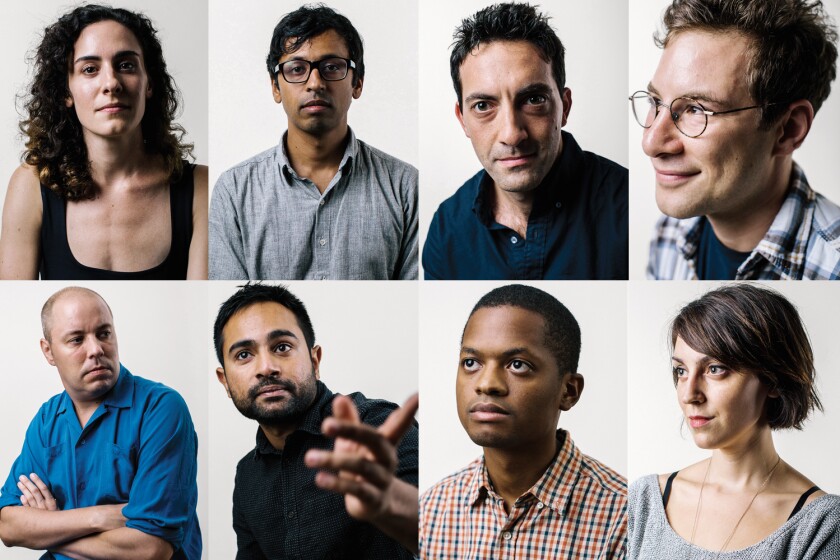
Clockwise from top left: Sarah Leonard, Nikil Saval, Jon Baskin, David Marcus, Rachel Rosenfelt, Remeike Forbes, Bhaskar Sunkara, and Peter Frase.
By Jerameel Kevins Owuor Odhiambo
Worth Noting:
- It has been noted overtime, that when intellectuals join government more harm than good is committed. Hear me out. I won’t mention names to buttress this point but am damn sure that a name or two will come to mind.
- There have been a number of intellectuals who in the past were vocal about missteps of the government and undoings of the government when they were in their private sphere and all over sudden when they get appointed to government they are vocal of government policies which are anti-populace. One wonders what type of baptism happened to them.
- It must be akin to from Paul to Saul moment. Whenever intellectuals join the ruling regime by the virtue of their sharp intellect they are used to champion for government policies which ideally are detached from reality.
James Baldwin once posited these immortal words, ‘the paradox of education is precisely this-that as one begins to become conscious one begins to examine the society in which he is being educated. The purpose of education, finally, is to create in a person the ability to look at the world for himself, to make his own decisions, to say to himself this is black or this is white, to decide for himself whether there is a God in heaven or not. To ask questions of the universe, and then learn to live with those questions, is the way he achieves his own identity. But no society is really anxious to have that kind of person around. What societies really, ideally, want is a citizenry which will simply obey the rules of the society. If a society succeeds in this, that society is about to perish. The obligation of anyone who thinks of himself as responsible is to examine society and try to change it and to fight it at no matter what risk. This is the only hope society has. This is the only way societies change.’
The above cited words of James Baldwin clearly accentuates the role of intellectuals in a society. An intellectual is a person who engages in critical thinking, research, and reflection about the reality of society and who proposes solutions for the normative problems of the society. An intellectual can be as well deemed to be one who is exposed to education. However, it is integral to realize that education isn’t a onetime think; and it shouldn’t be confused for schooling. Education is the culmination of facts, experiences and thought that is gained over a lifetime. It is the useful part of learning. Put differently, education is said to be the process of facilitating learning, it is also said to be the acquisition of knowledge, skills, values, beliefs and habits. The real goal of education is to leave a person asking questions.
I summon Martin Luther quote, ‘to think incisively and to think for one’s self is very difficult. We are prone to let our mental life become invaded by legions of half-truths, prejudices and propaganda. At this point, I often wonder whether or not education is fulfilling its purpose. A great majority of the so-called educated people do not think logically and scientifically. Even the press, the classroom, the platform, and the pulpit in many instances do not give us objective and unbiased truths. To save man from the morass of propaganda, in my opinion, is one of the chief aims of education. Education must enable one to sift and weigh evidence, to discern the true from the false, the real from the unreal, and the facts from the fiction. The function of education, therefore, is to teach one to think intensively and to think critically.’
There is a legitimate expectation that intellectuals play a major role in overcoming the existing challenges of a nation for comprehensive nation building, maintaining peace, creating consensus on the common issues of the country to move towards prosperity. In order to terminate the destructive political culture of a nation, intellectuals should free themselves first from bias and play their positive roles in bringing the society into political ideas that are based cultural grounding, knowledge and truth. Taking the primary objective towards generation and human resource building, intellectuals have to focus on preparing competent and morally shaped children as well as young generation through effective education system by teaching them to love their country, transform it with developed economy in all fields and build a society with developed democracy.
It has been noted overtime, that when intellectuals join government more harm than good is committed. Hear me out. I won’t mention names to buttress this point but am damn sure that a name or two will come to mind. There has been a number of intellectuals who in the past were vocal about missteps of the government and undoings of the government when they were in their private sphere and all over sudden when they get appointed to government they are vocal of government policies which are anti-populace. One wonders what type of baptism happened to them. It must be akin to from Paul to Saul moment. Whenever intellectuals join the ruling regime by the virtue of their sharp intellect they are used to champion for government policies which ideally are detached from reality. Interestingly they do this backed with facts and history. This is a perfect testament of these intellectuals aligning their thought process to the ruling regime. This extinguishes their former independent minds; which they used to critically debate on matters social governance.
When intellectuals allow themselves to be seduced into becoming politicians, they end up compromising the basic role they are expected to play in society. And that role is to sharpen the public’s sense of reality in a world bombarded by a plethora of information and so called alternative facts. This sharpened sense of reality, Foucault reminds us comes from ‘a certain determination to throw off familiar ways of thoughts and to look at the same things in a different way; a passion for seizing what is happening now and what is disappearing; a lack of respect for the traditional hierarchies of what is important and fundamental.’ The moment an intellectual seeks popularity, power or profit, it will not take long before she loses her autonomy, betrays her craft, and becomes no different from a media star or a politician.
Intoxicated by public adulation, she might be prodded to publicize everything that comes to her mind, no matter in what state it is, leaving no thought unpublished. Seeking constant affirmation, she might be tempted to become a mouthpiece for all kinds of advocacies, or, worse, a hack in the service of the moneyed and the powerful. Soon she might allow herself to be enticed to run for public office, convinced that she, indeed, is the embodiment of the alternative. Before she realizes it, she gives up the hard work of reflexive thinking and begins to dwell in one comforting delusion after another.
But let me not overstate these dangers, although it is a reality, lest we think the ideal intellectual has to retreat into the hallowed halls of academia, or find refuge in the aristocracy of incommunicable thoughts, in order to produce worthwhile ideas. No, that would be farthest from my conception of an intellectual’s vocation in society. I am of the belief that it is integral that an intellectual must engage her society and her time. She must speak to the public, make herself understood. She must learn to make use of all available media, never fearing that the appearance of lofty ideas in the popular media cheapens. The crux of this paper, was to decipher how intellectuals camouflage once they get to government. However, this doesn’t mean that it applies to all intellectuals but a good number of them.
In a nutshell, the words of Anais Nin comes to mind, ‘when we blindly adopt a religion, a political system, a literary dogma, we become automations. We cease to grow.’
Odhiambo Jerameel Kevins is a law student at University of Nairobi, Parklands Campus.
Similar Posts by The Mt Kenya Times:
- Mt Kenya Times ePAPER September 19-20, 2026
- Kenya joins US and UK to put citizens on the terrorism frontline
- Kenya’s parliament races to tame the AI frontier
- Kalonzo calls Ruto to order over Uhuru attacks
- Gachagua takes his 2027 campaign to America
About the Author