When Kenya looks for economic enemies: Is the foreign trader really the problem?
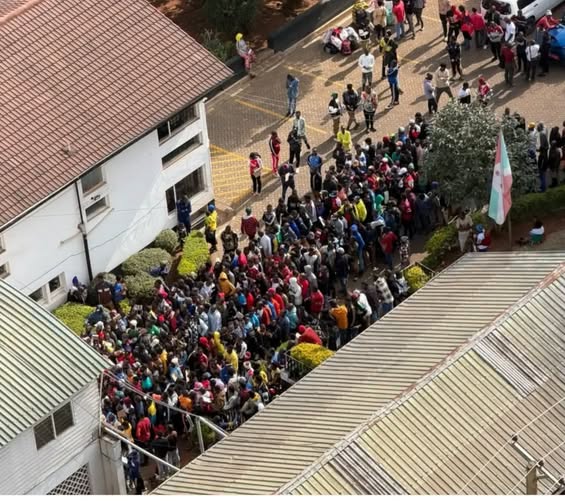
Burundians at their embassy in Kenya preparing to leave
Enforcing the law is governance — turning an entire nationality into a suspect is something else entirely
By Levis Wangamati
Kenya has entered that familiar season when every economic headache suddenly needs a human face. The cost of living is high, jobs are scarce, taxes keep knocking and the shilling seems to have developed a personal disagreement with ordinary Kenyans. So, naturally, someone must be blamed. This time, the spotlight has landed on foreign traders, with the government promising tougher enforcement against foreigners operating businesses without the necessary permits. Because apparently, when the economy refuses to behave, the first instinct is to find someone else to blame for the mathematics.
Let us be clear: Kenya has laws, and laws are not decorative lights. If a foreign national is operating a business illegally, the government has every right to enforce the law. If someone is working without the required documentation, violating licensing rules or engaging in activities legally reserved for Kenyan citizens, action should follow. But there is a very important difference between enforcing the law and creating the impression that foreigners are responsible for Kenya’s economic frustrations. One is governance. The other is political convenience wearing a government badge.
The frustration among Kenyan traders, however, is real. Walk through a market in Nairobi, Kisumu, Eldoret, Nakuru or Kitale and you will meet young people trying to make a living from businesses that barely cover their costs. A university graduate can spend years collecting certificates only to find the job market has collected something else: silence. The motorcycle taxi rider is struggling, the vegetable seller is struggling, the shopkeeper is struggling and the recent graduate is wondering whether the degree should be framed or used to level a table. Then someone arrives and says, “The foreigners are taking our businesses,” and suddenly a complicated economic problem has been reduced to a person standing behind a counter.
That explanation is attractive precisely because it is simple. Kenya’s unemployment problem is not simple. Neither is the cost of doing business, access to credit, taxation, corruption, weak industrialisation, expensive electricity, declining purchasing power or the mismatch between what universities produce and what the economy can absorb. None of these problems can be deported at the airport. None can be sent back to Burundi, Uganda, Tanzania, Somalia, India or anywhere else. Structural problems are terribly inconvenient that way. They do not have passports.
This is where Kenya’s economic conversation needs some adult supervision. If foreign traders are breaking the law, deal with the specific offenders. Do not turn an entire nationality into a suspect. If a business is operating legally, paying taxes and complying with regulations, then its owner being foreign does not make the business illegal. Competition can be uncomfortable, but discomfort is not evidence of criminality. A Kenyan entrepreneur should be protected by fair rules, not by creating a marketplace where success depends on who holds the right passport.
There is also something rather telling about Kenya’s selective relationship with regional integration. The country proudly champions the East African Community when Kenyan companies want access to neighbouring markets. Kenyan entrepreneurs expanding into Uganda, Tanzania and Rwanda are celebrated. Regional trade is applauded when it benefits us. But when another East African trader arrives here and competes effectively, regional integration suddenly starts looking like a bad idea that nobody read the terms and conditions for. A country cannot demand an open door for its citizens abroad while fitting a padlock when its neighbours arrive.
The answer is not to abandon regulation. Kenya needs stronger regulation, not weaker regulation. The government should know who is entering the country, what businesses they are running, whether the appropriate permits are in place and whether taxes are being paid. The same expectations should apply to Kenyan-owned businesses evading taxes, ignoring licences or operating outside the law. The principle should be straightforward: same offence, same law, same consequences. Not “same passport, same suspicion.”
But perhaps the more uncomfortable question is why some Kenyan businesses are struggling to compete at all. If the government genuinely wants to empower Kenyan entrepreneurs, it should make entrepreneurship less like an obstacle course designed by people who actively dislike entrepreneurs. A young person starting a small business needs affordable credit, reasonable taxes, reliable electricity, accessible markets and predictable regulations. Instead, too often the aspiring entrepreneur meets a government office before meeting a customer. By the time the paperwork is done, the enthusiasm has already applied for asylum.
Removing foreign competitors will not automatically make Kenyan businesses successful. If a shop closes today because its foreign owner was operating illegally, that does not mean a Kenyan entrepreneur will walk through the door tomorrow with capital, stock and customers. Markets do not work through magic. They work through purchasing power, capital, skills, efficiency and demand. You cannot create prosperity merely by subtracting people from the equation. Sometimes you have to improve the numbers.
There is also a political dimension to this debate that Kenyans should not ignore. Another election cycle is approaching, and Kenya has a remarkable habit of discovering economic villains whenever politicians need a convenient story. Yesterday it was another group. Today it is foreign traders. Tomorrow, who knows? Perhaps we shall discover that unemployment is hiding in a minibus, inflation is selling tomatoes at Gikomba market and the national debt has opened a kiosk in Eastleigh. Politics has a remarkable talent for turning complicated failures into very simple enemies.
That is why Kenyans should be cautious of solutions that sound wonderfully easy. “Remove them and our businesses will thrive” fits neatly into a rally chant. But after the microphone is switched off and the crowd goes home, the young graduate still needs a job. The trader still needs affordable credit. The manufacturer still needs cheaper production costs. The family still needs food that does not require a small loan. The economy does not accept campaign slogans as payment.
Kenya should also remember that foreign investment and regional commerce are not inherently enemies of Kenyan prosperity. They can create jobs, expand markets, introduce skills and bring capital into the country. Investment must, of course, operate within Kenyan law and should not suppress local enterprise. But there is a difference between protecting local businesses and insulating them from every form of competition. The first builds resilience. The second can build dependency.
The real challenge is much bigger than the foreign trader selling clothes, electronics or food in a Kenyan town. The real challenge is an economy that has not generated enough opportunities for its young population. Every year, thousands of Kenyans enter adulthood carrying degrees, certificates and ambitions, only to encounter an economy displaying a “No Vacancy” sign. That should concern us far more than the nationality of the person operating the shop across the road.
If Kenya wants to put Kenyans first, then let it do so in the ways that actually matter. Give young people an economy where starting a business does not require surviving twelve bureaucratic departments. Give manufacturers an environment where producing locally is competitive. Give farmers markets that reward production rather than punishing it. Give graduates opportunities beyond endlessly forwarding CVs to people who reply, “We shall get back to you.” Patriotism should be measured by the opportunities a country creates for its citizens, not simply by how aggressively it points fingers at foreigners.
The government must enforce immigration and business laws. But enforcement must be surgical, not theatrical. Catch those breaking the law. Shut down illegal operations. Collect what is owed. Protect sectors legally reserved for Kenyans. Then go further and address the economic conditions that make competition so frightening in the first place. Otherwise, Kenya will keep changing the villain while leaving the underlying plot entirely untouched.
The foreign trader did not create Kenya’s unemployment. The foreign trader did not write the country’s tax policy. The foreign trader did not decide how much the government borrows, how efficiently public money is spent or how many jobs the economy produces. A foreign trader cannot be held responsible for every Kenyan who sends a CV and receives the famous response: “We will call you.” Sometimes the call never comes because the problem is not sitting behind the shop counter.
Kenya needs to stop confusing economic protection with economic progress. A protected market can still be a poor one. A Kenyan-owned business can still fail. A foreign-owned business can still comply fully with the law. The passport of a business owner cannot tell us whether the economy is healthy. Numbers can. Jobs can. Wages can. Productivity can. The purchasing power of ordinary Kenyans can.
So let the law be enforced — but let Kenya also tell itself the truth. The country does not have an unemployment problem because foreigners decided to claim all available opportunities. Kenya has an economic problem because it has struggled to generate enough productive opportunities for its own people. That problem requires policy, investment, accountability and imagination. Unfortunately, those things are harder to fit into a campaign slogan than “blame the foreigner.”
Because if every economic problem is resolved by removing someone from the equation, eventually Kenya will run out of people to subtract. And when that happens, the country will finally have to confront the uncomfortable truth: the problem was never the people in the equation. The problem was the equation itself.
Similar Posts by The Mt Kenya Times:
- Mt Kenya Times ePAPER October 23, 2026
- Ruto’s parting COMESA call: Remove the barriers, honour the commitments
- Direct hospital access to KEMSA cuts drug delays, says PS
- Africa can’t wait: Continent seeks $1 trillion for climate adaptation
- Ruto passes the baton as Africa’s trade bloc faces a fragmenting world
About the Author