The Mt Kenya Times
 By: Jerameel Kevins Owuor Odhiambo
In 1963, a young nation stood at independence with promises thick in the air like the scent of rain before a storm. The founding fathers spoke of unity, of justice, of a Kenya where every child would sleep with a full belly and wake to the possibility of greatness. They painted visions of a country where merit would triumph over mediocrity, where the rule of law would reign supreme, where the dignity of every citizen would be sacrosanct. Sixty years have passed since those declarations rang out from podiums draped in the colors of freedom. The black, red, and green now flutter over a landscape vastly different from what was promised. Today, we must ask ourselves: where did we lose our way? When did the path that seemed so clear become obscured by the undergrowth of our own making? At what point did we trade the dreams of our founders for the mess of pottage we now consume? The questions are uncomfortable, as all honest questions must be. But discomfort is the price of truth, and truth is what we owe ourselves if we are to survive as a people worth surviving. We cannot continue to avert our eyes from the mirror that reflects our collective deformation.
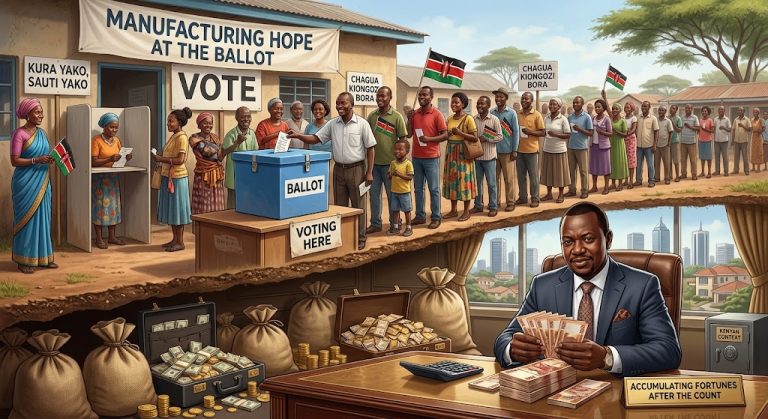
 The rot did not announce itself with trumpets. It crept in quietly, wearing the face of expedience, of necessity, of “this is how things are done.” A civil servant accepts a small bribe to process papers more quickly, telling himself that everyone does it, that his salary is insufficient, that the system is already broken. A teacher sells examination questions to students whose parents can afford the price, justifying it as a way to supplement meager wages in a profession that no longer honors those who shape young minds. A judge tilts the scales of justice toward the highest bidder, reasoning that his own family must eat, that justice is already a commodity in a world where nothing is sacred. A politician loots the public treasury while preaching development from platforms adorned with national flags, surrounding himself with praise singers who crown him a savior even as he devours the future.
These acts, small and large, compound like interest in a bank account we never meant to open. Each transgression normalizes the next. Each compromise of principle makes the following one easier. Now the debt has come due, and the interest is crushing. We see it in the hospitals where mothers give birth on floors because beds are reserved for those who can pay, where medicines meant for the poor are sold in private pharmacies, where doctors have learned to look past suffering unless it comes accompanied by cash. We see it in the streets where young people, brilliant and educated, hawk goods in traffic because merit has been replaced by connection, where a degree is worth less than a phone call from someone who knows someone. We see it in the eyes of children who have learned too early that the world rewards not goodness but cunning, not hard work but access to power, not truth but the ability to manipulate appearances. This is the harvest of our collective sowing, and it is bitter on the tongue.
What we face is not merely a crisis of governance or economics, though these symptoms are real and painful. We face a crisis of the soul, a fundamental disconnection from the values that make a society more than just a collection of individuals scrambling for survival. Our grandfathers understood something we have forgotten: that a community is held together not by force or fear but by shared commitments, by the invisible threads of trust and mutual obligation. In their time, a man who stole from the community faced not just legal consequences but social death, the shame was unbearable because the community’s judgment mattered more than individual gain. When a man’s word was his bond, contracts needed fewer lawyers, transactions moved at the speed of trust, and commerce flourished not despite but because of this moral foundation. When leaders saw themselves as servants rather than masters, they walked among the people without fear, listened to grievances without contempt, made decisions with the welfare of all in mind.
The people flourished even in scarcity because resources were used for the common good rather than private accumulation. When teachers taught because they believed in shaping minds rather than merely earning salaries, our children learned not just facts but how to think, how to question, how to become fully human. They learned that education was transformation, not just information. These were not abstract virtues but practical tools for building a nation. They were the mortar that held the bricks together, the foundation upon which everything else rested. We have discarded them at our peril, convinced ourselves that modernity means the abandonment of these old ways, that sophistication requires cynicism, that development is only about buildings and roads and GDP figures. In this, we have been spectacularly wrong.
 The reconstruction we need cannot come from above, cannot be imposed by decree or legislation alone. Laws are necessary, but laws without a people willing to uphold them are merely words on paper, easily circumvented, selectively enforced, ultimately meaningless. We have seen this pattern repeat itself: new constitutions are written, anti-corruption commissions are established, oversight bodies are created, and still the rot continues because the problem is not primarily institutional but moral. We must begin with ourselves, with the daily choices we make when no one is watching, in the small moments that seem inconsequential but that actually constitute the fabric of our collective life.
The parent who insists their child return borrowed items, even when keeping them would be convenient, is teaching more than a lesson about property they are teaching that what is right matters more than what is easy. The parent who refuses to use connections to jump queues at schools or hospitals, even when such shortcuts are available, demonstrates that fairness is not just a concept but a practice. The parent who speaks truth even when lies would be more profitable shows that integrity has value beyond market price. This is where change begins, in these unglamorous, daily acts of choosing principle over convenience. The business owner who pays fair wages when exploitation would increase profit margins, who refuses to bribe officials even when competitors are doing so, who treats workers with dignity regardless of their station; this person is not just running a business but building the foundation of a just economy. The citizen who votes conscience rather than tribe, who demands accountability from leaders regardless of whether they share ethnic or regional ties, who participates in the civic life of the community not for personal gain but from a sense of duty; this is how democracy becomes real rather than ritual, how governance becomes about service rather than extraction. The transformation of a nation happens one person at a time, one decision at a time, one act of courage at a time, until the collective weight of individual integrity shifts the entire society toward light. This is not naive optimism but historical reality: every great social transformation has begun with individuals who refused to participate in systems they knew to be wrong.
Consider what we are teaching our children. They watch us celebrate wealth regardless of its source, throwing lavish parties for politicians and businesspeople whose fortunes are clearly built on theft, treating ill-gotten gains as if they were legitimate success. They applaud power regardless of how it was obtained, praising leaders who have climbed to prominence over the bodies of their opponents, who have used violence and intimidation to silence dissent. They see us excuse wrongdoing when it benefits our own, defending corruption when it is “our person” who is corrupt, demanding justice only when the victims are from our community.
They learn that success means getting away with whatever you can, that being smart means being clever enough to game the system rather than wise enough to build something lasting. They absorb the lesson that leadership means access to resources rather than responsibility for the common good, that holding office is an opportunity for accumulation rather than service. Is this the inheritance we wish to leave them? Is this the Kenya we fought for, the Kenya our freedom fighters imagined when they faced bullets and detention camps and torture? Those men and women sacrificed not so their grandchildren could become sophisticated thieves but so they could live in dignity, free from oppression whether colonial or homegrown. Somewhere between then and now, we lost the plot. We began to believe that material progress alone constitutes development, that GDP figures and infrastructure projects could substitute for the harder work of building character, of nurturing a sense of collective purpose, of remembering that we are bound together in ways that transcend individual ambition. We forgot that a nation is not just an economy but a community, not just a territory but a shared story, not just a collection of citizens but a covenant between generations. This forgetting has cost us dearly.
The work of reconstruction is both simple and impossibly difficult. It requires that we become uncomfortable, that we examine our own complicity in the systems we claim to oppose, that we stop pretending that corruption is something that only happens “out there” in government offices and corporate boardrooms. The teacher who complains about corruption while selling exam papers is part of the problem, undermining the very institution meant to create an informed citizenry. The pastor who preaches against theft while embezzling church funds is destroying the moral authority religion might otherwise provide. The activist who demands accountability while accepting money to stay silent is betraying the movements that depend on credible voices. The journalist who exposes scandals in government while taking bribes to bury stories about the private sector is making a mockery of the fourth estate. The parent who tells children to be honest while coaching them to lie about their age for discounts is teaching duplicity as a survival skill. We are all implicated. We are all participants in the machine that grinds away at our collective future. No one is innocent. No one can claim to stand outside the system. Until we acknowledge this, until we accept that transformation begins with the person in the mirror, we will continue to wander in circles, pointing fingers, assigning blame, waiting for someone else to fix what only we can repair. The nation we want will not arrive by accident or miracle. It will not be delivered by a savior from outside or by a sudden reversal of fortune. It will be built by us, through the patient, unglamorous work of daily integrity, or it will not be built at all. This is the hard truth we must face.
So we stand at a crossroads, as every generation must. Behind us lies the easy path of continued decay, of accepting things as they are, of individual survival at the cost of collective death, of telling ourselves that we cannot change what seems too large and too entrenched. This path requires nothing of us except continued cynicism and self-interest. It is well-worn and familiar. Before us lies the harder road: the daily discipline of choosing right over easy even when there is no immediate reward, the courage to speak truth to power and to ourselves even when silence would be safer, the patience to invest in foundations that will outlast us without the guarantee that we will see the fruits of our labor.
It demands the wisdom to understand that a nation is not a machine that can be fixed with the right policy or program but a garden that requires constant tending, weeding, watering, pruning. Our children are watching what we do in this moment. History is watching. The ancestors whose blood and sweat purchased our freedom are watching. The generations not born are watching through the mist of time, waiting to see what world we will leave them. The question is not whether we can change, humans have always been capable of both degradation and elevation, of falling to depths and rising to heights. The question is whether we will choose to change before the weight of our accumulated failures crushes the possibility of redemption, before the center that Yeats warned about gives way completely, before we wake up one morning to find that the nation we knew, for all its flaws, has disappeared into chaos. Time, as it always does, will tell the story of what we decided. Let us write an ending that makes our struggle worthwhile, that honors those who came before, that gives those who come after a foundation on which to build. The pen is in our hands. The page is not blank, but neither is it finished. What we write now will echo in eternity.
The writer is a legal researcher and scrivener.
Similar Posts by The Mt Kenya Times:
- Kenya’s scouting laws face overhaul: Kiarie leads push to align movement with devolved governance
- Mt Kenya Times ePAPER September 19-20, 2026
- Kenya joins US and UK to put citizens on the terrorism frontline
- Kenya’s parliament races to tame the AI frontier
- Kalonzo calls Ruto to order over Uhuru attacks
About the Author