When thieves become patriots: Africa’s great political theatre and the digital memory that will refuse to forget
 The Mt Kenya Times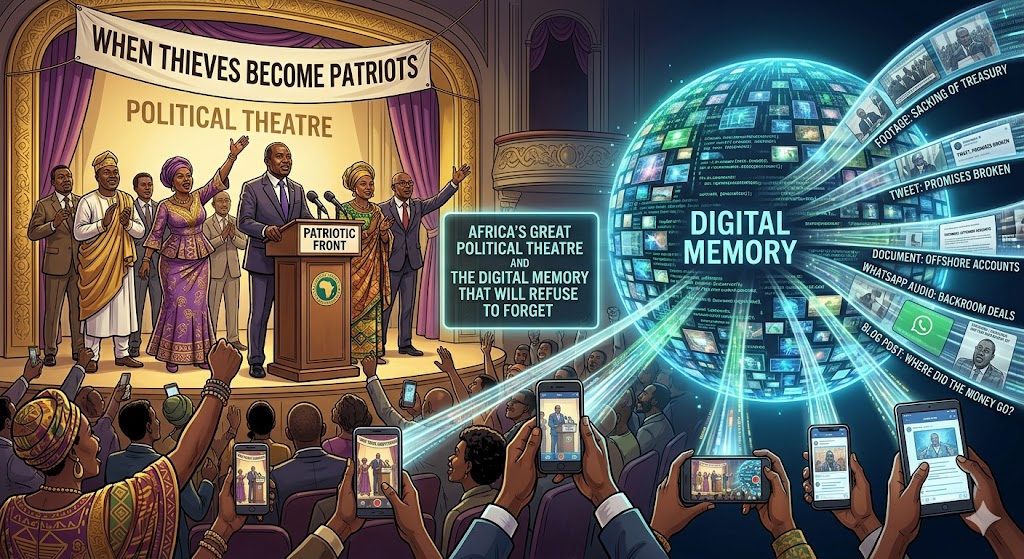
By Mr. Fredrick Kipchumba Chelimo PWD
Email: fkipchelimo@yahoo.com
Africa has for long been associated with witches, sorcery, and bad things, I am not writing this article to validate, invalidate or argue about such virtues. I am writing to acknowledge the rich predictive literary knowledge of some of the greatest foretellers, prophets and predictors. Our writers. They used their knowledge and contemporary understanding of the society to accurately tell what is ailing Africa. They are the men who looked beyond the excitement of independence celebrations and saw, what is hidden behind the waving flags and liberation songs, a darker future quietly sharpening its teeth.
They saw this long before the first billion disappeared through suspicious procurement deals, before parliaments transformed into constitutional laundromats for public theft, before citizens mastered the painful art of laughing at their own suffering, African writers had already diagnosed the disease with frightening accuracy. They warned that colonialism would not really end, but would change managers. The oppressor would lose his foreign accent, acquire a local name, and continue the business of extraction with even greater appetite.
The continent had and overtime produced one of the sharpest minds, Africa was never short of prophets. The tragedy is not that it lacked warning, the tragedy is that it celebrated the warnings as literature and ignored them as prophecy. Chinue Achebe in his book “A man of the people” saw it with clarity and exposed the birth of a new political species; the smiling liberator who steals while preaching patriotism. Independence had barely settled when politicians began behaving like hungry tenants accidentally handed ownership of the building. Ministers and senior government officials expanded physically alongside corruption scandals. Revolutionary slogans suddenly discovered imported whisky, motorcades, and urgent needs for foreign medical attention. They found suddenly a wired species that they could not live alongside them.
Achebe understood something many citizens grabble to understand to date; Africa would not be destroyed by obvious villains, but would be destroyed by performers. Men gifted with speeches, symbolism, theatrics, and emotional manipulation. Men with capability to steal during the day and leading national prayers against corruption in the evening. Men who inaugurate a bridge that existed only in budget documents and still receive applause from desperate citizens hoping crumbs might eventually fall from banquet table.
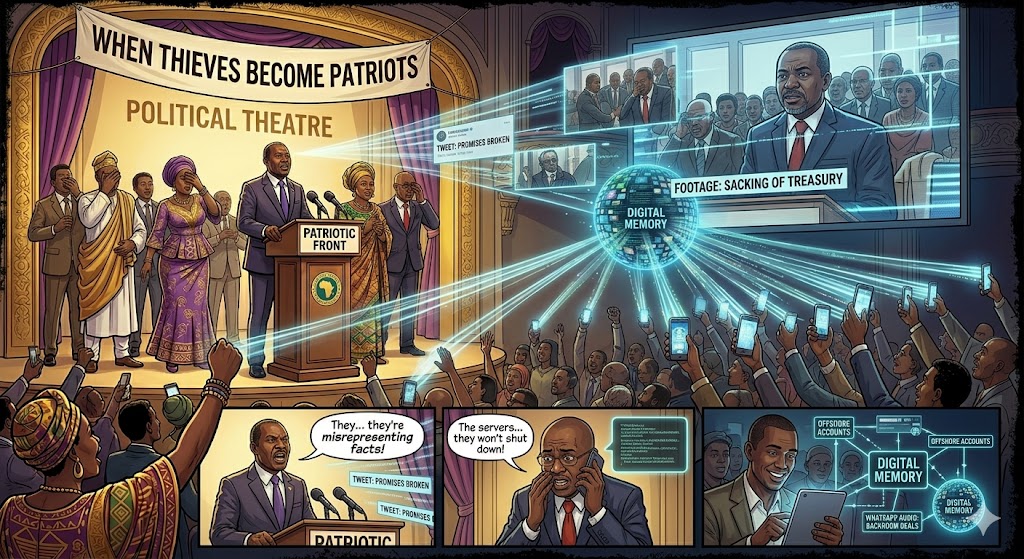 Roads are launched repeatedly like television reruns. A single hospital project receives more commissioning ceremonies than actual medicine supplies. Leaders arrive in helicopters to inspect poverty from a safe altitude before returning to air-conditioned conferences to discuss “grassroot empowerment”. Every scandal is accompanied by a dramatic press briefing, urgent committee formations, strongly worded statements, and promises of “thorough investigations” whose report disappears with astonishing efficiency. The public watches this spectacle with astonishing familiarity. Corruption is no longer hidden but televised, branded, defended and occasionally sponsored.
The absurdity has further matured. Money disappears electronically with impressive speed, while public institutions lose files manually with equal dedication. A poor citizen stealing a chicken or chicken egg is publicly paraded as a dangerous criminal, yet individuals stealing billions arrive in courts surrounded by politicians, lawyers and in some situations, worshipers singing solidarity songs. Entire churches pray passionately for leaders whose greatest miracle is surviving anti-corruption investigations. Meanwhile the citizen continues financing his suffering with admirable patriotism through taxation. He is taxed while earning, taxed while travelling, and eventually buried on roads budgeted for repeatedly, but build only on political speeches.
In his book “the beautiful ones are not yet born” Ayi Kwei Armah warned that corruption would move beyond politics and become spiritual decay. He opined that filth is everywhere because the moral condition of society itself has decomposed. Armah understood that the most dangerous phase of corruption arrives not when leaders begin stealing, but when citizens stop being shocked by thefts. Once society starts admiring criminals because they are wealthy, collapses has already rented permanent accommodation.
Today in most parts of Africa, we find entire communities defend corruption provided the thief belongs to the correct tribe, party or region. Public morality has become negotiable. Citizens who cannot afford hospital bills passionately defend leaders accused of stealing health funds. Young graduates on hopelessness celebrate politicians whose watches costs more than an entire classroom. Political rallies increasingly resemble emotional hostages’ situations where suffering citizens applaud the architects of their suffering simply because the alternative feels unfamiliar.
Corruption includes even the language. Bribery becomes “facilitation”, theft becomes “misappropriation”, lies become “clarification”, economic suffering becomes “temporary adjustment”, public outrage becomes “noise from critics”. The continent perfect the dangerous art of renaming disasters until they appear manageable. Ngũgĩ wa Thiong’o probably understood the Kenyan situation most painfully. In his book “petals of blood” independence is revealed as a tragic exchange programme where colonial administrators depart ceremoniously while the local elites inherit both the whip and the plantation. The faces changed, and the structures remained. Ngugi predicted the rise of local elites who would align themselves with foreign economic interests while abandoning ordinary citizens to unemployment, inequality and carefully managed hopelessness.
What he foresaw now unfolds daily with frightening precision. Governments celebrate economic growth explained in figures, graphs, charts, while citizens survive through debts, online fundraising, and motivational quotes. Universities produce graduates for economies that no longer have room for dreams. Parliament debates citizens’ suffering after heavily subsidized lunches. Leaders urge sacrifice from populations already surviving on economic skeletons. Fuel prices rise astronomically. Food prices climb like ambitious politicians. Hospitals prescribe patience because medicine is unavailable. Yet somehow, somewhere, parliament allowances remain healthier than the healthcare system.
Under such environments, political class still manage to speak with confidence about “shared pain”. One almost admires the courage required to discuss the austerity measure form inside fuel guzzling helicopters, convoys escorted by armed security officers.
Wole Sonyinka, laughing the dangerous laughter of a man who fully understood the absurdity of power. In his book “a play of giants, Sonyinka transformed dictators into grotesque theatrical figures swollen by ego, praise songs, and unchecked authority. Yet beneath the humour lay a terrifying truth; African politics survives not merely through force, but through spectacle. Leaders become actors. Government become choreography. National crisis becomes opportunities for televised compassion.
Every disaster receives a slogan, failure receives rebranding, scandal receives distraction, protests receive patriotically packaged suppression and even apologies become theatrical productions. A politician accused of stealing public money quotes the scripture with precision, visits the church, donates a water tank, and emerges politically purified before cameras. Redemption in moder day politics no longer requires accountability, it merely requires strategic photography.
Meanwhile, ordinary citizens have adopted psychologically to national dysfunction with remarkable creativity. Humour became survival equipment, citizens laugh at fuel prices because sustained crying causes dehydration, they create memes about collapsing healthcare systems while organizing online fundraisers for relatives abandoned by those same systems. They joke about corruption because anger without power eventually mutates into comedy. Yet beneath this laughter lies a dangerous exhaustion.
A Society can survive poverty longer than it can survive hopelessness and perhaps that is why much of Africa now stand: trapped between democratic language and feudal realities, between constitutional promises and economic humiliation, between patriotic speeches and institutional betrayal.
The writers, our foretellers and our predictors warned early enough that this moment would come. They warned that once corruption becomes normalized, would stop being a scandal and become governance philosophy. That parliament might eventually legalize exploitation procedurally, that citizens would gradually lower expectations from justice to merely survival and that truth would become negotiable depending on political convenience.
But there is now a new and deeply ironic development emerging within this era; the digital age that governments and powerful elites have increasingly weaponized to monitor, manipulate, intimidate, and economically suffocate citizens is simultaneously becoming history’s most unforgiving archive.
Previously historical injustices depended heavily on records with its attendant inadequacies, and courage of historians willing to challenge official narratives. Regimes survived partly because memory itself could be buried. Files disappeared mysteriously, witnesses died, records burned conveniently in government offices during suspicious midnight fires. Entire scandals dissolved into rumor because evidence travelled slowly and vanished easily.
This is not any more. Dr Edmond Locard concept that every contact leaves a trace also known as Locard exchange principle has emerged in the digital platform. This time we could say, whatever one did during the digital age and captured digitally will be reproduced faithfully in future. Today corruption leaves fingerprints everywhere. Speeches are uploaded online, parliament vote, procurement trails, audios, viral videos, deleted tweets, bank transactions, tender documents, GPS locations including campaign promises can all be preserved and achieved permanently in high definition.
The same digital ecosystem used to spread propaganda, surveil dissent, weaponize misinformation, and distract citizens with endless political theatrics is also quietly constructing the most detailed forensic memory Africa ever possessed. For the first time in history, future generations may not need to guess who betrayed the nation. They will know.
They will know who signed or authorised what, who voted for what, who defended what, who remained silent, who stole, who enabled theft, who normalized injustice, who privatized public resources, who inflated contracts while hospitals lacked oxygen. They will also know who borrowed recklessly in the name of development, who sold patriotism while purchasing properties abroad.
More painfully, they would know the exact consequences. They will calculate how many hospitals were never built, how many classrooms collapsed, how many children dropped out of school, how many citizens died while waiting for treatment, and probably how many youths drowned in unemployment and ended up in foreign countries as slaves while leaders discussed economic transformation in the most luxurious hotels.
Our great grandchildren may one day sit under cleaner governments or perhaps under different thieves with better suits and scroll through archived videos of today’s leaders making promises they never intended to fulfill. They would replay parliamentary debates with forensic precision. They will examine digital evidence like historians examining war crimes. And unlike previously, they will possess the truth. No rumors, no folklore, no distorted mythology, true evidence. clear, timestamped, recorded, searchable and undeniable.
Whether such evidence or clarity will be a basis for reparations, justice, institutional reform or merely a sophistication of anger is a matter of another day. The grandchildren of affected and perpetrators would be able to view from a perspective whether their inequality is a natural state or caused by a great-grandfather of one. While any emerging technology historically has been manipulated to serve the rich, powerful and mighty, the emergence of digital technology accelerated by AI and universal accessibility potent a different level ball game.
The old political class stole from citizens and escaped into retirement protected by disappearing files and faded witnesses. Today’s political actors operate under invisible cameras history never switches off. Perhaps that is the final irony of modern African state; in attempting to control information absolutely, it may have accidentally created the most powerful instrument of accountability future generations will ever inherit.
The writers warned that nations will collapse when the truth dies. The digital age may ensure that truth, however delayed, never fully disappears again. And somewhere in the future, long after today’s political slogans have faded and architects of modern scandals have become portraits hanging quietly in government archives, a child may ask a simple but pertinent question. “If they knew history would remember them this clearly, why did they still do it?” Our great grandchildren should remember and find us in the right side of historical recollection.
Similar Posts by The Mt Kenya Times:
- Mt Kenya Times ePAPER October 12, 2026
- Gachagua’s party storms Kikuyu from afar as 2027 countdown begins
- Counties caught: The KSh100B payroll scandal Kenya can no longer hide
- CS Ogamba: tree planting could generate carbon credit millions to fund education
- Farouk Kibet calls for unity and development as leaders rally behind Ruto’s 2027 re-election bid
About the Author