World marathon champion Jepchirchir suspended in fresh blow to Kenya’s clean sport drive
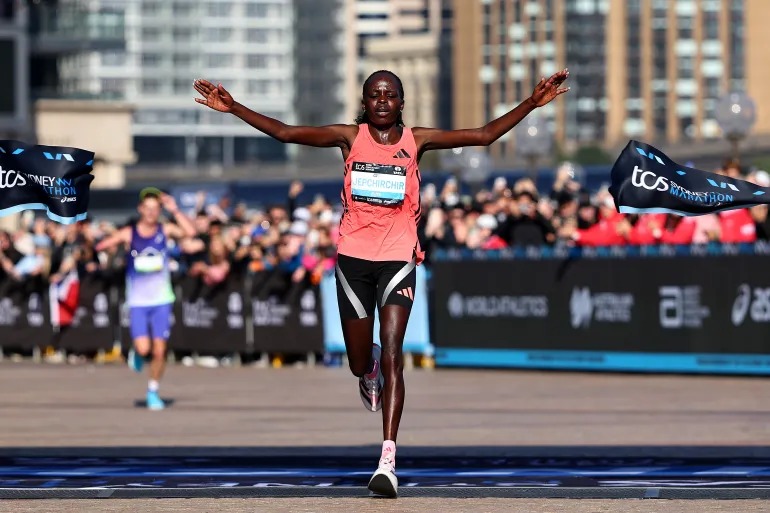
Peres Jepchirchir
The provisional suspension of Peres Jepchirchir for EPO use deepens a doping crisis that is threatening to overshadow Kenya’s extraordinary record on the world athletics stage.
By Martin Weche
Athletics Kenya yesterday expressed disappointment after world marathon champion Peres Jepchirchir was provisionally suspended by the Athletics Integrity Unit following a positive test for the banned blood-boosting substance erythropoietin, commonly known as EPO.
The suspension, announced on Friday by the Athletics Integrity Unit, follows a sample collected out of competition shortly before Jepchirchir, 33, competed in and won the Sydney Marathon in August. The timing is particularly troubling — the sample was taken before one of the most significant victories of her career, raising questions that will now hang over that result until the case is fully resolved.
Athletics Kenya moved quickly to distance itself from any suggestion of institutional failure, reiterating its zero-tolerance stance on doping while expressing support for the integrity body’s processes. “While it is unfortunate to receive such news regarding a high-profile athlete, Athletics Kenya remains firm in its stance on promoting clean sport and ensuring a level playing field for all competition,” the federation said in a statement. The governing body further noted that “the testing procedures and subsequent provisional suspension were conducted directly by the AIU, as the designated testing authority, in accordance with established anti-doping regulations, international standards and lawful case management protocols.”
The carefully worded statement reflects an organisation acutely aware of the reputational stakes. Kenya’s dominance of long-distance running over several decades has been one of the country’s most celebrated achievements — a source of national pride that generates significant economic returns through sponsorship, prize money, and global visibility. Every high-profile doping case chips away at the credibility that underpins that dominance.
Jepchirchir’s case is the latest in a series of damaging episodes that have placed Kenyan athletics under sustained international scrutiny. In July, middle-distance runner Kibiwott Kandie received a seven-year ban — one of the most severe penalties in recent Kenyan athletics history — after refusing an out-of-competition test and obstructing doping control officers. The length of the ban reflected not merely the offence itself but the deliberate nature of the obstruction, a distinction that anti-doping authorities have been increasingly willing to make in cases involving non-cooperation.
Before that, world record holder Ruth Chepngetich was suspended for three years after admitting to testing positive for hydrochlorothiazide, a diuretic that appears on the World Anti-Doping Agency’s prohibited list. Chepngetich’s case attracted particular attention given the scale of her achievements and the global profile she carried into the hearing.
The accumulation of cases at the elite level raises questions that Athletics Kenya’s carefully managed public statements cannot fully deflect. EPO, the substance at the centre of Jepchirchir’s suspension, is a performance-enhancing drug with a long and damaging history in endurance sport. It stimulates the production of red blood cells, increasing oxygen delivery to muscles and improving endurance performance. Its use is not a marginal infraction. It is a fundamental manipulation of athletic competition.
For the AIU, the Jepchirchir case represents another test of its capacity to police one of the world’s most athletically productive but also most scrutinised running communities. The unit has expanded its out-of-competition testing programme in Kenya in recent years, operating with greater independence from national federations — a structural change that Athletics Kenya’s statement implicitly acknowledged and endorsed.
The provisional nature of the suspension means Jepchirchir retains the right to contest the finding and request analysis of her B sample. The process will take months. Until it concludes, her Sydney Marathon victory exists in a kind of official limbo — celebrated but contested, recorded but under review.
What is not in limbo is the broader challenge facing Kenyan athletics. The sport’s administrators, coaches, agents, and the athletes themselves must confront a culture in which the pressure to perform at the highest level has, for some, made the temptation of chemical assistance feel like a rational calculation. Anti-doping enforcement can catch and punish those who make that choice. It cannot, on its own, address the conditions that make it.
Kenya’s clean athletes — and there are many — deserve a system robust enough to protect the credibility of their achievements. Right now, that system is being tested case by case, suspension by suspension. The question is whether the institutions responsible for Kenyan athletics are prepared to do more than issue carefully worded statements when the next one arrives.
Similar Posts by The Mt Kenya Times:
- Mt Kenya Times ePAPER October 27, 2026
- Sifuna draws hope from Serbia and Brazil as Kenya’s 2027 race heats up
- Uhuru calls for unity as he marks 65th birthday
- Kenya establishes international crimes division: Justice delayed, but will it be delivered?
- Manchester United in crisis as Bournemouth humiliate Carrick’s side 3-0
About the Author