Food security in Kenya: How farming, climate and policy shape the nation’s future
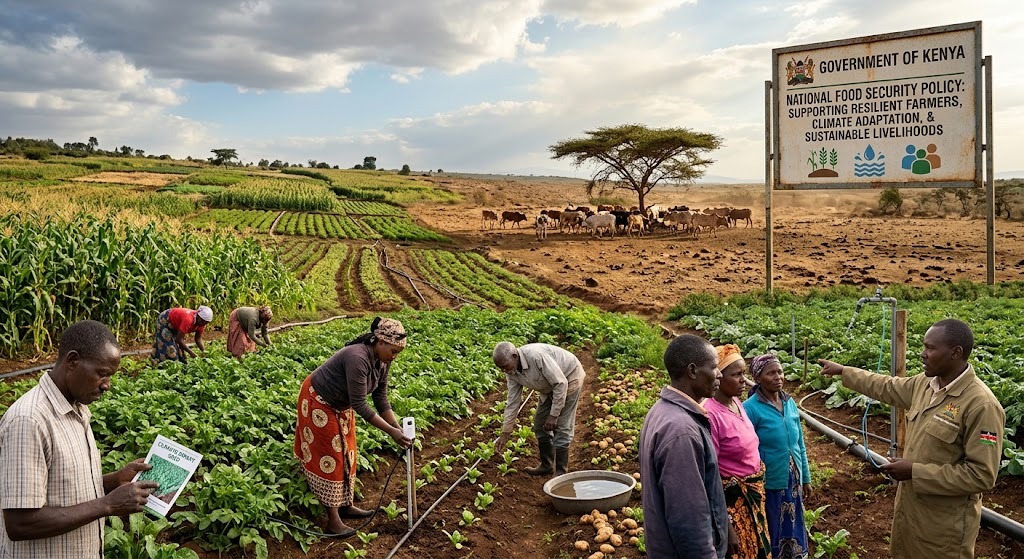
Food security and agricultural resilience in Kenya are under threat — and what happens in Trans Nzoia today will be felt on every dinner table tomorrow
By Fridah and Correspondent Daniel Kipchumba
Food security remains one of the most critical pillars of national development in Kenya, with farmers, educators, and policymakers urging coordinated action to strengthen agricultural production, improve food distribution, and ensure that every household has reliable access to sufficient, safe, nutritious, and affordable food.
The stakes could not be higher. Access to adequate food is a fundamental human necessity that directly shapes public health, education, economic productivity, and the overall well-being of society. A country that fails to guarantee food security exposes its population to the compounding crises of hunger, malnutrition, poverty, and economic instability — outcomes that no government, community, or household can afford to ignore.
Agriculture sits at the centre of that challenge, particularly in Kenya, where millions of households depend on farming for their livelihoods. Increased investment in modern farming technologies, irrigation infrastructure, quality seeds, and affordable agricultural inputs can meaningfully boost food production and reduce the country’s dependence on imports. The returns extend well beyond the farm gate. Children who receive adequate, nutritious meals are better positioned to concentrate in the classroom, attend school regularly, and achieve stronger academic outcomes. Strengthening school feeding programmes is therefore not merely a welfare intervention — it is an investment in Kenya’s future workforce.
That connection between food and economic productivity runs deep. Farmers, traders, manufacturers, and every other player along the agricultural value chain benefit from a stable food system. A well-fed workforce is a productive one, and a productive workforce generates the household incomes and employment opportunities on which national growth depends. The government and its partners have a clear responsibility to develop sustainable strategies that protect the most vulnerable — children, pregnant women, elderly persons, and low-income households — from the worst effects of food insecurity.
Nowhere is that responsibility more immediately visible than in Trans Nzoia County, which this year experienced prolonged absence of rainfall, severely reducing output and leaving farmers counting losses where they had expected harvests. The challenge is not unique to Trans Nzoia; adverse climatic conditions have disrupted food production across multiple parts of Kenya, underlining how deeply the nation’s food supply depends on weather patterns that are becoming increasingly unpredictable. Farmers in the county are being urged to shift toward short-season crops that can mature within constrained rainfall windows, and to store their produce carefully through the coming months rather than selling immediately — a discipline that will prove vital between January and July, when food availability is expected to tighten.
Ronald Francis Toili Wamalwa, an educator and farmer from Trans Nzoia County, argues that the long-term answer to these climatic pressures lies, in part, in the soil beneath our feet. “Plant more trees,” Wamalwa urged residents. “Trees curb soil erosion, serve as water catchments, and ultimately attract rainfall — and that rainfall improves agricultural production not just in Trans Nzoia, but across the entire nation. A greener country is a productive nation.” Addressing these structural challenges requires not just individual action but coordinated effort among agricultural experts, farmers, development partners, and the private sector.
Equally important is reducing waste once food has been produced. Modern food preservation technologies and proper storage facilities must be prioritised to ensure that harvested produce reaches consumers in good condition. Sustainable farming practices, investment in rural infrastructure, and effective food policies will be essential in building a food system resilient enough to withstand the pressures of climate change, rising production costs, and post-harvest losses. Kenya’s food security is not a seasonal concern — it is a permanent national priority, and every citizen’s well-being depends on getting it right.
Similar Posts by The Mt Kenya Times:
- Mt Kenya Times ePAPER November 3, 2026
- Kang’ata: ‘I turned down the Deputy President’s job — it was a trap’
- World Bank’s KSh26B project to restore Kenya’s degraded landscapes and transform 750,000 lives
- Wiper sets final deadline for 2027 aspirants as Kenya’s electoral race begins in earnest
- Kalonzo draws his line in the sand
About the Author