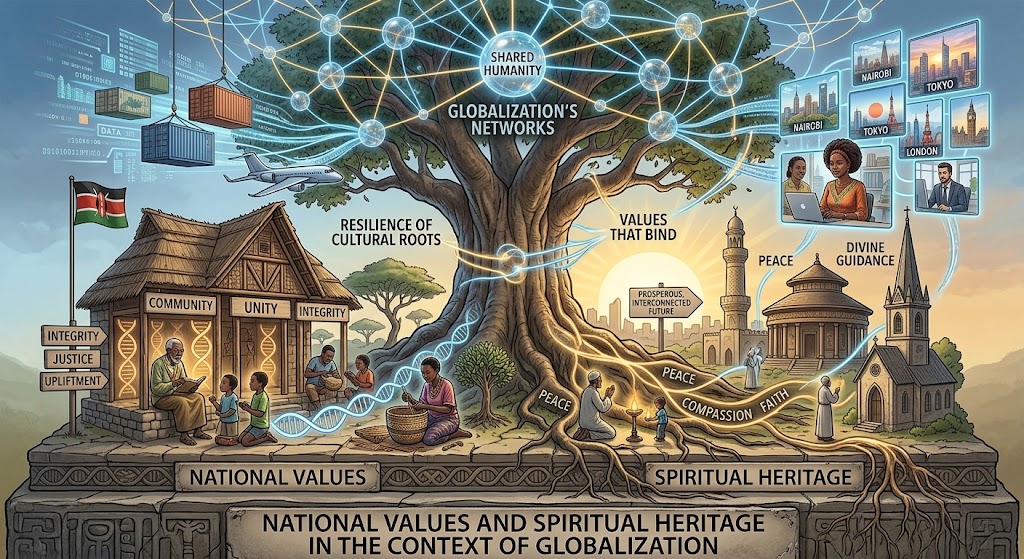
National values and spiritual heritage in the context of globalization
By: Oynazarova Dilfira
Abstract
This article examines the role of national values and spiritual heritage in the context of globalization. Particular attention is paid to preserving national identity, traditions, and cultural heritage in modern society. The article analyzes the impact of globalization processes on the worldview of young people, as well as the importance of national values in shaping a spiritually developed generation.
Keywords: national values, spiritual heritage, globalization, national identity, youth, traditions, culture, spiritual development.
Introduction
National values are among the most important means of reflecting the culture, history, and identity of every nation. They represent a foundation that has been passed down from generation to generation over many years and centuries, reflecting the moral, cultural, and spiritual state of a nation. National values serve as a kind of mirror that reflects the distinctive characteristics of a people, their identity, worldview, and way of thinking. They find expression in historical works, oral folk traditions, and everyday life.
In the modern era of globalization, intercultural connections between nations are expanding, while various traditions, principles, and customs are becoming increasingly widespread. Under these circumstances, the promotion of national values at the international level, the presentation of a people’s cultural identity, and the preservation of national traditions in accordance with modern requirements are becoming particularly important. The development of digital technologies, linguistic interaction, and tourism creates new opportunities for promoting national heritage, especially among the younger generation. At the same time, there is a growing need to find effective approaches to preserving national identity and the spiritual uniqueness of young people. This article examines the significance of national values in the context of globalization, ways to enhance their role in modern society, approaches to developing national self-awareness among the younger generation, and methods of presenting cultural heritage at the international level.
Main Part
1. National Values as the Foundation of a Nation’s Cultural Identity
National values constitute an essential component of the spiritual and cultural life of society. They develop over a long historical period and reflect the distinctive features of a particular people’s worldview, lifestyle, moral principles, and cultural heritage. Their significance lies not only in preserving historical memory but also in shaping public consciousness, educating the younger generation, and strengthening national identity.
As B. Isakov points out, in the context of globalization, particular importance is attached to educating young people in the spirit of respect for national and universal human values. The author emphasizes the need for cooperation between families, educational institutions, and mahallas in the process of the spiritual upbringing of the younger generation. The history of the Uzbek people is a vivid example of the richness of national and spiritual heritage. Over the centuries, traditions of respecting elders, honoring parents, hospitality, mutual assistance, and the pursuit of knowledge have developed. These qualities are reflected in the works of great Eastern thinkers, folk art, literature, and everyday life. The works of Alisher Navoi, Abu Ali ibn Sina, Abu Rayhan Beruni, and Mirzo Ulugbek are of particular importance. Their scientific and literary heritage occupies a significant place in the history of world civilization. Studying their works contributes to developing respect for history, enhancing intellectual potential, and understanding the moral foundations of human society. Thus, national values should be regarded not only as the heritage of previous generations but also as an important factor in the spiritual development of modern society.
2. National Traditions of Uzbekistan in the Context of Globalization
Uzbekistan possesses a rich cultural heritage manifested in national holidays, family customs, traditional crafts, music, literature, and traditional lifestyles. Many elements of this heritage have not only national but also international significance.
One of the most prominent examples is the holiday of Navruz, which symbolizes the renewal of nature, the arrival of spring, unity, and goodwill. Traditions associated with Navruz bring together representatives of different generations and contribute to strengthening social ties. The culture of preparing and sharing plov also holds an important place, reflecting traditions of hospitality, mutual assistance, and family unity.
According to UNESCO, Navruz and the culture of plov have been included in the Representative List of the Intangible Cultural Heritage of Humanity. In addition, askiya, katta ashula, shashmaqom, and the Boysun cultural space have received international recognition. These examples demonstrate that national heritage can become an important part of international cultural dialogue. Becoming familiar with Uzbekistan’s traditions allows representatives of other countries to gain a better understanding of the history, worldview, and spiritual characteristics of the Uzbek people.
However, the preservation of cultural heritage should not be limited to organizing festive events or displaying national symbols. It is necessary to ensure the transmission of traditions to the younger generation, support folk art, develop national arts, and create opportunities for studying native history.
3. The Influence of Globalization on the National Identity of Young People
Globalization is a complex social and cultural process that promotes the expansion of international relations, the exchange of information, and interaction among different peoples. The development of the internet, social media, international education, and tourism has significantly expanded opportunities for cultural exchange. At the same time, these processes have a certain influence on the worldview of the younger generation. Modern young people encounter various cultural models, values, and behavioral patterns every day. This contributes to broadening their horizons, developing language skills, and increasing their interest in other cultures.
In J. Xasanov’s research, particular attention is given to the socio-philosophical factors involved in shaping the worldview of young people based on national and universal human values. The author examines the influence of family, the education system, the spiritual environment, and digital culture on the formation of the younger generation’s consciousness. In our opinion, one of the main challenges of modern times is finding a balance between openness to global cultural processes and preserving one’s own national identity. Learning foreign languages, studying foreign literature, and gaining international experience should not become reasons for losing interest in one’s native culture.
On the contrary, young people who are well acquainted with their country’s history and traditions are capable of presenting its cultural heritage more consciously at the international level. Therefore, educational institutions, family upbringing, cultural events, and independent study of historical heritage play an important role.
M. Alimova also emphasizes the importance of national values in educating young people, considering families, educational institutions, mass media, and cultural organizations as important institutions for transmitting spiritual heritage.
4. The Role of Modern Technologies in Promoting National Heritage
In today’s information society, digital technologies provide extensive opportunities for preserving and promoting national values. The internet, social media, digital libraries, and virtual museums make it possible to introduce the history, culture, and traditions of different peoples to a wide audience. Young people play a particularly important role in this process. By using modern digital platforms, they can create educational materials, publish information about historical monuments, share knowledge about national holidays, and present traditional art to an international audience. For example, publications about Samarkand, Bukhara, and Khiva can attract attention to Uzbekistan’s historical and architectural heritage. Video materials about national cuisine, traditional crafts, music, and cultural celebrations also contribute to spreading information about the country’s cultural identity.
Creating high-quality content in foreign languages is of particular importance. This not only helps expand the audience but also makes national heritage more accessible to people from other countries. International educational projects, cultural forums, scientific conferences, and youth initiatives serve as important tools in this area.
Thus, modern technologies can serve as effective instruments for preserving national identity. Their proper use makes it possible to connect historical heritage with modern forms of communication and transmit cultural values to future generations.
Conclusion
To summarize, national values and spiritual heritage play an important role in preserving a people’s cultural identity, shaping public consciousness, and educating the younger generation. They serve as a link between the past, present, and future, ensuring continuity between generations and the preservation of historical memory.
In the context of globalization, preserving national identity becomes particularly important. The expansion of international relations and the development of information technologies create new opportunities for cultural exchange. However, at the same time, they require a conscious attitude toward one’s own historical and spiritual heritage.
In our opinion, the preservation of national values should not be viewed as something opposed to modern development. On the contrary, it is necessary to find a harmonious balance between national traditions and universal human values.
The younger generation bears particular responsibility in this process. Young people should not only study their nation’s cultural heritage but also actively participate in its preservation and promotion. National values are an important factor in the spiritual development of society and the strengthening of national identity. Their preservation, study, and presentation at the international level should become one of the priority areas of activity for educational institutions, cultural organizations, and young people themselves.
Oynazarova Dilfira
First-year student,
Faculty of Russian Philology,
Uzbekistan State World Languages University.
Similar Posts by The Mt Kenya Times:
- Mt Kenya Times ePAPER November 3, 2026
- Kang’ata: ‘I turned down the Deputy President’s job — it was a trap’
- World Bank’s KSh26B project to restore Kenya’s degraded landscapes and transform 750,000 lives
- Wiper sets final deadline for 2027 aspirants as Kenya’s electoral race begins in earnest
- Kalonzo draws his line in the sand
About the Author