Jubilee accuses UDA of stealing its slogan as 2027 election battle lines sharpen
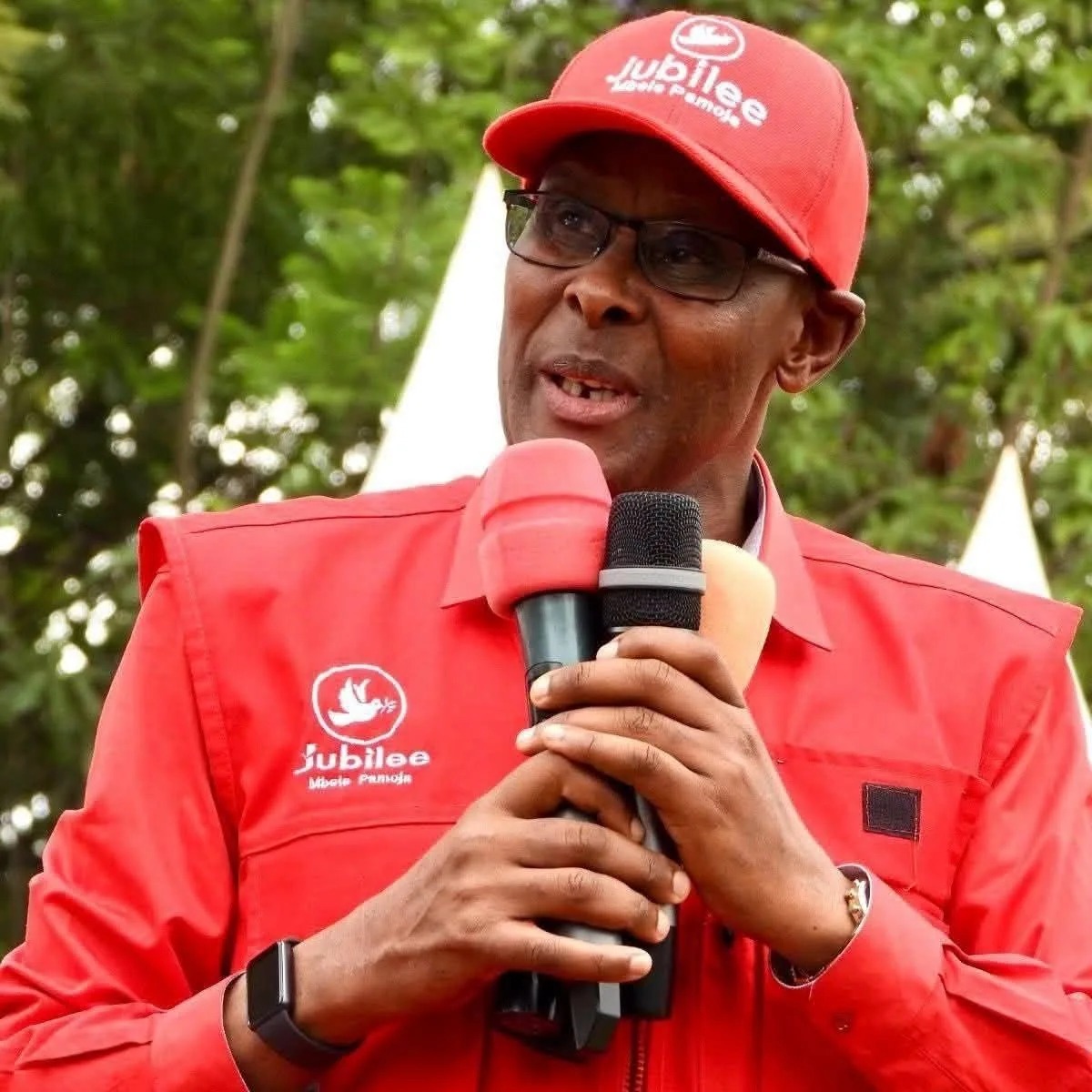
Jubilee Party Secretary General Moitale Ole Kenta addressing in Kisii. PHOTO/ Courtesy
A dispute over three Swahili words has exposed the intensifying rivalry between Kenya’s ruling party and its former political home, with the registrar of political parties now drawn into the fray nine months before the general election
By David Kimani
Jubilee Party yesterday petitioned the Registrar of Political Parties to stop the United Democratic Alliance from using the phrase “Mbele Pamoja” — meaning “Forward Together” — after UDA adopted it as part of its new election slogan, in a row that has laid bare the deepening hostility between President William Ruto’s ruling party and the organisation from which it effectively grew.
In a formal complaint dated 5 November 2026 and addressed to the Office of the Registrar of Political Parties at Lion Place, Sarit Centre, Jubilee Secretary General Moitalel Ole Kenta argued that “Mbele Pamoja” is already registered as Jubilee’s official slogan and forms a recognised part of the party’s political identity. Its appropriation by UDA, Jubilee contends, risks confusing voters about the distinct identities of the two parties at precisely the moment when electoral messaging is beginning to matter most.
The dispute was triggered by UDA’s announcement on 5 November that it was replacing its previous slogan, “Kazi ni Kazi” — “Work is Work” — with the new formulation “Usawa ni Sawa – Mbele Pamoja,” meaning “Equality is Right — Forward Together.” The change was formally notified by UDA Secretary General Hassan Omar under Section 20(2) of the Political Parties Act. Ruto had already been using the phrase “Mbele Pamoja” at public rallies in call-and-response exchanges with supporters, suggesting the linguistic shift had been in preparation for some time.
“Jubilee Party hereby formally lodges a complaint with your office concerning the adoption and intended use of its registered political slogan, ‘Mbele Pamoja,’ by the United Democratic Alliance, as part of the latter’s newly announced political slogan, ‘Usawa ni Sawa – Mbele Pamoja,'” the party’s letter stated. The complaint calls on the registrar to verify and formally confirm that the phrase is registered to Jubilee, issue a cease-and-desist notice directing UDA to halt use of the phrase while the matter is considered, take administrative measures to protect the integrity of the parties register, and provide a written determination setting out the legal basis for whatever action is taken.
Jubilee’s legal argument rests on several provisions of the Political Parties Act, Cap. 7D. The party cites Section 20(1)(d), which recognises a party’s slogan as a registered particular, alongside Section 34(e), which places an obligation on the registrar to maintain the register and safeguard the distinct identities of political parties. It also invokes Section 34(a) and (g), which provide for the registrar’s regulatory, monitoring and investigative responsibilities, including handling complaints between parties.
The legal framework is relatively clear. What is less clear is whether “Mbele Pamoja” was ever formally registered in Jubilee’s name in a manner that would survive a challenge, or whether the phrase — common in Swahili political discourse — carries the kind of distinct registered identity that the Act is designed to protect. That is precisely the determination Jubilee is asking the registrar to make.
Beneath the procedural surface, however, the dispute carries a significance that extends well beyond trademark law. Jubilee and UDA share a complicated and deeply personal political history. Ruto built his national political machine within Jubilee, serving as Deputy President under former President Uhuru Kenyatta before the relationship collapsed spectacularly in the years leading up to the 2022 general election. UDA emerged as the vehicle for Ruto’s presidential ambitions, drawing heavily on networks, personnel and political capital accumulated during the Jubilee years. The bitterness of that separation has not dissipated. If anything, as the 2027 election approaches and both parties position themselves for a contest in which every marginal advantage matters, it is intensifying.
A slogan dispute may appear trivial against that backdrop. It is not. Political slogans are the condensed expression of a party’s identity and electoral proposition. “Mbele Pamoja” encapsulates a message of collective forward movement that both parties now appear to want to own — a signal that they are competing for similar terrain, similar voters and similar narratives of progress and national purpose.
The registrar must now navigate a complaint that is simultaneously a legal question and a political grenade, with nine months remaining before Kenya goes to the polls.
Three words. Two parties. One election. The fight has begun.
Similar Posts by The Mt Kenya Times:
- Mt Kenya Times ePAPER November 7-8, 2026
- Karua demands Lissu’s release as Tanzania court conviction draws regional condemnation
- Kenya’s green service passport: What it is, who qualifies and why it matters
- Rigathi Gachagua mourns elder sister Eunice Nyangari Gachagua, 77, the family’s guiding light
- A father’s prayer: Ruto celebrates daughter Charlene’s wedding in heartfelt message
About the Author