The Mt Kenya Times
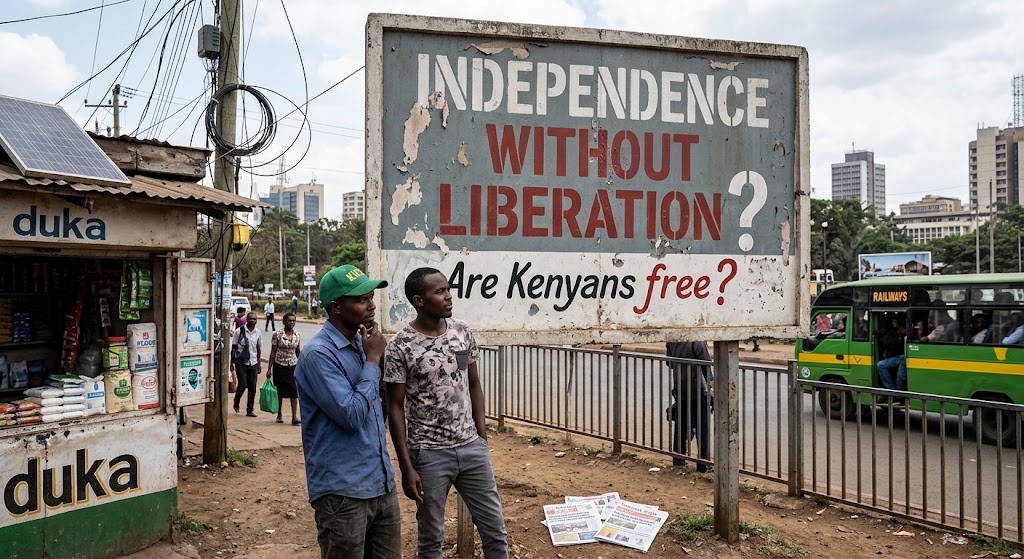
Six decades after independence, the gap between constitutional promise and everyday reality confronts Kenya’s national conscience
By Fredrick Kipchumba Chelimo
More than six decades after Kenya attained independence, an uncomfortable question continues to confront the national conscience: are Kenyans truly free, or have they simply exchanged one form of dependence for another? These are not questions born of political pessimism. They arise from the growing disconnect between the promises of independence and the daily experiences of ordinary citizens who pay more, suffer more and increasingly expect less.
A Kenyan who questions government decisions, challenges administrative injustice or expresses dissatisfaction with public leadership should not have to contemplate intimidation, abduction or unlawful detention. Articles 29, 33 and 37 of the Constitution protect personal liberty, freedom of expression and peaceful assembly. These rights are not privileges that government may grant or withdraw according to political convenience. Dissent is not treason, criticism is not rebellion, and patriotism cannot be measured by unquestioning loyalty to those in power.
The contradiction becomes equally visible in public service delivery. Kenyans pay income tax, VAT, statutory deductions, licence fees and numerous other levies to sustain government institutions. Yet citizens routinely encounter deliberate delays, unnecessary administrative obstacles and unofficial demands for additional payments to obtain services for which they have already paid. Whether seeking official documents, business permits, police assistance or healthcare, the ordinary Kenyan often finds themselves negotiating an additional financial burden simply to move an otherwise legitimate process forward.
This is not mere administrative inconvenience — it is a subversion of constitutional government. Article 47 guarantees lawful, reasonable and procedurally fair administrative action, while Article 232 requires responsive, prompt and impartial public services. The Ethics and Anti-Corruption Commission’s National Ethics and Corruption Survey 2024 documented the persistence of bribery in public service encounters. Corruption has consequently become more than the theft of public resources; it operates as an informal taxation system imposed on people already struggling with the cost of living. The poorest citizens suffer most, possessing the least capacity to withstand additional demands.
Road enforcement presents another troubling dimension. Nobody should oppose lawful traffic regulation — road safety is a national necessity. However, enforcement must never become an avenue for intimidation, humiliation or financial exploitation. Recent complaints concerning the National Transport and Safety Authority, including arbitrary penalties, alleged vehicle damage and questionable roadside conduct, deserve serious scrutiny. Every enforcement action must have a lawful basis, be properly documented and remain subject to accountability. Articles 28, 40 and 47 protect dignity, property and fair administrative action. The law must bind motorists, but it must equally bind those enforcing it.
Perhaps the most painful contradiction in Kenya’s independence story is the displacement of professional merit by political patronage. Parents have sold livestock, borrowed money and sacrificed family resources to educate their children. Young Kenyans graduate with impressive qualifications and specialised skills, only to spend years searching for meaningful employment. Some eventually resort to hawking or casual labour — activities that carry no dishonour, but represent a profound injustice when a system rewards political connections over professional competence. Public institutions are not political reward centres. When competence is sacrificed to political loyalty, taxpayers bear the cost through poor management and deteriorating services.
For persons with disabilities, the contradictions of independence are even more pronounced. A qualified professional may be denied employment because an employer equates disability with incapacity. A wheelchair user may encounter inaccessible public offices. A visually impaired citizen may struggle with government digital platforms. A deaf person may be excluded from public participation because interpretation services are unavailable. These are institutional failures, not personal shortcomings. Articles 27 and 54 of the Constitution guarantee equality, non-discrimination, dignity, accessibility and reasonable accommodation for persons with disabilities. The Persons with Disabilities Act 2025 reinforces these statutory obligations. Yet disability inclusion must move beyond political speeches and ceremonial representation. It must be reflected in employment, healthcare, accessible infrastructure, education and meaningful participation in decision-making. Disability is not an absence of ability, and inclusion is not charity — it is a constitutional obligation and a measure of democratic maturity.
The wider population faces similar questions concerning healthcare, education, housing and economic opportunity. Article 43 guarantees economic and social rights, while Article 174 establishes devolution as an instrument for equitable development and accessible services. Yet families continue to struggle with healthcare costs, young people remain unemployed and rural communities experience inadequate infrastructure. The existence of policies, institutions and budgetary allocations cannot, by itself, constitute successful governance. What matters is whether public investment translates into tangible improvements in people’s lives.
Kenya does not need another collection of political promises. It needs institutional accountability. Alleged human rights violations must be independently investigated. Public service charges must be transparent. Corruption must attract real consequences. Enforcement agencies must demonstrate genuine professionalism. Public appointments must be grounded in competence. Parliament and county assemblies must exercise meaningful oversight, while citizens must reclaim their constitutional sovereignty through informed participation and electoral choices that demand better.
The question is not whether Kenya is legally independent — it unquestionably is. The harder question is whether ordinary Kenyans enjoy the practical benefits of that independence. What value does political freedom hold for someone afraid to express an opinion? What meaning does constitutional equality carry for a qualified person with a disability excluded from employment? What is the purpose of taxation when citizens must pay again, unofficially, to access legitimate services? And what is the value of education when political connections consistently outweigh merit?
Kenya has patriotic citizens, professional talent, constitutional protections and enormous national potential. What it urgently requires is leadership that understands public office as responsibility rather than privilege. A nation is not truly independent merely because its flag flies — it is independent when every citizen, regardless of economic circumstance, political persuasion or disability, can live without fear, access their rights without humiliation and demand accountability without intimidation.
Until freedom becomes an everyday experience rather than an annual celebration, Kenya’s independence will remain politically accomplished but socially unfinished.
Similar Posts by The Mt Kenya Times:
- The auction of the soul: Data Concentration as Kenya’s competitive farce against its own privacy
- Winnie Madikizela-Mandela, Stompie Seipei and an apology that took nine years
- Has money replaced love?
- Strengthening Global Diaspora giving-back partnership with Murang’a Catholic Diocese and communities
- Mt Kenya Times ePAPER November 6, 2026
About the Author