Public Embrace Organic Food to Keep them Healthy and away from Lifestyle Diseases
 The Mt Kenya Times
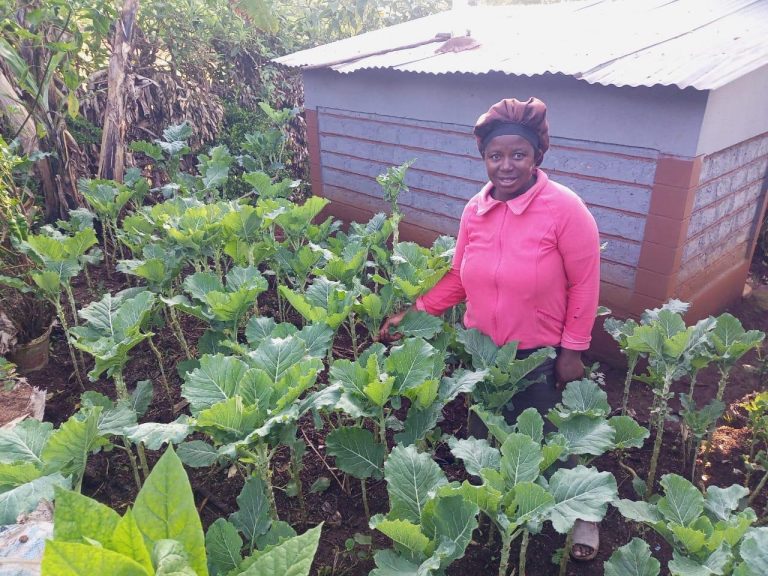
Askah Obaigwa together with her friends, weeding spinach at her garden at Nyamataro , Kisii County she has purely embraced organic farming as she urge public to eat organic food to keep them healthy and away from diseases photo credit/Elizabeth Angira
By: Elizabeth Angira
Worth Noting:
- Ms Obaigwa on her 2 acres land located at Nyamataro , Kisii county, busy on her garden pruning her vegetables together with other women , she has every reason to why she chose organic agriculture because the consumers want clean product, they no longer want food which are being applied with chemical products and fertilizers.
- She grows, herbs, tissue culture banana, maize, vegetables, sweet, Irish potatoes, , pumpkins, sweet berries , fruits and other high value food crops, which she sells to the markets, and institutions to earn a living.
- Obaigwa she is among the farmers in Kisii County who receives training in organic farming by Bio vision Trust.
As the world celebrates world food day, Kenyans have started to embrace organic farming as they shift to eat purely on organic food to keep them healthy and way from lifestyle diseases.
World Food Day is observed annually on 16 October to highlight the millions of people worldwide who cannot afford a healthy diet and the need for regular access to nutritious food. The theme for 2022 is Leave NO ONE behind.
World Food Day 2022 is being marked in a year with multiple global challenges, including the COVID-19 pandemic, conflict, climate change, rising prices and international tensions. All of this is affecting global food security. The Day is led by The Food and Agriculture Organization (FAO).
The Food and Agriculture Organization of the UN (FAO) designated 16 October as World Food Day in 1979.
Organic farming has been seen as the best solution to lifestyle diseases, increases soil fertility and reduces unnecessary costs.
Askah Obaigwa 70, organic farmer, she explains why she decided to switch from inorganic farming to organic farming.
Ms Obaigwa on her 2 acres land located at Nyamataro , Kisii county, busy on her garden pruning her vegetables together with other women , she has every reason to why she chose organic agriculture because the consumers want clean product, they no longer want food which are being applied with chemical products and fertilizers.
She grows, herbs, tissue culture banana, maize, vegetables, sweet, Irish potatoes, , pumpkins, sweet berries , fruits and other high value food crops, which she sells to the markets, and institutions to earn a living.
Obaigwa she is among the farmers in Kisii County who receives training in organic farming by Bio vision Trust.
She says that together with other members they have reaped a lot from the training and they continue to empower others.
“The training has been an eye opener to me and my members, and we have ventured into agri business,” she says.
Organic farming generates more employment in rural areas and labor achieves higher returns per unit of labor input.
UN’s Food and Agriculture Organization (FAO). Its main purpose is to make sure people have regular access to enough high-quality food to lead active, healthy lives. Its three main goals: the eradication of hunger, food insecurity and malnutrition; the elimination of poverty and the driving forward of economic and social progress for all; and, the sustainable management and utilization of natural resources, including land, water, air, climate and genetic resources for the benefit of present and future generations.
By using local resources better, organic agriculture facilitates smallholders’ access to markets and thus income generation and delocalizes food production in market-marginalized areas.
With organic farming in place, farmers can use fewer pesticides, decrease nitrate leaching into groundwater and surface water and organic farming is identified with products free from chemicals.
She says that organic farming has enabled her to reduce the expenses that she previously incurred in purchasing inorganic fertilizer and pesticides.
The farmer affirms that she uses organic fertilizer obtained from his composite pit, liquid organic manure for top dressing that acts both as pesticide and insecticide.
She says it’s easy to maintain her vegetables with no pesticides but only uses locally made pesticides such as fermented rabbit urine, molasses and plant nutrients and water.
She mixes soil and organic manure and planted head seedlings of African nightshade (Managu) spider flower (Saga) kales and spinach, which took her two weeks and she started harvesting.
Ms Obaigwa says that the reason for using different plant and vegetable leaves is to ensure that all rodents and destructive insects are killed.
Organic farming establishes farm soil PH as compared to the time that she was using inorganic fertilizer that made the soils acidic, noting that her farm produce has greatly improved while at the same time improving the health of her family.
Ms Obaigwa says that by venturing into organic farming has given her the opportunity to travel to other counties where she has acquired new skills also on her part she also share skills and knowledge she has to other farmers.
“Interacting with people from various backgrounds has also sharpened my worldview as well as opened up new markets, I can proudly say that organic farming is the best, “she says
Value addition
Ms Obaigwa she has ventured into value addition on her farm produce.
She is producing honey, wine, and crisps from banana, and herbs medicine.
“I receive and collect waste from the animal wastes, I use wastes from, poultry, livestock and pigs, she says.
Ms Obaigwa says that she sells her produce to the market and the surrounding neighboring counties.
Josephine Kemunto vegetable seller at Kisii County, states that most of her customer prefers to buy organic vegetables rather than those that have been applied pesticides.
Empowerment
The International Fund for Agricultural Development (IFAD) has focused exclusively on rural poverty reduction, working with poor rural populations in developing countries to eliminate poverty, hunger and malnutrition, raise their productivity and incomes, and improve the quality of their lives.
All IFAD-funded programs and projects address food and nutrition security in some way. IFAD has supported about 483 million poor rural people over the past four decades.
Anthony Mukhongo, field officer Bio vision, says that the rise in organic farming goes hand in hand with the growth in organic fertilizers.
Mr Mukhongo cites that they have trained many farmers in Gusii region and they have embraced organic farming.
Mr Mukhongo hopeful that growing crops without chemicals like pesticides will secure a market for their green produce in the European market.
He says that boost yields, it is a common practice for many farmers to use pesticides which in turn increase chemical residue in the produce
According to him organic farming is gaining ground in Gusii region and framers are now farming using purely organic.
He cites that efforts to reduce use of harmful chemicals would also help reduce the cost of production to farmers and increase their incomes.
He encourages farmers to go organic to avoid the use of chemicals, which affects the health system of human beings directly or indirectly.
“We have introduced our farmers into organic farming to help reduce diseases such as cancer which has killed many people, “he says.
Mr Mukhongo says he has enrolled a number of farmers to their programs of organic farming not only in plants but also dairy farming and local poultry. He said they use magazines, local radio programs to educate farmers on the importance of organic farming.
Hunger and nutrition numbers
According to United Nation, food is at the core of the Sustainable Development Goals (SDGs), the UN’s development agenda for the 21st century.
The second of the UN’s 17 SDGs is to “End hunger, achieve food security and improved nutrition and promote sustainable agriculture.” Achieving this goal by the target date of 2030 will require a profound change of the global food and agriculture system.
Around 660 million people may still face hunger in 2030, in part due to lasting effects of the COVID-19 pandemic on global food security.
Of the total number of undernourished people in 2020 (768 million): 282 million live in Africa, 418 million live in Asia, and 60 million live in Latin America and the Caribbean.
Nearly one in three people in the world (2.37 billion) did not have access to adequate food in 2020 – that’s an increase of almost 320 million people in just one year.
The gender gap in the prevalence of moderate or severe food insecurity has grown even larger in the year of the COVID-19 pandemic, with the prevalence of moderate or severe food insecurity being 10 percent higher among women than men in 2020, compared with 6 percent in 2019.
Nutrition value
Mr. Robinson Beta, the Gucha Sub-county Nutrition Officer, says Organic produce may have more of certain antioxidants and types of flavonoids, which have antioxidant properties.
The nutritionists states that the feeding requirements for organic farm animals (livestock) usually cause higher levels of omega-3 fatty acids. These include feeding cattle grass and alfalfa. Omega-3 fatty acids — a kind of fat — are more heart healthy than other fats. These higher omega-3 fatty acids are found in organic meats, dairy and eggs.
Cadmium is a toxic chemical naturally found in soils and absorbed by plants. Studies have shown much lower cadmium levels in organic grains, but not fruits and vegetables, when compared with crops grown using usual (conventional) methods. The lower cadmium levels in organic grains may be related to the ban on synthetic fertilizers in organic farming.
Similar Posts by The Mt Kenya Times:
- Mt Kenya Times ePAPER October 26, 2026
- Sakaja challenges Kamukunji police over Eastleigh suspect bail
- Muturi demands binding livestreaming rules for 2027 polls to prevent repeat of 2022 chaos
- NTSA calls for road safety to be declared a national disaster after 24 die in Mtito Andei crash
- Ruku turns on Waiguru over deputy president ambitions: ‘That seat is not being contested for’
About the Author