Mudavadi calls for whole-of-society war on corruption amid rising bribery trends
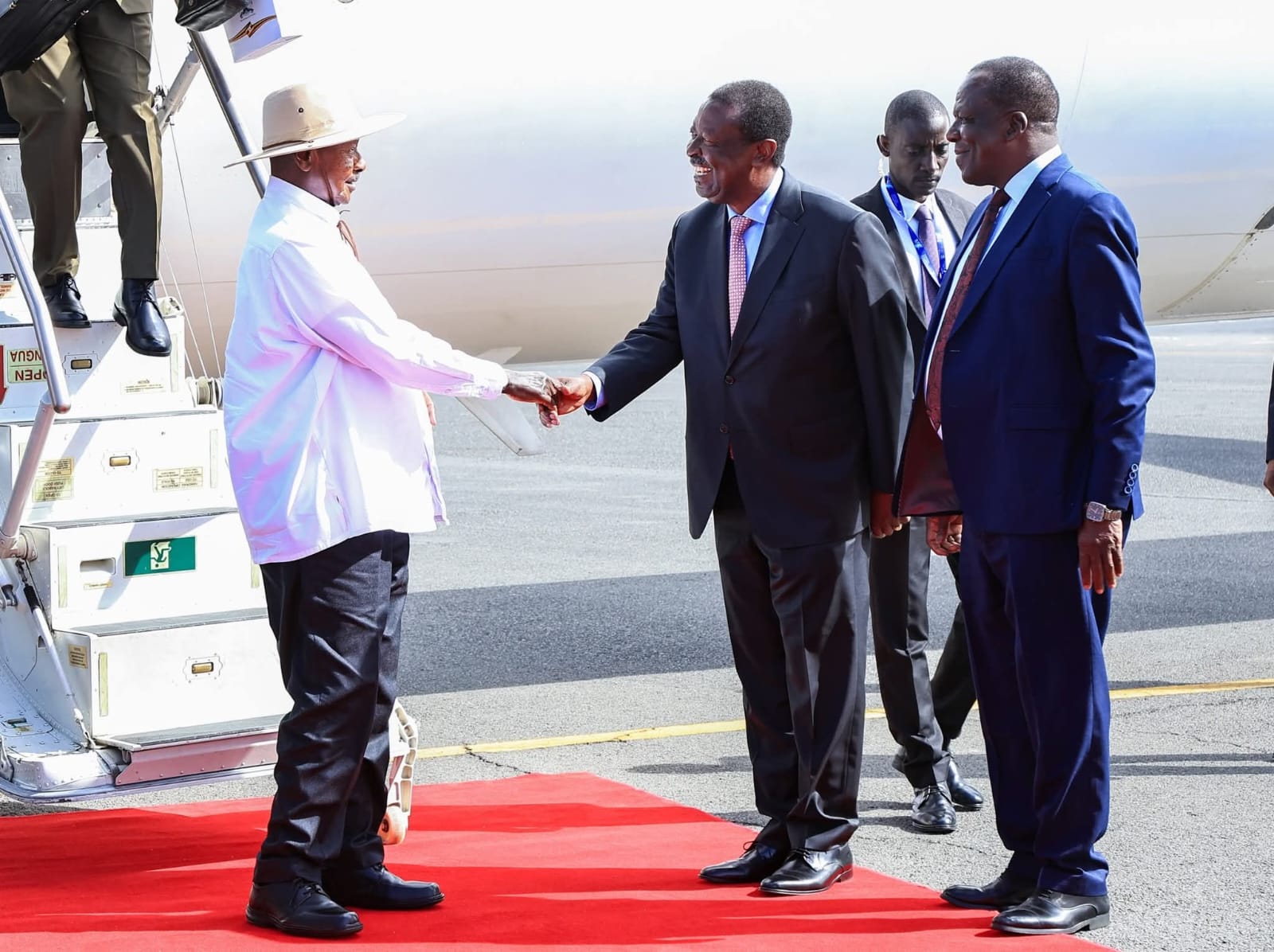
PCS welcoming Uganda president Yoweri Museveni who attended the forum.
By MKT Correspondent
Prime Cabinet Secretary Musalia Mudavadi has called for a united, society-wide approach to combating corruption, warning that rising bribery levels and declining public trust threaten Kenya’s governance, economic growth, and national cohesion.
Speaking yesterday during the 16th Eastern Africa Association of Anti-Corruption Authorities (EAAACA) Annual General Meeting and Conference in Nairobi, Mudavadi cited findings from the 2025 Kenya National Gender and Corruption Survey that paint a troubling picture.
According to the report, 84.3 per cent of bribes in Kenya are paid before services are delivered, effectively turning corruption into a “gatekeeper” for access to public services.
Even more concerning, he noted, is that 98.6 per cent of those who paid bribes did not report the incidents, signaling a deep crisis of trust in public institutions.
The average bribe also rose sharply from KSh4,878 in 2024 to KSh6,724 in 2025, a 38 per cent increase within a year.
Mudavadi highlighted generational disparities in corruption experiences, revealing that citizens aged 65 and above are often forced to pay bribes just to access services, while those aged between 18 and 64 typically pay to expedite processes.
He also pointed to corruption in employment, noting that the average bribe for securing a government job stands at Sh85,033, while promotion-related bribery averages Sh1,626.
“This is theft of merit, morale, and public confidence,” Mudavadi said, warning that when effort is overshadowed by bribery, public service becomes compromised.
Despite these challenges, Mudavadi expressed cautious optimism, noting that 31.9 per cent of citizens who refused to pay bribes did so on ethical grounds, demonstrating that integrity remains a strong value in society.
Strong legal framework, weak implementation
Mudavadi emphasized that Kenya has developed a robust legal and institutional framework to combat corruption. Key laws include the Anti-Corruption and Economic Crimes Act, which criminalizes corruption and economic crimes; the Ethics and Anti-Corruption Commission Act, which establishes the Ethics and Anti-Corruption Commission (EACC); and the Leadership and Integrity Act, which enforces ethical standards for public officers.
Other critical laws include the Anti-Bribery Act, the Proceeds of Crime and Anti-Money Laundering Act, and the 2023 Anti-Money Laundering and Combating of Terrorism Financing Laws (Amendment) Act, which expanded disclosure requirements for beneficial ownership, including foreign companies.
Mudavadi also cited amendments to the Companies Act and Beneficial Ownership Regulations, which require firms to disclose ownership structures, helping to curb illicit financial flows.
These frameworks are supported by institutions such as the Financial Reporting Centre, the Assets Recovery Agency, and the Central Bank of Kenya, all of which play key roles in monitoring, enforcement, and recovery of illicit assets.
Additional safeguards include the Witness Protection Act, which protects individualsi involved in legal proceedings, and the Virtual Asset Service Providers Act, which regulates digital financial transactions to address emerging risks.
Mudavadi also highlighted the recently enacted Conflict of Interest Act, which introduces stricter disclosure requirements and tighter controls on public officers’ private interests, as well as the Public Benefits Organisations Act, which modernizes oversight of non-profit entities and addresses corruption risks in donor funding and procurement.
Despite this extensive framework—comprising more than ten key laws—Mudavadi stressed that the main challenge lies in enforcement and implementation. He warned that some preventive measures, such as asset declarations by public officers, risk becoming mere compliance exercises without proper verification and enforcement mechanisms.
Progress and persistent gaps
Mudavadi pointed to progress made by the Ethics and Anti-Corruption Commission, which in its 2024/2025 report forwarded 175 investigation files to the Director of Public Prosecutions, secured 33 convictions, traced Sh22.9 billion in unexplained assets, recovered Sh3.4 billion, and prevented the loss of Sh16.5 billion in public funds.
However, he warned that corruption is not confined to government institutions. It also exists in private corporations, civil society organizations, business networks, and even religious institutions, often facilitated by weak accountability systems and opaque financial flows.
Citing global trends, Mudavadi noted that corruption is increasingly transnational, with illicit funds moving across borders through complex financial systems. Kenya’s efforts, he said, align with global standards set by the Financial Action Task Force (FATF), particularly in promoting transparency in beneficial ownership.
Globally, the scale of corruption is staggering. The World Bank estimates that over $2.6 trillion—about 5 per cent of global GDP—is lost annually to corruption, while the United Nations puts the figure at $3.6 trillion in bribes and stolen funds. The Organisation for Economic Co-operation and Development (OECD) estimates that organizations lose about 5 per cent of revenue to fraud each year, with up to 25 per cent of public investment lost through procurement fraud.
Regionally, Mudavadi referenced the 2025 Corruption Perceptions Index by Transparency International, noting that Seychelles ranks highest in Africa with a score of 68, while countries such as South Sudan and Somalia remain among the lowest performers.
A collective responsibility
Mudavadi stressed that fighting corruption requires participation from all sectors of society. He urged public servants to act with integrity, the private sector to reject bribery, civil society to maintain oversight, and the media to continue holding institutions accountable.
“Each of us either strengthens the culture of integrity or feeds the culture of impunity. There is no neutral ground,” he said.
He called for practical reforms including real-time data sharing between agencies, stronger verification of beneficial ownership, faster asset recovery processes, protection for whistleblowers, improved procurement systems, and more rigorous audits.
At the regional level, he emphasized the importance of cooperation among anti-corruption agencies to enhance intelligence sharing and deny safe havens to criminals.
Mudavadi concluded by warning that corruption is not just a governance issue but a fundamental threat to development, democracy, and economic competitiveness.
He noted that in a rapidly evolving financial landscape, characterized by digital currencies and complex ownership structures corruption continues to adapt.
“Corruption thrives where anonymity survives,” he said, adding that exposing hidden ownership structures is key to dismantling illicit networks and reclaiming stolen resources.
He emphasized that the fight against corruption is ultimately about nation-building, warning that failure to address it will erode public trust, reduce investment, and slow economic growth.
Similar Posts by The Mt Kenya Times:
- Mt Kenya Times ePAPER October 23, 2026
- Ruto’s parting COMESA call: Remove the barriers, honour the commitments
- Direct hospital access to KEMSA cuts drug delays, says PS
- Africa can’t wait: Continent seeks $1 trillion for climate adaptation
- Ruto passes the baton as Africa’s trade bloc faces a fragmenting world
About the Author