The season for change has come, primary school headteachers told
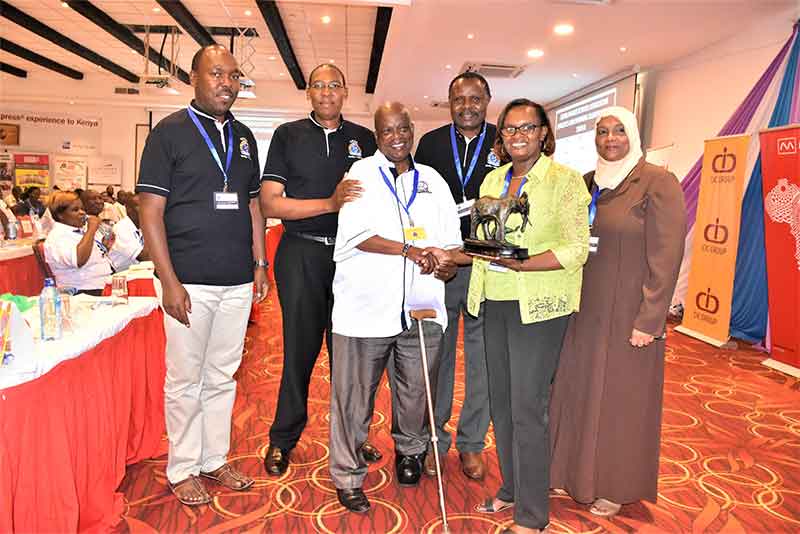
Kenya Private Schools Association leadership

By James Wakahiu
Worth Noting:
- Organization refers to how activities like task allocation, coordination and supervision are directed towards achievement of the institution’ aims and goals “The organizational structure affects a school’s action and provides the foundation on which standard operating procedures and routines rest. The governance itself is not an activity but a process; the decision-making process within an organization,” she said.
- “The educational managers’ traditional roles are planning, organizing, directing, and controlling the activities of the institution. They deal with planning and making policies. In contrast, educational administrators mainly implement the policies made by their managers. Effectively, school administrators a thus considered an aspect of management process but have lower order duties since they deal with implementing directives given by managers,” she said.
There is a season for everything. A season for planting and a season for harvesting; a time to be happy and a time to mourn.
For the Kenya’s teachers, the season to pools change curriculum and how schools operate has arrived. “We should be able to know when seasons shift; thus when there is need for a pause to re-evaluate things and navigate ways forward,” Ms Mary M. Olubayi, Secretary of the Kenya Private Schools Association (KPSA), Nairobi County has told a national conference of primary school managers in Mombasa.
President William Ruto recently directed that the Grade 6 Kenya Primary School Education Assessment (KPSEA) examination shall not be used to determine the placement of pupils to Junior Secondary School (JSS) under the new Competency Based Curriculum (CBC). The policy was recommended by the Presidential Working Party on Education Reforms to evaluate the CBC system and make recommendations submitted its preliminary report.
According to Ruto, KPSEA will instead be used to scrutinize learning progress and provide feedback to education sector players on areas of the Competency-Based Curriculum (CBC) that require intervention. The President further directed that the junior secondary schools – Grade 7, Grade 8 and Grade 9 – be domiciled in primary schools. “The Ministry of Education will provide the necessary guidelines on how this will be done,” State House said in press statement.
“The time is now for us to consider all these things and work out a way forward,” Olubayi said at ongoing 18th Kenya Primary Schools Headteachers Association (KEPSHA) annual general meeting and conference at Shaikh Zayed Children’s Centre in Mombasa.
“This means school heads must start learning and adopting new management methods. They have to understand the different roles of school leaders, managers and administrators. The organization structures of the schools should be looked into afresh and if necessary changes should be introduced,” Olubayi is also a director at St Nicholas Junior Academy, Teacher TC and College of Professional Studies based in Nairobi, said.
Organization refers to how activities like task allocation, coordination and supervision are directed towards achievement of the institution’ aims and goals “The organizational structure affects a school’s action and provides the foundation on which standard operating procedures and routines rest. The governance itself is not an activity but a process; the decision-making process within an organization,” she said.
“The educational managers’ traditional roles are planning, organizing, directing, and controlling the activities of the institution. They deal with planning and making policies. In contrast, educational administrators mainly implement the policies made by their managers. Effectively, school administrators a thus considered an aspect of management process but have lower order duties since they deal with implementing directives given by managers,” she said.
Leadership on the other hand implies an influence relationship to achieve expected and stated goals. “It deals with higher order duties designed to improve staff, learners and school performance hence it focuses on people,” she said.
Olubayi tipped the tutors to identify, know and align their purposes to those of the schools they lead. “Look at the bigger picture and remember it’s not about you; your bus has other stake holders and owners: learners, parents, teaching a non-teaching staff. There is also a parents’ association, the school’s Board of Management and the surrounding community,” she added.
The school manager told the headmasters and headmistresses to learn to keep things moving at a faster rate. ; “Board meetings should stick to the agenda, minutes and reports issued well and advance so as to stick to recommendations thereto,” she said.
Above all, she said, the head teachers should aspire to be ethical and truthful financial reporting. “Plans alone do not determine your organization’s future; practice does,’ she said.
Opening the forum earlier, the new Basic Education Principal Secretary Belio Kipsang’ dropped a bombshell when he announced that the government will from January do away with boarding primary schools for pupils learning in Grades 1 to 9. The net effect of the radical policy means that pupils transiting to Junior Secondary Schools will join day schools in their home areas. The government will from January 2023 do away with boarding primary schools for pupils learning in grades 1 to 9.
The PS was speaking when he officially opened the annual meeting where primary school heads from all 47 counties have congregated for the five day conference.
Similar Posts by The Mt Kenya Times:
- Diaspora Times Global Aug 29 – Sep 5, 2026
- When soldiers turn on the junta they helped create
- Educational empowerment: A non-negotiable investment in Kenya’s future
- What aging parents want their adult children to understand
- Zimbabwe to roll out emotional learning programme to all 72 districts
About the Author