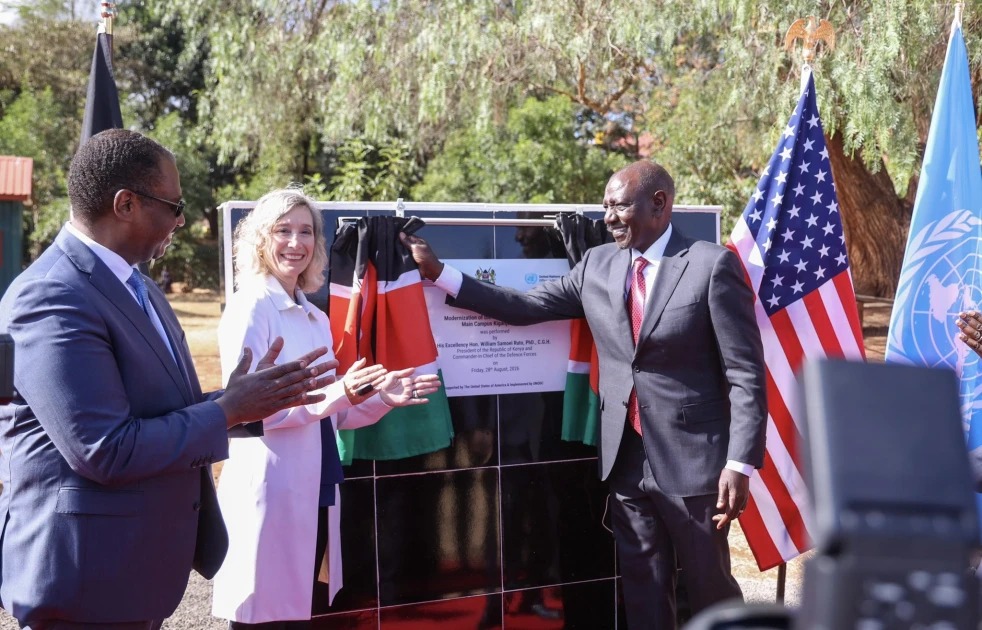
President William Ruto wiith the United States Chargé d’Affaires to Kenya, Ms. Susan M. Burns at the Kenya Police Training College in Kiganjo.
Washington’s investment in Kenyan policing arrives as Ruto unveils new uniforms — but the deeper question is whether reform can outpace the country’s troubled security history.
By David Kimani
The United States government yesterday launched a KSh930M initiative to modernise and professionalise Kenya’s police service, unveiled at the Kenya Police Training College in Kiganjo, Nyeri County, during a ceremony at which President William Ruto presided over the graduation of more than 6,000 new officers.
The $7M programme, announced by the US Embassy in Kenya, marks one of Washington’s most significant direct investments in Kenyan security sector reform in recent years. It arrives at a politically charged moment — twelve months before Kenya’s August 10, 2027 general election, in a country where the conduct of its police force remains one of the most contested questions in public life.
“We believe well-trained officers can best protect and serve their fellow citizens. Safety is vital for Kenyan and American businesses operating here,” the US Embassy said. “This is why we are proud to launch a $7 million initiative today at the Police Training College in Kiganjo to support Kenya’s pursuit of a modern, professional, and effective police service.”
The programme signals that the United States views police reform in Kenya not merely as a domestic governance matter but as a strategic interest tied to trade, investment and regional stability. Kenya hosts one of the largest US embassies on the African continent and remains a critical partner in Washington’s East Africa security architecture. American businesses with operations in Nairobi and beyond have a direct stake in whether Kenya’s streets are safe and its institutions trustworthy.
The timing is layered with significance. Ruto also used yesterday’s ceremony to unveil new uniforms for the Kenya Police Service as part of a broader rebranding exercise — a move that drew immediate scepticism from the opposition. Wiper leader Kalonzo Musyoka was pointed in his criticism, noting that the previous uniform had itself been changed only eight years ago. “Kenyans want the police trained on how to change the way they serve Kenyans, not how to wear uniforms. They should be humane in their service delivery,” Musyoka said.
That tension — between symbolic gestures and structural change — sits at the heart of Kenya’s policing debate. Human rights organisations have documented repeated patterns of excessive force, with security agencies implicated in the deaths of protesters during the 2024 and 2025 Gen Z demonstrations, in which at least 127 people were killed. Public trust in the police remains fragile, and with the election season gathering pace, how the force conducts itself over the next twelve months will matter enormously — both politically and constitutionally.
The US initiative, which focuses on training, professionalism and institutional effectiveness, is precisely the kind of long-term structural investment that reform advocates have called for. Whether KSh930M and American technical expertise can shift entrenched institutional culture within a politically sensitive timeframe is a question that will be answered not in Kiganjo’s parade grounds — but on Kenya’s streets.
Similar Posts by The Mt Kenya Times:
- Mt Kenya Times ePAPER October 17-18, 2026
- Ruto bets billions on Kerio Valley — with one eye on 2027
- Ruto’s health ministry kills Murang’a’s digital hospitals
- Kenya bets on Mount Kenya to drive a billion-shilling tourism revival
- Do you have a wealth vision? Or are you just working until you die?
About the Author