Old Mutual swings to KSh882M profit as insurance arm ends losing run
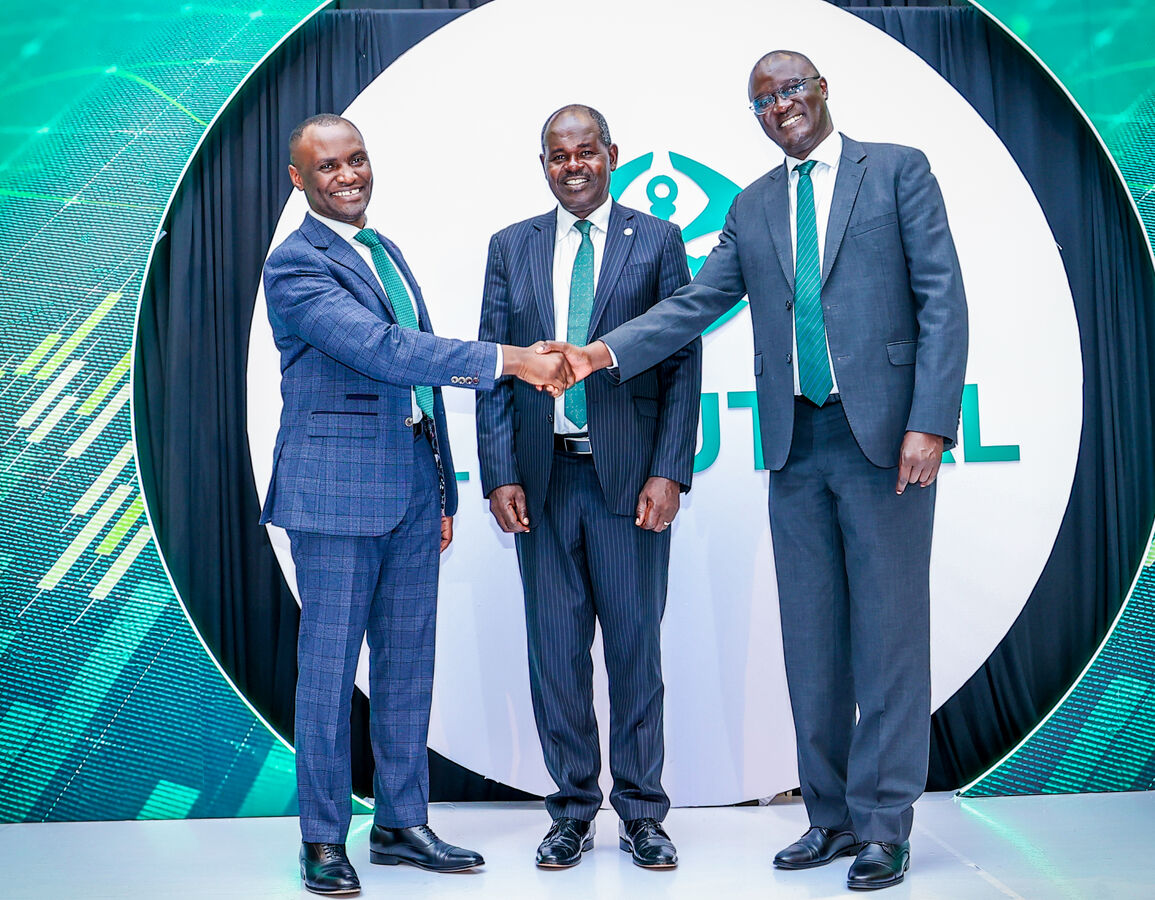
From left, Isaiah Gakonyo, Chief Operating Officer, Dr. Habil Olaka (EBS), Chairman and Non-Executive Director, and Arthur Oginga, Group Chief Executive Officer, Old Mutual Holdings PLC, during the announcement of the company's financial results.
A dramatic turnaround in underwriting performance and surging assets under management have restored confidence in Kenya’s oldest diversified financial group.
By Waceke Joan
Old Mutual Holdings Plc yesterday reported a profit after tax of KSh882M for the six months ended June 30, 2026, a near-miraculous recovery from the KSh5M profit recorded in the same period last year, driven by a sharp reversal in its insurance business and robust growth across its investment and asset management operations.
The results, released in Nairobi, mark the most significant turnaround the Nairobi Securities Exchange-listed group has delivered in recent memory, arriving at a moment when the broader insurance industry continues to grapple with compressed underwriting margins and an increasingly competitive financial services landscape.
The headline figure is striking enough. But the story behind it is more instructive. The insurance service result — the core measure of whether an insurer is actually making money from the business of insuring — swung from a loss of KSh303M in the first half of 2025 to a profit of KSh287M in the equivalent period this year. That is a KSh590M turnaround in twelve months, achieved through what the group describes as focused claims management, tighter underwriting discipline and rigorous cost control across all business lines.
Group Chief Executive Arthur Oginga said the performance reflects the group’s strategic intent rather than a favourable market accident. “Our performance demonstrates the progress we are making in executing our strategy and delivering on our long-term ambitions. We will continue to enhance this performance through new growth engines and a focus on a value-led rather than a volume-led business,” Oginga said. He added that the group’s ambition remains unchanged: to become customers’ first choice for sustaining, growing and protecting their prosperity, guided by strategic pillars of lifestyle and wellness, technology and digital transformation, sustainability, strategic partnerships and customer experience.
The investment business delivered equally encouraging numbers. Net investment results rose 16 per cent to KSh1.9B, up from KSh1.7B in the corresponding period, supported by selective allocation to higher-yielding instruments, asset-liability matching initiatives and disciplined liquidity management. The group has clearly been deliberate about where it places its money — and that deliberateness is beginning to show in the numbers.
Perhaps the most eye-catching metric is the growth in assets under management, which expanded by 32 per cent over the period. That expansion drove a 34 per cent rise in commission income, contributing to total commission, fees and other income of KSh1.6B. When an asset manager grows its AUM by nearly a third in six months, it suggests that clients are entrusting the group with more capital — a vote of confidence that goes beyond what any quarterly earnings announcement can manufacture.
Group Chief Financial Officer Isaiah Gakonyo was measured but firm in his assessment. “Our first half performance reflects disciplined execution across the group, delivering improved insurance profitability, stronger net investment results, and sustained growth in asset management. These outcomes demonstrate the effectiveness of our strategic interventions in strengthening earnings quality and resilience,” Gakonyo said. He identified asset-liability management, cost optimisation, balance sheet restructuring and targeted technology investments as the pillars sustaining the improvement.
The group’s chairman, Habil Olaka, offered the most forward-looking commentary, and the one that shareholders will have read most carefully. Olaka said the board’s priority is to ensure that the first-half improvement translates into sustained long-term profitability rather than a single-period anomaly. “We are strengthening the group’s businesses, balance sheet and operating model to build greater resilience and create sustainable value for shareholders,” he said. He added that as profitability and the group’s financial position continue to improve, the board’s ambition is to create the capacity for sustainable shareholder distributions — including the future resumption of dividend payments, subject to the group’s financial position and applicable regulatory requirements.
That last sentence will have been noted. Old Mutual has not paid a dividend in some time. The chairman’s language suggests the pathway back to regular distributions is being cleared, even if no timeline has been set.
For a group that entered 2025 with its insurance arm bleeding and its profitability barely registering, the first half of 2026 reads like the opening chapter of a genuine recovery story. The second half will determine whether that story holds.
Similar Posts by The Mt Kenya Times:
- Dr. Ekrah Ndung’u wins TVET advocacy award after 12 years
- Mt Kenya Times ePAPER October 17-18, 2026
- Ruto bets billions on Kerio Valley — with one eye on 2027
- Ruto’s health ministry kills Murang’a’s digital hospitals
- Kenya bets on Mount Kenya to drive a billion-shilling tourism revival
About the Author