Nyeri Farmers Earned Sh7 Billion from Various Livestock Farming Engagements

A milk cooling plant

By Our Correspondent
Worth Noting:
- In the county, the poultry industry comes second in production with an estimated population of 950,000 birds, followed by sheep at 162,785 and goats (dairy and meat). Indigenous poultry continues to play an important role as an income-generating activity, especially in poor to average households.
- Dairy goat keeping continued to rise, especially due to support from the County, which has been assisting farmers with breeding bucks and does. Other enterprises like beekeeping are slowly picking through honey production.
- On the other hand, rabbit keeping continues to be silent with very nominal growth in the enterprise, probably due to a need for a coordinated market for rabbit meat and products.Farmers from Nyeri County practicing in various livestock sectors earned more than Sh7 billion in the last financial year.
The dairy sector continues to be a major enterprise in the area with 193,310 dairy cows where about 80 per cent of the rural household keeps at least a dairy cow. These animals are kept mainly in zero-grazing and semi-intensive systems, especially in Kieni constituency.
During the last financial year that started in July 2021, ending in June last year, an estimated 127.9 million litres of milk worth Sh5.1 billion were produced.
Most of it was sold formally through dairy cooperatives and self-help groups within the County.
In this period, milk prices oscillated between Sh36 and Sh40 at the processor level to Sh 34 to Sh38 per litre for the farmer.
Most dairy animals are crosses of the main dairy breeds like Friesian, Ayrshire, Guernsey, and Jersey.
During the period under review, 25 cooperative societies and 37 self-help groups were active in marketing the milk across the County, mainly feeding into the processors.
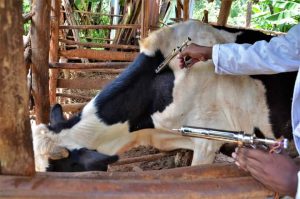
In the county, the poultry industry comes second in production with an estimated population of 950,000 birds, followed by sheep at 162,785 and goats (dairy and meat). Indigenous poultry continues to play an important role as an income-generating activity, especially in poor to average households.
Dairy goat keeping continued to rise, especially due to support from the County, which has been assisting farmers with breeding bucks and does. Other enterprises like beekeeping are slowly picking through honey production.
On the other hand, rabbit keeping continues to be silent with very nominal growth in the enterprise, probably due to a need for a coordinated market for rabbit meat and products.
On meat production, estimated revenue of Sh1.9 billion was generated from selling various livestock products like beef, chevon, mutton, poultry meat, pork, eggs, and honey.
Nyeri County is a beef deficit zone; therefore, most of the animals slaughtered are sourced from neighboring rural counties of Laikipia, Isiolo, and Samburu.
The average price for beef is Sh500 per kilogram while that of mutton and chevon is Sh550, pork pricing at Sh400 with poultry meat going Sh500 as the average price per tray of eggs being Sh360 and that of refined honey settling at Sh1,000.
On extension activities, the County Government of Nyeri resumed normal training programs and methodologies with the relaxation of observance to some of the Covid-19 protocols like wearing of masks.
Extension activities were conducted by the Department of Agriculture, Livestock & Fisheries using favorable approaches like;
Outdoor group training, Office consultations and issue resolution.
Others were demonstrations, individual farm visits and Field days.
Other key activities and events involved collaboration meetings and workshops with projects like Kenya Climate Smart Agriculture Project (KCSAP) in the sourcing of breeding stock and equipment for CIGs, Agricultural Sector Development Support Programme II (ASDSP II) in capacity building of farmers, National Drought Management Authority (NDMA) in food security assessment survey, Small Holder Irrigation and Value Addition Project (SIVAP) and climate Smart Agriculture-FAO (CSA) in implementation of activities geared towards mitigating against the effects of climate change.
Other partners included World Vision, 2Scale, and Advanta, which operated in some sub-counties localized areas. The above also gave much logistical support in ensuring the farmers were reached. They also organized the capacity building of technical officers on various capacity gaps. This, contributed to up scaling livestock production and productivity, enhancing food security, increasing household incomes, and improving living standards.
On Pasture and fodder Conservation, the 2021-2022 financial year was generally hot and dry across most parts of the County, with a few sub-counties experiencing slightly wet days while others were cold but dry. This, in turn, impacted negatively on the pastures and browsed with very little regeneration, which translated to low performance of the livestock sector in terms of productivity for the better part of the year.
Kieni was most affected, especially Mugunda, Mweiga, and Gatarakwa wards in Kieni West, Naromoru/Kiamathaga, Gakawa, Thegu river and some parts of Kabaru wards in Kieni East, Rutune in Rugi ward, Mukurweini Central and Kiganjo in Nyeri Central.
The livestock feed reserves needed to be improved in most parts of the county while natural pastures got depleted, especially in Kieni. Prices of feeds from the stockists were equally the concentrates’ quality was a big issue as most farmers reported poor results. Since the outbreak of Covid-19, the availability of quality raw materials has been low, prompting the limitation of important nutrients during feed formulation, thus the complaints on quality and performance.
Internal movement of local herds in search of water and pasture was evident as pastures dwindled, and some water-holding structures went low or dried.
This was particularly so in Kieni and parts of Mathira. The period under review also registered the influx of herds and flocks of immigrating livestock from neighboring counties of Laikipia, Samburu, and Isiolo into Kienis in search of pastures and water.
An estimated 5,000 livestock grazing and watering in Kieni for the better part of the year.
Their entry triggered resource-based conflicts initially, but later the issues were settled through dialogue.
Disease outbreaks, especially Foot and Mouth Disease (FMD), were also common.
Livestock body condition for all livestock species ranged from fair to poor for the better part of the year, with a few farmers having their animals in good body condition, which is mainly attributed to the availability of resources to buy feeds and the use of alternative feed sources.
During the period, the livestock industry, especially milk production, recorded a drop and a decrease in productivity for other species as feed reserves continued to dwindle.
In general, the livestock sector could have performed better. Still, with initiatives and support by the county government, national government projects and other stakeholders continued to cushion farmers against the effects of bad weather.
During the period, several farmer groups also benefited through empowerment and procurement of breeding stocks, the establishment of livestock infrastructures, and also by dissemination of appropriate technologies extensively through farmers’ groups’ training mainly by county government of Nyeri, KCSAP, SIVAP, ASDSP II, 2 Scale, and Upper Tana projects among others.
Further, the directorate was involved in other activities including seminars, stakeholder planning meetings, development of weather advisory bulletins for MAM rains, and development of the Nyeri County Contingency Plan through support from NDMA.
Similar Posts by The Mt Kenya Times:
- Mt Kenya Times ePAPER October 26, 2026
- Sakaja challenges Kamukunji police over Eastleigh suspect bail
- Muturi demands binding livestreaming rules for 2027 polls to prevent repeat of 2022 chaos
- NTSA calls for road safety to be declared a national disaster after 24 die in Mtito Andei crash
- Ruku turns on Waiguru over deputy president ambitions: ‘That seat is not being contested for’
About the Author