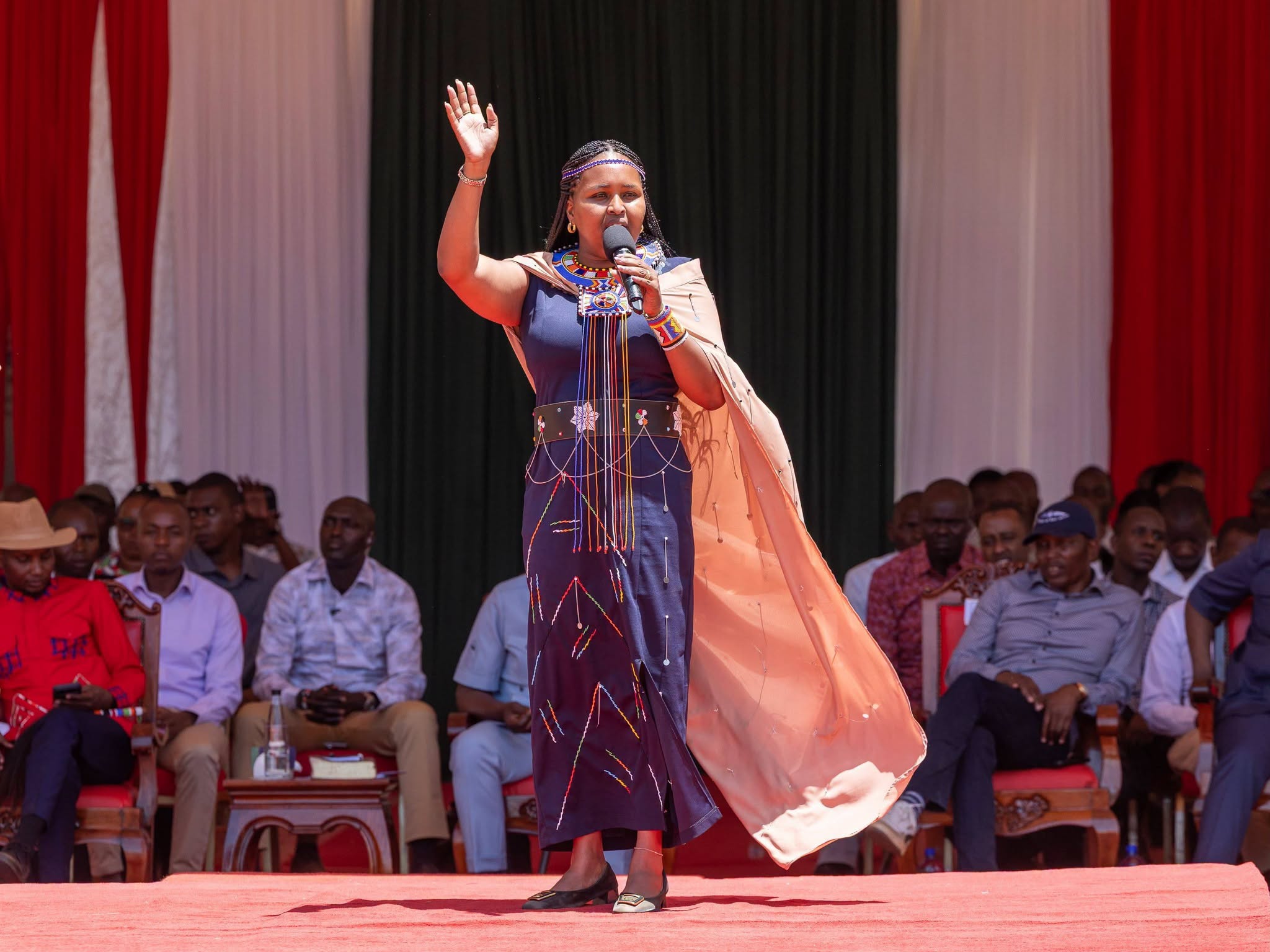
Samburu West MP Naisula Lesuuda
The first woman ever elected to represent Samburu West has joined Ruto, and the calculation behind the move runs deeper than development
By Grace Wanja
Samburu West MP Naisula Lesuuda publicly broke with the Azimio coalition yesterday and declared her support for President William Ruto, telling him at a thanksgiving ceremony in South Horr that she was the last holdout in Samburu to cross over — and that the government’s development record, not political pressure, had finally brought her across.
The declaration landed in a room already primed for political theatre. Ruto had travelled to South Horr for a thanksgiving service honouring Devolution Principal Secretary Michael Lenasalon, attended by Samburu Governor Jonathan Lelelit and a gathering of political leaders from northern Kenya. Into that setting, Lesuuda offered the President something worth considerably more than applause: a public break with the coalition she had stood with since 2022, delivered on his terms, in front of his audience.
“I remained in Azimio, and I saw my leaders here like Leuton putting pressure on me every day. My sister Soipan and others were putting pressure on me, but it wasn’t actually them who pressured me. It was the work that you have done for Kenyans,” Lesuuda told Ruto. The distinction she was drawing — between political inducement and policy persuasion — was careful and clearly rehearsed. In Kenyan political culture, where defections are routinely explained as acts of principle and routinely understood as acts of calculation, the framing matters as much as the fact.
Lesuuda is not an ordinary defector. She entered elective politics as a nominated senator in 2013 and went on to win the Samburu West parliamentary seat in 2017 on a KANU ticket — becoming the first woman ever elected to represent the constituency. She retained the seat in 2022, again on KANU, cementing her reputation as one of the party’s most capable and recognisable leaders in the north. When KANU, under Gideon Moi, joined Raila Odinga’s Azimio la Umoja coalition ahead of the 2022 election, Lesuuda went with it. She served on Azimio’s national executive council and publicly defended the coalition’s rationale.
That is the political history she walked away from yesterday in South Horr. The walk was deliberate, the timing precise, and the implications for both KANU and the broader opposition calculation are not trivial.
For Gideon Moi, Lesuuda’s move presents a problem that goes beyond losing a single legislator. KANU has been trying to navigate an increasingly uncomfortable position — nominally within Azimio while individual members drift towards Kenya Kwanza. Lesuuda’s public declaration accelerates that erosion and makes it harder for Gideon to present KANU as a coherent political vehicle ahead of 2027. Although she remains listed as a KANU MP, her alignment with Ruto creates a practical split that formal party membership cannot paper over.
For Ruto, the calculus is straightforwardly positive. Samburu County sits in the arid north — a region defined politically by pastoralist identity, insecurity, and decades of marginalisation from the mainstream development agenda. Lesuuda’s endorsement does not merely add a vote in the National Assembly. It signals to pastoralist communities in Samburu and beyond that the administration is delivering enough on the ground for leaders who have been openly critical to change their position publicly. That signal travels.
She made a point of enumerating what had changed. The upgrading of a hospital to a referral facility. Appointments of Samburu residents to senior government positions. School capitation funds arriving in classrooms on time — a detail she was careful to ground in her role on the National Assembly Budget Committee, giving it institutional weight rather than political spin. “During your time, capitation funds arrive in schools on time,” she said. “I can state that as an MP and as an individual because sometimes it is easier to just tell lies to be popular, but continue doing what you are doing for Kenya.”
Lesuuda also used the platform to raise the issue that most directly affects her constituency’s daily life — banditry and insecurity. On 11 July, armed raiders killed three civilians in Samburu West in a single attack. Lesuuda called on Ruto to intensify security operations and facilitate the return of families displaced by repeated attacks. The dual message she delivered in South Horr — joining the government while also making a demand of it — is a reminder that her calculation involves leverage, not simply loyalty. She was not simply endorsing a president. She was notifying one of what he now owes her people in return.
That backdrop matters when reading the larger political landscape heading into August 2027. Kenya’s pre-election period is shaped by the same dynamics it always has been: development delivery as the currency of political allegiance, and regional leaders as the brokers who translate that currency into votes. What has changed is the pace. With the election eleven months away and the opposition’s ticket question still unresolved, leaders across every county are making their calculations faster and more openly than usual. Those aligned with the government can point to projects, appointments, and funds. Those outside it are betting that a unified opposition can still overturn the arithmetic of incumbency.
Lesuuda has looked at both sides and made her choice. She was direct about what she expected the reaction to be. “It is not for any other reason even if politicians say we are liars or that we are just seeking favours from you. Today the priest has said that work has been done,” she told Ruto.
There is also a dimension the South Horr crowd understood even if it went unstated. Lesuuda has made no secret of her ambitions for the Samburu County gubernatorial seat in 2027. Running for governor requires a political base that can survive a tough county-wide contest. Alignment with the administration — and the access to resources and goodwill that comes with it — is not irrelevant to that calculation.
“Let us push Kenya forward, let us roll the wheel forward, and let me join hands to help these others so that all of Samburu is behind you,” she told Ruto.
Whether all of Samburu follows remains to be seen — but the first woman to win Samburu West has made her position plain enough.
Similar Posts by The Mt Kenya Times:
- Direct hospital access to KEMSA cuts drug delays, says PS
- Africa can’t wait: Continent seeks $1 trillion for climate adaptation
- Ruto passes the baton as Africa’s trade bloc faces a fragmenting world
- Kenya’s recall law: Parliament sets the threshold — but the real test comes in 2027
- Kenya’s deadliest bridge to be replaced in KSh7.5B project
About the Author