Kenya’s recall law: Parliament sets the threshold — but the real test comes in 2027
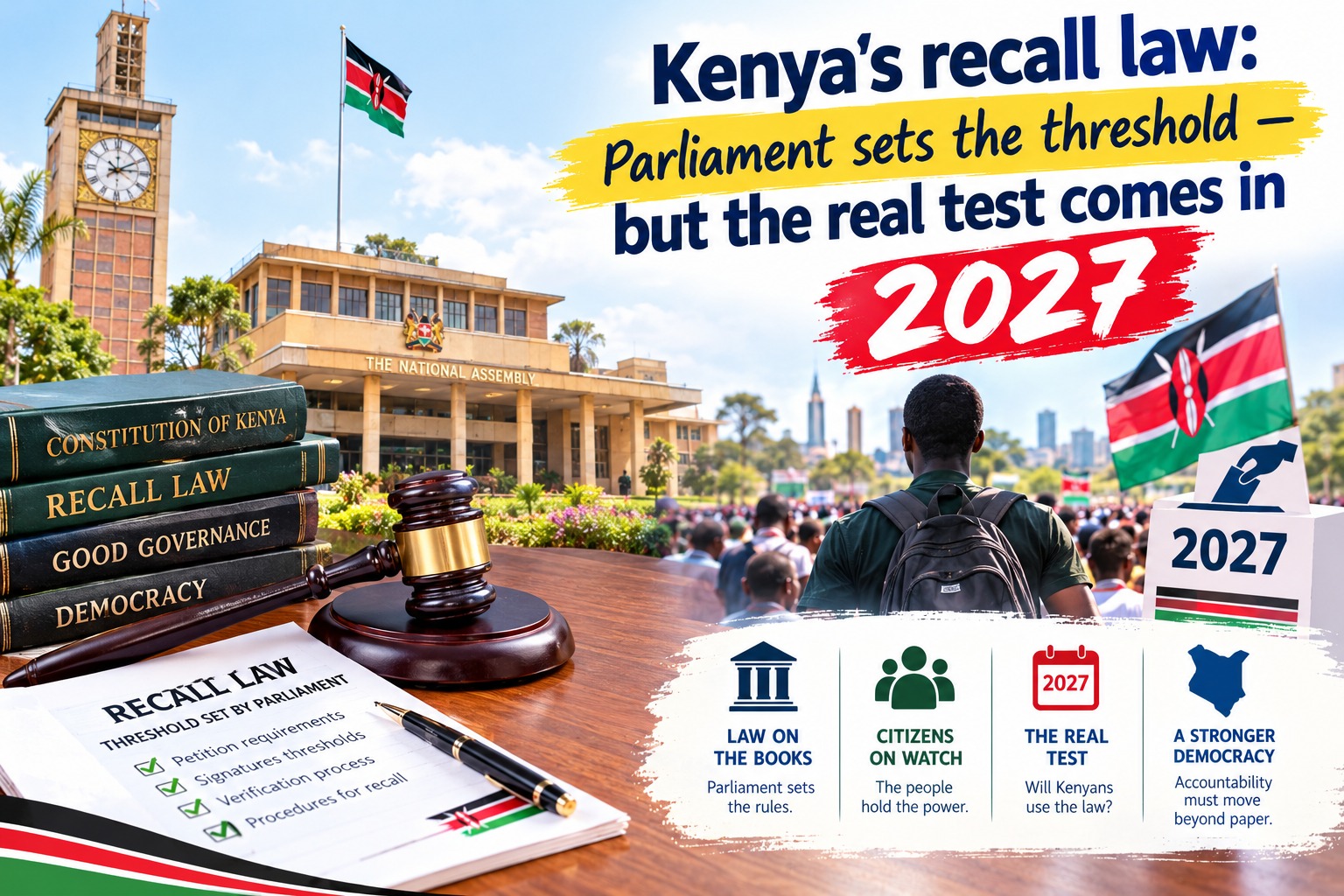
The National Assembly has passed a one-third voter threshold to recall MPs, but in an election year already thick with political manoeuvring, the law’s true purpose may be less about accountability than survival.
By David Kimani
The National Assembly yesterday approved a one-third registered voter threshold required to recall a sitting member of parliament, passing amendments to the Elections Amendment (No. 2) Bill that will now return to the Senate for concurrence — and almost certainly mediation.
The legislation, Senate Bill No. 29 of 2024, has been navigating parliament at a moment of acute political sensitivity. Kenya is less than ten months from general elections scheduled for August 2027, and the debate over how easily — or how difficultly — a sitting MP can be removed from office carries implications that extend well beyond constitutional housekeeping. In a parliament where alliances are shifting, where the government of President William Ruto faces growing opposition pressure and where several incumbents are calculating their survival odds, the precise wording of a recall threshold is not an academic exercise. It is a political instrument.
Under the revised Clause 26A, a recall election for a National Assembly member will require the support of at least one-third of registered voters in every ward within the affected constituency. For a senator, the threshold rises to at least one-third of registered voters in every constituency within the affected county. A recall by-election, should one be triggered, will be decided by a simple majority of those who vote. The Bill now goes back to the Senate, and given the divergence between the two Houses, a mediation committee will be required before it proceeds further.
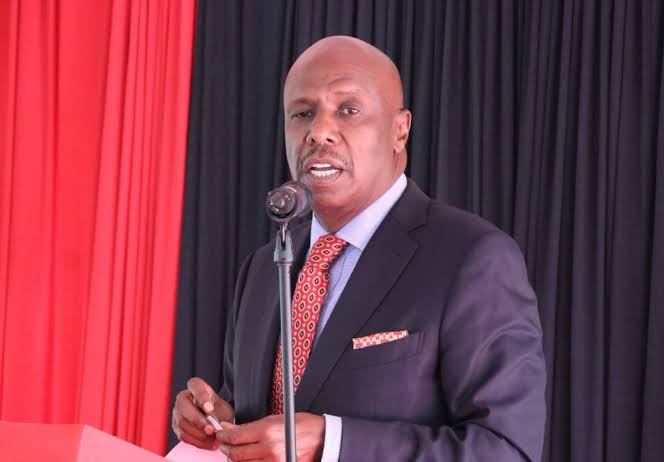
The debate that produced this outcome was candid, occasionally blunt and instructive about the anxieties that animate Kenya’s legislative chamber in the months before an election cycle. The initial proposal, moved by Kigumo MP Kimani Kuria, had set the threshold at 50 per cent of registered voters in every ward — a figure that critics immediately identified as prohibitively high and legally vulnerable. Minority Leader Junet Mohamed was direct about the risks. “If we repeat what the court has rejected, we will just be legislating in vain because the thing will go back to court again and the court will reject it again for the same reasons,” he told the House, invoking the 2017 High Court ruling that struck down the previous recall framework as unconstitutional.
That judgment, in Katiba Institute and Transform Empowerment for Action Initiative v Attorney-General, invalidated sections 45 through 48 of the Elections Act, citing discriminatory restrictions on who could initiate a petition and structural defects in the statutory procedures. Parliament has been attempting to fill that legal void ever since. The stakes of getting the threshold wrong a second time are therefore significant — not merely politically embarrassing but potentially rendering the entire framework unenforceable once again.
Majority Leader Kimani Ichung’wah made the arithmetic case against the 50 per cent proposal with a clarity that drew applause from several benches. “In any case, many of us are not elected by 50 per cent of the registered voters in each ward — facts of life,” he said. His argument was simple: requiring a recall to clear a bar that the original election itself did not reach is not accountability — it is immunity by another name. “To convince in every ward, including your home ward, a third of your voters that you should go home, then it would mean there’s something absolutely wrong that you have done to the people,” he added.
West Mugirango MP Stephen Mogaka moved the amendment that ultimately restored the one-third threshold, replacing Kuria’s 50 per cent proposal. The amendment was adopted, and Kuria subsequently supported the revised version, clarifying that the one-third requirement applied to triggering the recall process while the simple majority provision would determine the outcome of the resulting by-election.
Not all voices were comfortable with how the debate was being conducted. Suba North MP Millie Odhiambo supported the recommittal of Clause 26A for further consideration but issued a pointed warning about the legislative culture surrounding emotionally charged votes. “I don’t pander to issues of populism, and because of that, I reluctantly support — but we need to be very serious when we are dealing with issues like this,” she said. “Sometimes we are too excited and we shoot ourselves in the foot.”
Her caution is well-placed. The recall mechanism being constructed now will operate in the political environment of 2027 — an environment that is already shaping up to be among the most contested in Kenya’s recent history. Ruto faces a re-election campaign against an opposition that has consolidated around former Prime Minister Raila Odinga and his Azimio coalition, while fractures within the Kenya Kwanza alliance have produced a landscape in which loyalty is transactional and political realignments are frequent. In that context, a recall law that is too easily triggered becomes a weapon available to well-resourced opponents; one set too high becomes a shield for underperforming incumbents.
Homa Bay Town MP Peter Kaluma, who had earlier called for the clause to be recommitted on the grounds that an unclear threshold could expose MPs to recalls initiated by a single petitioner, struck a considered note about the mediation process ahead. “Let us use the period between now and the time the Bill will be before the mediation committee to clean it up, but pass it as it is for now,” he said. He urged his colleagues to balance the public’s constitutional right to remove a non-performing representative against the need to prevent the mechanism from becoming a tool for routine political disruption. “On one level, we should not make it difficult for the people of Kenya to recall their elected representative; but at another level, we should make it very difficult so that we alert the people of Kenya when they are conducting elections to do that consciously.”
The legislation is an attempt to operationalise Article 104 of the Constitution, which has existed as a right on paper since 2010 but has never been successfully exercised. For Kenyans frustrated by representatives who disappear between election cycles, the passage of a workable recall framework would represent a meaningful democratic advance. For MPs watching the political weather ahead of 2027, the precise calibration of that framework matters enormously.
The mediation committee will have to reconcile the Senate and National Assembly positions before the Bill can proceed to presidential assent. Whatever emerges will then face the scrutiny of courts that have already once found Kenya’s recall law wanting.
Parliament has set the threshold. Whether it has set it correctly — and whether the law will survive legal challenge — will only become clear when someone actually tries to use it.
Similar Posts by The Mt Kenya Times:
- Mt Kenya Times ePAPER October 24-25, 2026
- Muturi calls on IEBC to keep election technology tender clean and on schedule
- Ruto meets UAE minister in push to deepen trade ties
- Gideon Moi breaks silence on Ruto fallout, cites broken promises
- The doctor who refused to abandon a sick Uganda
About the Author