Muturi calls on IEBC to keep election technology tender clean and on schedule

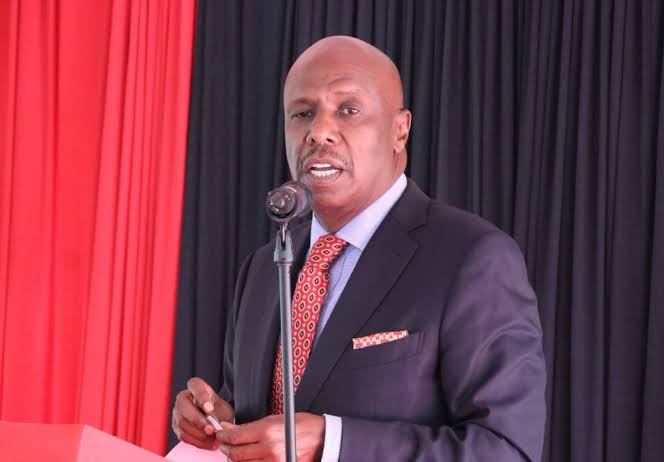
Democratic Party of Kenya leader Justin Muturi
With six bids on the table and 2027 closing in fast, the Democratic Party leader warns that procurement shortcuts now will cost Kenya dearly at the ballot box
By Jane Njeri
Democratic Party of Kenya leader Justin Muturi urged the Independent Electoral and Boundaries Commission yesterday to conduct a rigorous, transparent evaluation of six bids received for the country’s Integrated Electoral Management System and to resist any pressure to abandon the competitive process in favour of direct procurement ahead of the 2027 General Election.
The bids, opened on Wednesday, covered the supply, installation, testing, commissioning and maintenance of IEMS hardware and accessories — the technological backbone of Kenya’s electoral infrastructure. The price spread among the six suppliers was striking. Greencom Enterprise Solutions submitted the lowest bid at KSh 1.5B, followed by Laxton at KSh 10.3B, China Hainergy New Energy Corporation at KSh 12.5B, Miru at KSh 14.3B, Smartmatic at KSh 19.3B and Haitek Limited at the top of the range with KSh 22.3B. Muturi was careful to note that these figures represent opening prices, not final rankings. “The prices announced during the opening should not be mistaken for the final evaluation ranking,” he said, adding that the successful bidder would emerge only after preliminary, technical and financial assessments were completed.
His intervention came after a procurement process that had already survived legal challenges before the Public Procurement Administrative Review Board. Muturi commended the IEBC for pressing ahead despite those petitions. “We write to commend the Commission and its Secretariat for bringing this critical procurement to a successful tender opening on 22 October 2026,” he said, while simultaneously putting the commission on notice that the hard work of transparent evaluation still lay ahead.
The core of Muturi’s message was a warning against two threats he regards as equally dangerous: bad-faith review applications designed primarily to stall the process, and the temptation to sidestep competition altogether. On the first, he acknowledged that bidders have a legal right to challenge procurement decisions but said the IEBC’s best defence was a meticulously documented evaluation that applied published criteria consistently and without favour. On the second, he was categorical. “Having supplied the Commission before is not, by itself, a ground for direct procurement,” he stated, arguing that the six submitted bids demonstrated a functioning competitive market for the required technology. Any move toward direct procurement, he added, would need to satisfy the conditions set out under Sections 103 and 104 of the Public Procurement and Asset Disposal Act — a high threshold that existing market competition would make very difficult to meet.
Muturi grounded his demands in constitutional language, invoking Article 227(1), which requires that public procurement be fair, equitable, transparent, competitive and cost-effective. He called on the IEBC to ensure that any contract award remained within the approved budgetary allocation and that price was weighed alongside all eligibility and technical qualification criteria. His list of specific procedural recommendations was detailed and deliberate: maintain written records of evaluation findings, notify all bidders of the outcome simultaneously, observe the mandatory standstill period before signing any contract and require evaluation committee members to declare conflicts of interest before the process advances.
He also called for physical verification of the technical specifications of proposed equipment, particularly biometric devices and fingerprint sensors, against samples submitted and the requirements contained in the tender documents. In a procurement of this scale and sensitivity, the gap between what a supplier promises and what it delivers is precisely where disputes — and, ultimately, electoral crises — begin.
The IEMS tender is one of several critical procurement processes the IEBC must conclude before polling day. Muturi specifically urged the commission to accelerate the separate tender for ballot papers, signalling concern that the overall procurement timeline is tighter than it may appear. With the General Election scheduled for August 10, 2027, the window for procurement, delivery, testing and deployment of electoral technology is narrowing.
The broader political context lends Muturi’s intervention added weight. Kenya is entering one of its most contested pre-election periods in recent memory. A mounting opposition comprising former Deputy President Rigathi Gachagua, former Vice-President Kalonzo Musyoka and Linda Mwananchi leader Edwin Sifuna is consolidating rapidly, and questions about the integrity of the electoral process — from the controversial Elections (Amendment) (No. 2) Bill’s removal of mandatory livestreaming to the management of technology procurement — have become central to the political conversation. In that environment, how the IEBC conducts itself over the coming months will shape not only the outcome of individual procurement decisions but the credibility of the election itself.
Muturi’s message to the commission was clear and carried the authority of a former Attorney General who understands procurement law in granular detail: transparency is not optional, documentation is non-negotiable and the IEBC’s credibility in 2027 will be built or broken in the decisions it makes today.
A clean procurement process will not, by itself, guarantee a credible election. But a compromised one will guarantee the opposite.
Similar Posts by The Mt Kenya Times:
- Diaspora Times Global Oct 24 – Oct 30, 2026
- America’s baby bust: U.S. birth rate hits record low as women choose later motherhood
- Literary Outreach Incubation Program Instills The Culture From Book Adaption To Spoken Words
- Why starting school too early is failing our children
- Who defines Africa’s destiny? The western lens, African compliance and the struggle for intellectual sovereignty
About the Author