
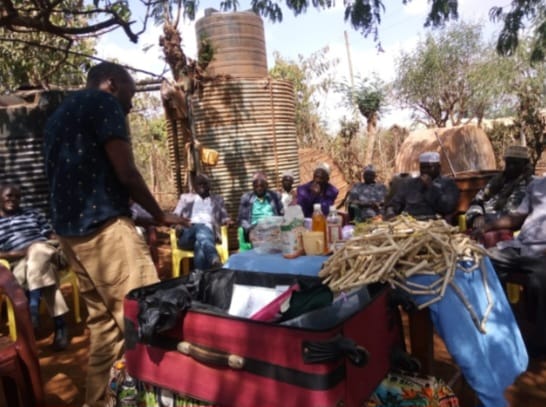
Dr Mwaniki and his team meeting Marsabit community leaders

By Our Correspondent
Worth Noting:
- According to Dr Mwaniki, some of the findings are summarized as; under optimal rain-fed conditions in the Semi-Arid areas, 1 Hectare of safflower will produce 1,500-3,000 Kg of safflower seeds and 100-200 Kg of dry safflower petals.
- These figures double up under irrigation conditions. 1 Kg of Safflower Kiama composite yields 300-400 mls of safflower oil. Between 30-70 days from germination, Safflower Kiama composite profusely produces a tasty vegetable which contains more proteins, minerals, vitamins than spinach, rape, or cabbage when sun-dried.
- Consequent to the above findings, on the recommendation by BUAN, farmers wishing to grow safflower in Botswana are eligible for government subsidy and rewards as a strategy for boosting food security and cutting the food import bill.

A Kenyan scientist based in Botswana is planning to change the economic wellbeing of the arid Marsabit region through farming of a drought resistant crop.
Dr Nelson Kiama Mwaniki hopes to use his scientific research to introduce the base and economical ways of farming Safflower which is botanically referred to as Carthamus Tinctorius.
This crop has been grown in major economies like China and India for millennia for its oil, dye and medicinal products production.
For the last 20 years, Modern Occupational Health and Training Services (MOHE), a Botswana registered private practice company owned by Dr Mwaniki, has been carrying out on-farm safflower research and development culminating in the discovery of a high performing seed variety known as the Safflower Kiama composite.
Further extensive scientific research on the Safflower Kiama composite has been conducted by the Botswana University of Agriculture and Natural Resources (BUAN) whose findings are widely published in international peer reviewed journals of Agriculture.
According to Dr Mwaniki, some of the findings are summarized as; under optimal rain-fed conditions in the Semi-Arid areas, 1 Hectare of safflower will produce 1,500-3,000 Kg of safflower seeds and 100-200 Kg of dry safflower petals.
These figures double up under irrigation conditions. 1 Kg of Safflower Kiama composite yields 300-400 mls of safflower oil. Between 30-70 days from germination, Safflower Kiama composite profusely produces a tasty vegetable which contains more proteins, minerals, vitamins than spinach, rape, or cabbage when sun-dried.
Consequent to the above findings, on the recommendation by BUAN, farmers wishing to grow safflower in Botswana are eligible for government subsidy and rewards as a strategy for boosting food security and cutting the food import bill.
In an interview, Dr Mwaniki revealed that additional unpublished On-farm research conducted by MOHE shows that; In 2009, 1 Ha of the Safflower Kiama composite, yielded 400 Kg of dry safflower petals under irrigation.
In February 2022, MOHE submitted a sample of dry petals to a Chinese Pharmaceutical company for undisclosed content analysis. Following the analysis, the company sent a Letter of Intention to buy 500,000Kg of dry Safflower Kiama composite petals per year from MOHE.
Further tests on the potential for commercial growing of Safflower Kiama composite for production of food colours were conducted in December 2022 by a leading food colour Multi-National Corporation laboratories in USA and Germany showing the EV food colour value of the Safflower Kiama composite to be 26 (acceptable range for commercial farming being 23-28) while the Safflomin A content was acceptable for commercial farming.
He further disclosed that Marsabit county is set to benefit first following a delegation that visited him in Botswana five years ago. The delegations which was led by then Deputy Government Solomon Gubo was on a visit for a benchmarking mission on the Botswana public health system.
During the interaction, MOHE made a presentation on the health and economic benefits of safflower which prompted the Deputy Governor to extend an invitation to Dr Mwaniki to visit Marsabit for the purpose of reviving the growing of safflower which was already in the Marsabit County Development Plan.
He visited Marsabit on February 18 this year with a team of four MOHE members where they met members of the Borana, Burji and Redille communities in two separate meetings in Songa and Badassa villages near Marsabit town with the help of local facebook contacts.
It is hoped that the successful completion of this project will enhance the much needed cohesion between the adversarial communities in Marsabit which have been long known to live in constant fighting for animal grazing grounds for their survival.
Dr Mwaniki noted that the project will be done in Marsabit, also as a way of honouring two great Kenyans namely David D. Wabera – the first African District Commissioner in North Eastern Kenya who was born in Marsabit (Wabera Street which connects the Kenya High Court and Mac Millan library in Nairobi is named after him) and Bonaya Godana both who lost their lives trying to reconcile their people.
Following the declaration of famine as a matter of national concern in Kenya, MOHE came up with the “Making Marsabit Food Secure (MMFSS Project) which is a 10 year project to replicate what MOHE is doing in Botswana whereby it will grow and process safflower products on 100 acres of land leased from the community land owners for the first 5 years. MOHE will then return the land (plus the developments) to the owners and provide consultancy and the necessary training on safflower farming for the remaining 5 years.
By the end of the project, the diverse Marsabit communities will be growing nutritious safflower products for themselves and their animals as well as selling safflower based relief food to the County Government and the World Food Programme.
The project will involve soliciting donor funds to enable fencing off the land, digging boreholes, setting up irrigation system, building the necessary farm infrastructure, purchase of farm implements and vehicles, growing, processing, packaging and marketing safflower products in an accountable manner which can be replicated in the rest of the county and beyond.
Similar Posts by The Mt Kenya Times:
- Two weekends, two fronts: How DCP is fighting on both sides of the Atlantic
- Kalonzo becoming a movement: The quiet storm that is scaring Ruto
- Sifuna climbing the mountain: Kenya’s political map is being redrawn
- Counting regions, chasing power: Kenya’s road to 2027
- When the tax math changed, Kenyans found their voice
About the Author



Good job dr Kiama and team