From being paid a peanut to successful poultry rearing Farmer, Robert Onsare
 The Mt Kenya Times
Robert Onsare feeding his chicken at his home-photo Elizabeth Angira
By Elizabeth Angira
Worth Noting:
- Mr Onsare interest in poultry farming began in 2014 when he was still in formal employment. He started by raising Kienyeji chickens for meat and eggs, then scaled up to egg production only.
- “I first bought 20 chicks from neighbors and within three months, many had died. I did not give up, and I bought another 100 kienyeji chicks and continued scaling up to 300 and by 2015 when I quit, I had 500 birds,” he said.
- After a few years, he realized that the demand for eggs was more than that of meat, so he shifted from kienyeji chicken to high breed broilers.
- However, he has had a passion for farming since childhood. And this passion kept him the reason as to why he decided to resign a job in one of the company.
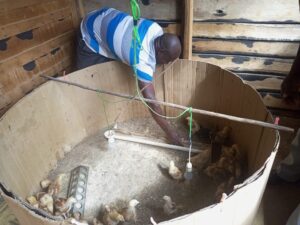
Everyone not only hopes to be part of a success story but also wants to be the one succeeding. That being the case, we have people taking part in various businesses. The aim is to achieve financial goals.
Robert Onsare a poultry farmer he is a successful farmer in Kisii County, he has beaten all odds to ensure that he succeeds in chicken rearing.
He does his poultry farming full time, he rears improved Kienyeji which earns him Ksh 20, 000.
According to the 2019 Economic Survey Report, the total value of marketed chicken and eggs in Kenya increased from Sh10.67bn in 2017 to Sh12.7bn in 2018.
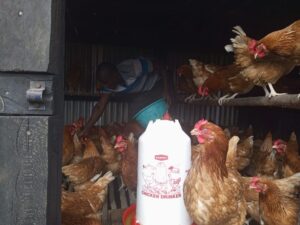
He also gets her market through referrals from people she trained or sold to previously.
His education background is plant operator, in the year 2013 he left the job where he was employed by one of the company in Kenya and felt the income he was earning was not satisfying him his needs and to take care of his family he decided to venture into poultry farming, he has no regrets.
His educational background plant operator has played a big role in running his poultry farm in Bonchari Kisii County.
“I resigned in 2013 and got into agribusiness starting with 50 chicken. During this time, I attended several meetings on poultry farming and interacted with several entrepreneurs, he explains to Development reporter during the visit in his farm located in Bonchari Sub County.
Journey of poultry
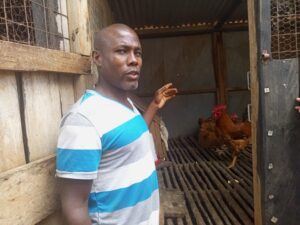
Mr Onsare interest in poultry farming began in 2014 when he was still in formal employment. He started by raising Kienyeji chickens for meat and eggs, then scaled up to egg production only.
“I first bought 20 chicks from neighbors and within three months, many had died. I did not give up, and I bought another 100 kienyeji chicks and continued scaling up to 300 and by 2015 when I quit, I had 500 birds,” he said.
After a few years, he realized that the demand for eggs was more than that of meat, so he shifted from kienyeji chicken to high breed broilers.
However, he has had a passion for farming since childhood. And this passion kept him the reason as to why he decided to resign a job in one of the company.
Mr Onsare to date, loves farming and seeing his chicken increasing in number every other day gives him hope and happiness.
With little capital of Shs. 15, 000 he bought 150 one year old broiler chicks from a supplier from Kisii county 2014. As they continued to multiply he decided to put up a poultry house for them which cost Shs.70, 000.
, The farm is currently housing between 20000 and 3000 chicken. He is therefore restocking to meet the high demand. He supplies 14 mature chicken of above three months old to two schools in the area every week. One such mature chicken goes for Sh1000 earning her Sh20, 000 per week.
The order between 250-300 chicks. This makes her commit to a month supply of 2000 chicks. he sells a day old chick at Sh100, a week old chick at Sh130, two weeks Sh150, three weeks Sh200, a month old chick at Sh250, three months Sh450 and above three months at Sh600 -800. To cope with the high demand, Onsare has an incubator with a capacity of 1026 eggs that helps her hatch more chicks for the market.
Feeding
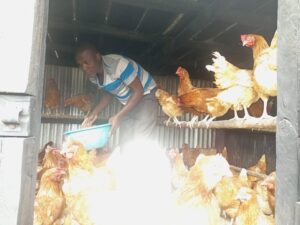
To keep them healthy, Onsare feeds the birds with kitchen waste, sunflowers, cereals, fish meal, green grass and maize germ. Also keeping her chicken in a large fully fenced compound where they can scavenge and get insects. Remember, keeping indigenous chicken thrives in a rural areas where people prefer them over exotic ones. Ensuring a strict vaccination schedule prevents loss of poultry.
Onsare likes crossbreed chickens because they are resistant to diseases and mature faster than the local Kienyeji chicken.
He says poultry farmers should vaccinate the chicken after every 10 weeks to keep away diseases like Newcastle which is a big threat to poultry farmers.
He says that farmers should ensure that the chicken cages are cleaned regularly and provide enough water for them to grow healthy.
“Cleanliness is what has ensured my chickens do not contract diseases easily,” he says.
She keeps her chickens in a large fully fenced compound where they can scavenge and get insects.
Kisii county empowerment
Joshua Mainga Bonchari sub director says that they empower farmers with skills on how to take care of the chickens and they link with them the ready market
Mr Mainga says that they encourage farmers to form self-help group so that they can be reached to be empowered.
He says that they educate farmers on how to take care of the chicken and on how to keep them in modern way and also how to have vaccination schedule.
He says they have been working with small and medium entrepreneurs in the Marketplace for Nutritious Foods project and now they want to target the farmers.
The trained food technologist sells 80 per cent of his eggs in the area while the rest is sold in kisii and its environs. He sells to the retail shops that then sell to the consumer and this ensures that the eggs are affordable.
Income
Mr Onsare sells a three-week old chicks in which they go for Sh150 -200 each. You can rear the other chicks until three months before you allow them to mix with other chicken. The matured ones are sold in terms of kilos with each going for Sh450. She is able to raise a net of between Sh80, 000 to Sh120, 000 monthly from selling the crossbred chickens, the original breed chicks and eggs.
Mr Onsare is currently producing 150,000 trays daily. He spends about Sh210 to produce a tray of eggs and then sells it at Sh280 at the farm gate and the same tray retails at Sh300.
He says 60-70 per cent of the eggs consumed in Kenya are imported and Sande is planning to increase production to 20,000 in the next two to three years and 100,000 chicken in the next five years.
Challenges
Mr Onsare says that the cost of vaccines and feeds are high
Importation of eggs from neighboring countries affects them end up selling eggs in cheap price.
Value
Due to high cost of fertilizer , Mr Onsare uses droppings from the chicken to plant maize, banana sweet potatoes , vegetables thus cuts the cost of farm inputs .
“Feeds take up the biggest chunk of production, which is 70 percent of the production cost. So I plan to start making my own chicken feed so I can maximize on my profit,” he said.
Advice
He advises farmers or anyone interested in venturing into poultry farming to undertake research first, invest in good housing structure for the birds and then get quality chicks to ensure maximum returns.
He urges youth snot to be obsessed with formal jobs rather than to create jobs for others
“As a youth should come up with something to cushion them, farming is interesting if only you have passion on it, he says.
Similar Posts by The Mt Kenya Times:
- Mt Kenya Times ePAPER October 12, 2026
- Gachagua’s party storms Kikuyu from afar as 2027 countdown begins
- Counties caught: The KSh100B payroll scandal Kenya can no longer hide
- CS Ogamba: tree planting could generate carbon credit millions to fund education
- Farouk Kibet calls for unity and development as leaders rally behind Ruto’s 2027 re-election bid
About the Author