Sovereignty Under Assault: Trump’s Reckless Meddling in South Africa’s Land Question
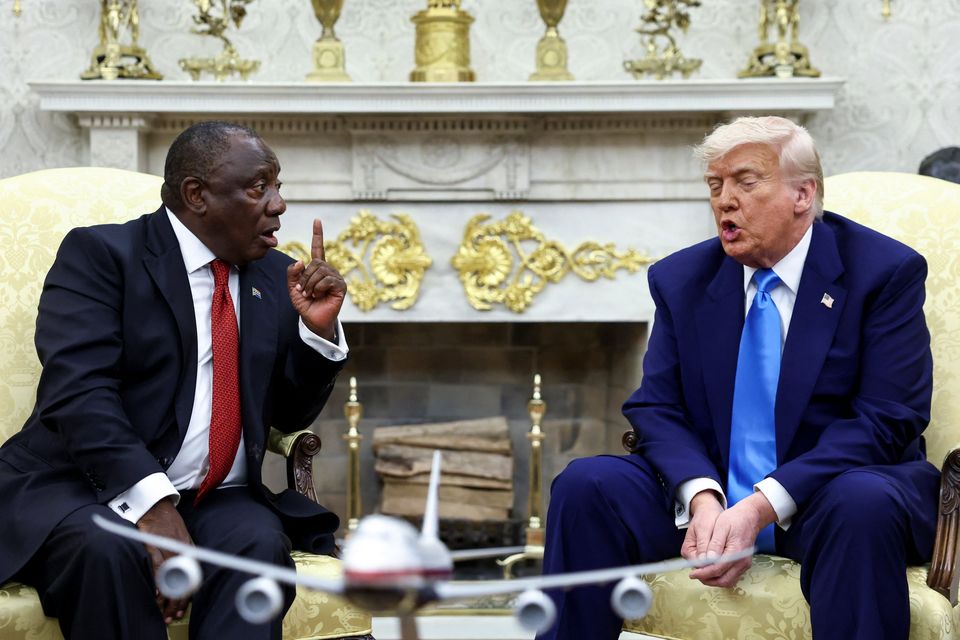
Donald Trump ambushing South African President Cyril Ramaphosa in the Oval Office
By: Silas Mwaudasheni Nande
The recent, deeply troubling spectacle of Donald Trump ambushing South African President Cyril Ramaphosa in the Oval Office, playing unverified videos and brandishing news clippings to accuse the South African government of presiding over a ‘genocide’ of white farmers, represents a profound and dangerous breach of international diplomatic norms and an unacceptable interference in the sovereign affairs of a democratic nation. This calculated act of aggression, fueled by misinformation and a deliberate disregard for the complex realities of South Africa, not only undermines the delicate balance of international relations but also actively endangers the fragile peace and reconciliation efforts within the rainbow nation.
To understand the gravity of Trump’s actions, one must delve into the historical wounds of South Africa, the nuanced discussions surrounding land reform, and the stark statistical realities that stand in stark contrast to the sensationalist, racially charged narratives propagated by certain right-wing elements globally.
The Specter of Interference: A Violation of International Law
At the heart of the international order lies the principle of state sovereignty, a cornerstone of the Westphalian system. This principle, enshrined in the UN Charter, dictates that each state has exclusive authority over its internal affairs and that other states should refrain from intervening in them. Trump’s theatrical display was not merely an ill-informed gaffe; it was a deliberate and public attempt to dictate domestic policy to a sovereign nation, based on demonstrably false pretenses.
The United States, as a signatory to numerous international conventions and a vocal proponent of democracy, should uphold, not undermine, these foundational principles. Yet, Trump’s actions, including the alleged offering of refuge to white South African farmers based on ‘racial discrimination claims’ which Pretoria deems baseless, and even the reported cutting of US assistance, clearly indicate a coercive intent. This goes beyond legitimate diplomatic discourse and crosses into the realm of prohibited intervention under international law. Such unilateral pronouncements, especially when driven by a domestic political agenda and devoid of factual grounding, set a dangerous precedent for international relations, threatening to destabilize global cooperation and foster resentment.
Unpacking the Land Question: A Legacy of Dispossession
To grasp the complexities of South Africa’s land discourse, one must journey back through centuries of colonial conquest and apartheid-era injustices. The 1913 Natives Land Act, a foundational pillar of racial segregation, legally stripped the Black majority of their ancestral lands, limiting their ownership to a mere 7% of the country’s territory. This was further entrenched by the 1936 Native Trust and Land Act, which expanded this to a meager 13%. Millions were forcibly removed from their homes, dispossessed of their livelihoods, and relegated to impoverished ‘reserves’ or ‘homelands.’ This systemic dispossession created the deep-seated economic inequality that continues to plague South Africa today.
The democratic transition in 1994, while a monumental achievement, did not immediately rectify these historical injustices. The land question remains a deeply emotional and politically charged issue, central to the ongoing struggle for true social and economic justice. Land reform in South Africa is not about targeting a specific racial group; it is a long-overdue attempt to address the historical imbalances of land ownership and ensure a more equitable distribution of resources for all citizens, irrespective of race. The South African government’s current policy on land expropriation without compensation is a nuanced and contentious issue, debated within the country’s democratic institutions. It is not, as Trump falsely claimed, a policy of seizing land and then orchestrating the murder of its owners.
The Misinformation Machine: Debunking the ‘White Genocide’ Myth
The narrative of ‘white genocide’ in South Africa, amplified by Trump and various right-wing media outlets, is a dangerous fabrication. It is a carefully constructed disinformation campaign designed to stoke racial fear and undermine legitimate efforts at land reform. While farm attacks and murders are a tragic reality in South Africa, as they are in any country with high crime rates, the assertion that white farmers are being systematically targeted for extermination is patently false and deeply irresponsible.
Let us examine the statistical realities, which paint a very different picture from the one Trump presented:
Overall Crime Rates: South Africa has a disturbingly high overall crime rate, and violence affects all communities, regardless of race. The majority of murder victims in South Africa are Black, reflecting the demographic composition of the country and the disproportionate impact of crime on marginalized communities.
Farm Murders in Context: While every life lost is a tragedy, the number of farm murders, when viewed against the national murder rate, is not indicative of a genocide. Reliable data from organizations like AgriSA and the South African Police Service (SAPS) consistently show that while farm attacks are a serious concern, the numbers fluctuate and do not support claims of a targeted, systematic extermination. For instance, in the period between 2017 and 2018, AgriSA reported 47 farm murders, which translates to roughly one every eight days. This figure, while tragic, pales in comparison to the average of nearly 50 murders per day across the entire country.
Motive: Investigations into farm attacks have consistently found that the primary motive is robbery, not racial hatred. While racial slurs or discriminatory acts may occur in isolated incidents, they do not constitute the overarching motivation for the vast majority of these crimes. A 2001 committee of inquiry, for example, found that robbery was the motive for the vast majority of the 2,700 attacks studied, with racial motives accounting for a mere two percent.
Disproportionate Impact: Furthermore, it is crucial to recognize that farm attacks affect farmers of all races, as well as farmworkers. The narrative of ‘white genocide’ conveniently ignores the suffering of Black farmworkers who are also victims of violence, often at higher rates, and who have historically faced significant abuse and exploitation on farms.
The selective presentation of data and the deliberate misrepresentation of isolated incidents as evidence of a widespread genocide serve only to inflame racial tensions and distract from the very real challenges of crime and inequality that South Africa grapples with. This exaggeration, peddled by figures like Trump, actively deteriorates South African peace by fostering divisions and undermining trust between communities. It fuels a dangerous sense of victimhood among a minority group, while simultaneously ignoring the historical injustices faced by the majority.
The Incendiary Rhetoric of Julius Malema: A Separate, Though Related, Issue
Trump’s decision to play a video of Julius Malema, leader of the Economic Freedom Fighters (EFF), reportedly saying South Africans have to ‘occupy land by force and even kill for the land,’ further illustrates his intent to sensationalize and misrepresent. While Malema’s rhetoric is undeniably provocative and has been condemned by many within South Africa for its inflammatory nature, it is crucial to understand its context and avoid conflating it with the official policy or intent of the South African government.
Malema’s pronouncements are often delivered in the context of political rallies and reflect a radical viewpoint on land redistribution. His party, the EFF, advocates for a more aggressive approach to land expropriation. However, Malema’s words, while concerning, do not represent the policy of the ruling African National Congress (ANC) government, nor do they reflect the overall sentiment of the South African population. President Ramaphosa himself has consistently distanced his government from such calls for violence, emphasizing a commitment to constitutional processes and peaceful land reform. The South African government has repeatedly stated that it is ‘completely opposed” to the behavior alleged by Trump and that such actions are “not government policy.’
To equate Malema’s rhetoric with a government-sanctioned genocide is a malicious distortion. It is akin to taking the extreme views of a fringe political figure in any democratic country and presenting them as the official policy of that nation. This tactic is designed to create fear and justify external interference, rather than engage with the complexities of democratic discourse.
The Real Cost of Reckless Intervention
Trump’s actions have far-reaching negative consequences:
Undermining South African Democracy: By casting doubt on the legitimacy of South Africa’s democratic processes and its handling of internal affairs, Trump undermines the very institutions that are striving to address historical injustices and build a more equitable society.
Exacerbating Racial Tensions: The ‘white genocide’ narrative, amplified by a figure of Trump’s stature, inflames racial tensions within South Africa and plays into the hands of those who seek to divide rather than unite. It risks reigniting old wounds and hindering genuine reconciliation efforts.
Damaging Diplomatic Relations: Such a public and disrespectful confrontation damages the vital diplomatic relationship between the United States and South Africa, a key African democracy. This could have negative implications for cooperation on critical issues, from trade and investment to regional security.
Emboldening Extremist Elements: By legitimizing unsubstantiated claims, Trump inadvertently emboldens extremist elements both within South Africa and internationally who subscribe to racist ideologies and seek to destabilize the country.
Distorting Global Perceptions: The spread of misinformation about South Africa’s land issue distorts global perceptions, potentially deterring investment and tourism, and isolating a nation that is striving for progress.
A Call for Respect and Responsibility
The United States, under any administration, has a moral and diplomatic obligation to engage with sovereign nations like South Africa with respect, understanding, and a commitment to factual accuracy. This means recognizing the historical context of challenges, supporting democratic processes, and refraining from propagating divisive and baseless narratives.
Instead of playing into sensationalist fears, international actors should support South Africa’s efforts to address the deeply rooted inequalities stemming from apartheid. This means understanding the complexities of land reform as a constitutional and democratic process, rather than demonizing it as a racially motivated campaign. It means acknowledging the genuine efforts of the South African government to ensure justice and reconciliation for all its citizens.
The international community must unequivocally condemn such blatant disregard for state sovereignty and the dissemination of dangerous misinformation. The peace and stability of South Africa, and indeed the integrity of the international system, depend on it. Donald Trump’s theatrical performance in the Oval Office was not an act of concern; it was an act of reckless interference that threatens to destabilize a nation striving for justice and reconciliation. It is a stark reminder that responsible international engagement demands respect for sovereignty, adherence to facts, and a commitment to fostering, not fracturing, peace.
Similar Posts by The Mt Kenya Times:
- Mt Kenya Times ePAPER October 24-25, 2026
- Muturi calls on IEBC to keep election technology tender clean and on schedule
- Ruto meets UAE minister in push to deepen trade ties
- Gideon Moi breaks silence on Ruto fallout, cites broken promises
- The doctor who refused to abandon a sick Uganda
About the Author