
Raila Odinga: The Man, the Mission, the Memory: Mortal Yet Immortal
 The Mt Kenya Times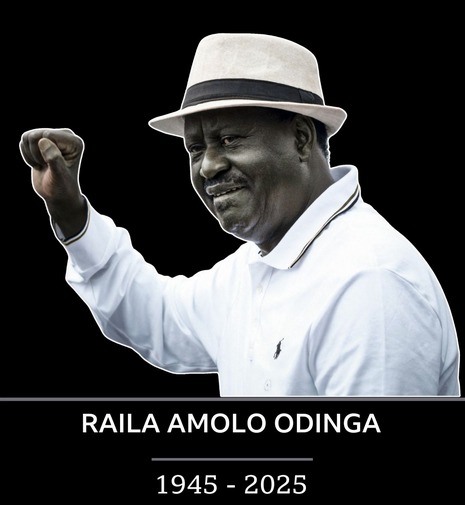
The Silent Arrival of Death
Death arrives without announcement, without courtesy, without regard for the schedules we keep or the dreams we harbor. It is the ultimate thief, slipping through locked doors and bypassing security details, stealing not our possessions but our very presence from the world. No alarm system can detect its approach, no intelligence service can predict its timing, no bodyguard can stand between us and its cold embrace. This ancient adversary respects neither title nor achievement, neither youth nor wisdom, neither wealth nor poverty. It takes the infant from the cradle and the elder from the rocking chair with equal efficiency, leaves empty chairs at dinner tables and silent spaces in conversations that will never be completed.
A Nation Bereaved: Baba Is Gone
On the morning of October 15, 2025, death came as a thief in the early light and stole from Kenya one of its most formidable sons; the Right Honorable Raila Amollo Odinga, known affectionately across the nation and beyond as Baba.
The Father of Democratic Aspiration
The word “Baba” meaning father carried on the lips of millions who never shared his bloodline but claimed him nonetheless as a patriarch of democratic aspiration. He was not merely a politician but a symbol, not simply a leader but an embodiment of Kenya’s long march toward justice, accountability, and the rule of law. For decades, his voice had been a constant in the national conversation, sometimes in power, often in opposition, always consequential. Now that voice has been silenced by the one force that cannot be opposed, cannot be negotiated with, cannot be defeated through strategy or courage or sheer force of will. Death has done what political opponents could not do despite detention, exile, rigged elections, and assassination attempts; it has removed Raila Odinga from the stage of history, leaving behind only memory, legacy, and the aching absence that follows when giants fall. The nation wakes to find itself suddenly, irrevocably diminished, forced to continue a conversation without one of its most essential participants.
The Final Silence in Kerala
Death is destruction incarnate, the great equalizer that reduces all human accomplishment to the same dust and silence. It cares nothing for the constitutions drafted, the reforms championed, the bridges built between communities on the brink of tearing each other apart. The hands that once signed historic agreements now lie still; the mind that strategized through five presidential campaigns and countless political negotiations has ceased its calculations; the heart that beat for eighty years with passion for a more just Kenya has pumped its final rhythm. In a hospital room in Kerala, India thousands of miles from the red earth of Bondo, from the bustling streets of Nairobi, from the political platforms where he stood unbowed; death claimed its prize during what should have been a routine morning walk. There is a cruel irony in this: that a man who survived the brutality of detention without trial, who walked out of prison when others emerged broken, who endured exile and returned undeterred, should fall to something as ordinary as cardiac arrest. But death does not deal in irony or poetry; it deals only in finality, and it has stolen from Kenya, from Africa, and from the world a statesman whose like we may not see again in our lifetimes.
The Last Breath of a Titan
In the early morning hours of October 15, 2025, death came knocking at a hospital in Kerala, India, and claimed a son of Kenya whose voice had thundered across decades of struggle and aspiration. The news arrived with the cruel swiftness that characterizes mortality’s indiscriminate hand; Raila Amollo Odinga, Kenya’s second Prime Minister, collapsed during a morning walk and breathed his last at 9:52 AM Indian time, his heart surrendering to the same biological frailty that binds king and commoner alike. At eighty years of age, this titan of African politics, this champion of democracy and the rule of law, discovered what all mortals eventually learn: that life’s lease expires without negotiation, without regard for unfinished business or the mourning multitudes left behind.
Dust and Shadow: The Truth of Mortality
The man who had defied dictators, challenged electoral injustices, and survived detention, exile, and assassination attempts could not defy the one adversary that never loses, death itself. In that sterile hospital room, thousands of miles from the red soil of his homeland, mortality reminded us once again that we are but dust and shadow, temporary custodians of borrowed breath. This moment compels us to confront an uncomfortable truth: that all human endeavor, no matter how noble or consequential, unfolds against the backdrop of our own inevitable erasure. It is in this sobering recognition that we must pause and reflect not only on what has been lost but on the nature of loss itself.
Memento Mori: Wisdom from the Ancients
The ancient Stoics understood what we so desperately try to forget in our daily distractions and digital noise: that life is inherently fragile, a candle flame flickering in an indifferent wind. Marcus Aurelius, who ruled the Roman Empire at its zenith, reminded himself each morning that he would encounter ingratitude, arrogance, deceit, and envy but more importantly, he reminded himself that everyone he would meet that day was mortal, including himself. This practice of memento mori, remember that you must die was not morbid pessimism but radical realism, a philosophical foundation for living with clarity and purpose. We are born into a world that makes no promises, where the strong fall as suddenly as the weak, where genius and folly alike return to the same earth. Thomas Hobbes captured this brutishness when he described life in the state of nature as “solitary, poor, nasty, brutish, and short”—and while civilization has softened some of these edges, the fundamental precariousness remains. We build our monuments and write our constitutions, we fight our wars and negotiate our peace treaties, all the while standing on ground that will eventually swallow us whole. The death of Raila Odinga forces us to reckon with this reality: that even those who shape the destiny of nations are subject to the same biological clock that ticks within the chest of every living creature.
The Fragile Illusion of Permanence
We are creatures born of dust, bound by breath, and yet so wildly convinced of our permanence until that final breath reminds us we were always temporary. The mind recoils at the sudden realization that even the mightiest among us is subject to decay, to the ticking of time that knows no plea. We gather the shards of memory—his speeches, his courage, the strains of his laughter, the furrowed brow in moments of decision—and in doing so we confront the brittle truth: life is brutish, often unfair, and always finite. There is no promise that the next sunrise will find our beloved leader among the living. Death cares not for titles, for ambition, for the dreams we erect upon the fragile foundations of flesh and blood.
A Life of Vision and Sacrifice
He was born into our people’s long arc of struggle: a champion for rule of law, democracy, multipartyism, good governance. He bore the burden of expectations, of hopes, of the relentless demand that Kenya become more than its hurts. Even when his stabs at the presidency did not yield the success the people longed for, he remained a unifier, a guardian of ideals larger than his own chance at power. Through times of fierce contestation he held aloft the torch of vision, guided by something deeper than partisan triumph: the abiding conviction that Kenya must be more just, more free, more humane. He did not shirk sacrifice; often, he shouldered the cost of truth even when it was lonely, even when betrayal lurked in shadows. He accepted the scars of struggle knowing that freedom is not free, that justice exacts its toll in isolation, in persistence, in the refusal to compromise the soul. And yet he stood undaunted, dignified, resolute.
Grief and Grace: What Remains
So here we are, the nation, wrenched by grief, wrestling with our own mortality. For what is death, if not a mirror held up to every living soul? In recalling his life, we are forced to remember that each heartbeat is borrowed time. We must contemplate that the hopes we nurse, the visions we pursue, the legacies we aspire to—none guarantee permanence. We must reckon with the fact that no avalanche of achievement can halt the quiet inevitability of the end. Yet, in this contemplation, there is a strange grace: the awareness that life’s fragility is what renders it sacred. Each sunrise, each act of kindness, each struggle for truth and justice—these are what matter when the final tally is made.
The Relentless March of Time
The lesson of mortality is that time does not pause for our convenience, does not wait for us to accomplish all we set out to do, does not grant extensions based on the importance of our mission. Raila Odinga ran for the presidency of Kenya five times and never occupied that office, yet his influence on Kenyan politics exceeded that of many who did. This irony speaks to a deeper truth: that legacy is not measured solely by the positions we hold but by the movements we inspire, the changes we catalyze, the minds we awaken. His political career was marked by both triumphant moments and devastating defeats, by periods of immense influence and stretches of marginalization. Through it all, the clock kept ticking, his body kept aging, and death kept its appointment in its diary, waiting for the proper moment to collect what was always owed.
Death’s Indifference to Justice
We imagine that important people should receive warnings, that the architects of democracy should be granted time to finish their blueprints, but death is not a respectful subordinate waiting for permission to enter. It crashes through doors, interrupts conversations, strikes in foreign lands among strangers. The fact that Raila Odinga died in India, away from the Kenyan soil he fought for, underscores death’s essential indifference to narrative symmetry or poetic justice.
The Stoic Path of Leadership
To live fully is to accept, stoically, that suffering and disorder are woven into the human condition. Our leader knew this. He knew that injustice is not always vanquished, that corruption and division will always loom as adversaries, that sometimes democracy wobbles and falters. He acted nevertheless; he spoke truth to power, even when betrayal was the more expedient path. He did not delude himself into imagining that the arc of history bends swiftly or without resistance. He understood that the fight for the rule of law is often walked in darkness, sometimes in despair, but always with hope as the lodestar. We need to reflect on that courage, for we too are called upon—each of us—to persist, to speak, to build, even knowing the hourglass runs unceasingly.
The Poverty of Permanence
When a person of great stature departs, the void is not only theirs but ours; it exposes the poverty of our permanence, the illusion that any of us might endure indefinitely. We see in his passing the certainty that one day we too shall fall, and any claim to immortality is arrogance. We are all subject to loss: of loved ones, of our own health, of our dreams. The bright spectrum of our life can shrink in a moment; time can undo what we have built, erode what we have believed to be bedrock. And yet, this knowledge forces us into reflection: how shall we live knowing that death will come, unbidden, unavoidable? What shall we leave behind?
Echoes Louder Than Voice
The political fire that he sparked and tended throughout his life, the fearlessly spoken truth to power, and the summoning of the nation to higher ideals, will now be carried forward by his enduring example, not his physical presence. His voice is stilled, but its echoes are now more resonant, perhaps louder in the silence he has left behind. The memory of his tenacity, his ability to pivot from opposition to collaboration, his sheer political gravity, becomes a timeless resource for the generations he inspired. This transition from a living force to a historical legacy is the ultimate process of immortalization, where the mortal body fails but the soul of the contribution endures.
The Geography of Grief
He died in India, far from home in his final hours. The geography of death does not respect borders or distance: Kenya’s son passed beyond horizons, and though our hearts strain to bridge the gap, the separation is more than physical. It is an echo, the reminder that grief travels with us. It is intensely personal; because when death comes, it does not ask permission, it does not wait for preparedness. He breathed his last after eighty years, a prime age, but still homelessness of life. We are prone to believe eighty is long; yet in the ledger of eternity, it is brief. Even one more word unspoken, one more embrace unshared, one more dawn uncelebrated—and we know weakness of time.
Humanity in Leadership
Let us not forget that he was human, brilliant, flawed, passionate, mistaken sometimes, but always striving. His flaws were politically expedient, as politics often demands compromise, as history often judges harshly the frailty of intentions. But those blemishes do not erase the merits; they contextualize them. If perfection were required, none would be worthy of remembrance. It is his struggle, his courage, his willingness to stand when many would have walked away, that renders him timeless. In embracing his humanity, we embrace our own fallibility, and in doing so we glimpse compassion.
A Clarion Voice for Kenya
Kenya remains grateful for his steadfast leadership, for his vision, for his refusal to let expediency extinguish principle. He fought for Kenyan democracy and put country before self; he made of his life a testament to ideals. He held aloft the banners of human rights, inclusivity, economic opportunity, believing that every Kenyan deserved dignity. His voice was a clarion call in times of compromise, a reminder that loyalty to truth matters more than loyalty to comfort. He summoned us repeatedly to higher ideals of nationhood; he taught us that citizenship demands more than silence. We owe him gratitude not only for what he achieved but for who he made us able to become.
A Legacy Without Borders
His is a legacy not confined to Kenya, but stretching across Africa, across the world. He was a patriot, a pan‑Africanist, a global statesman; yet also a man among men, grounded in his people, aware of his roots. His presence on the world stage lent dignity to our struggles, and his attention to local pains honored the universal longing for justice. He understood that democracy is not just an idea, but a living thing, nurtured in every village, every court, every classroom. He believed in voices raised, in laws that protect, in institutions that serve. Though he is no longer with us, his footprints remain in the sands of time: in the reforms he pushed, the bridges he built, the dividing lines he dared to cross.
Living with Urgency and Purpose
Even as we mourn, let us allow his departure to sharpen our awareness: that our own lives are brief, that the hourglass turns for each of us, and that what we do today matters. In every decision, in every act of kindness, in every moment of courage, we lay our stones, we craft our legacy. Let us live so that when our summons comes, we have no deep regrets—at least in those things over which we bore agency. Regret for not speaking, for not loving, for not striving—that is our greatest sorrow. May we honour him not only in tears but in the renewed commitment to justice, democracy, and unity.
Virtue in an Indifferent World
Stoicism teaches us to set our hearts against delusion: that control is in our hands over externals. We can control our actions, our choices; we cannot control the coming of death. We can face loss, but we cannot always prevent it. The world is indifferent; planets turn; seasons shift; empires rise and fall. And yet in the face of that indifference, we discover the possibility of virtue: compassion, integrity, courage. His life was virtue lived—not perfect, but nevertheless luminous. Let us take courage from him: to live not for comfort, nor for acclaim, but for the enduring truths that outlast kings and kingdoms.
The Candle and the Darkness
In remembering him, we remember too that every life is a candle in the dark, bright, fragile, flickering against the wind. We are all subject to flame’s sputter. We are all at risk of being snuffed out: by illness, by accident, by betrayal, by the slow guillotine of time. And yet the candle’s light, even short‑lived, banishes darkness: illumines paths, gives comfort, guides others. His flame, though now extinguished, has lit a thousand paths. We are those who walk in that light; even though it shivers, even though the night threatens.
The Hope Beyond Finality
Death, ruthless and absolute, seems forever undefeated. It stands at the threshold of every cradle, awaits the close of every eye, the last whisper in every body. It is the horizon from which no traveller returns; the silence after the final chord. We curse death, fear it, strive to outrun it in memory and fame and legacy. Yet death is not our foe alone, it is also the dimension of all meaning. Without it, nothing would matter: no urgency, no love, no sorrow, no song. The fragile life is precious precisely because it ends.
And yet, stoic eyes must also see beyond this finality; must entertain the audacious hope that someday Death itself will die. Yes, that which seems most absolute might succumb to something greater, something we scarcely comprehend. If laws of justice, of moral reckoning, of love can outlast tyrants; if the ideals for which our fallen leader lived—democracy, equality, human dignity—can continue into the future; then death’s dominion may be limited. For in the memory of the virtuous, in the works they inscribe upon the world, in the transformation they kindle in hearts, death does lose power. Someday, death will die, when our remembrance is not
Mortality as the Measure of Meaning
Philosophy and religion have long grappled with the problem of death, seeking to make peace with the undeniable fact of our finitude. The existentialists insisted that authentic living requires confronting death directly, staring into the abyss without flinching or seeking comfort in illusions. Heidegger spoke of “being-toward-death,” the recognition that our mortality fundamentally structures how we experience time and make meaning. Raila Odinga’s life can be read through this lens as someone who, particularly after surviving detention, exile, and violence, lived with an acute awareness that time was precious and that political cowardice was a form of wasting that time. His willingness to challenge power even when it was dangerous, to contest elections even after repeated defeats, to negotiate compromises when they served the larger goal of democratic progress—all of this suggests someone who understood that death would eventually come and that the question was not whether but how one would face it. Would it find you hiding in comfort, or would it find you in the arena, still fighting for something beyond yourself? He chose the arena, repeatedly, and in that choice demonstrated a kind of courage that only makes sense when filtered through the awareness of mortality. If we live forever, there is no urgency; if we die tomorrow, every action carries weight.
Death’s Democratic Reach
The brutal honesty we must embrace is that death is democratic in the cruelest sense; it comes for the righteous and the corrupt, for the builder and the destroyer, for those whose work is finished and those whose work has barely begun. It came for Raila Odinga not because he had completed his mission (indeed, his pursuit of the African Union Commission chairmanship remained active), but simply because his heart muscle, having faithfully contracted and expanded for eighty years and roughly three billion beats, could no longer maintain the rhythm. There is no deeper meaning to extract from this biological fact, no cosmic justice that waited for the precisely right moment. The universe is not so finely tuned to human narratives. We die when our bodies fail, period. Yet this very absence of cosmic design is what makes human meaning-making so poignant and necessary. Since the universe will not remember Raila Odinga, we must. Since death erases indiscriminately, we must discriminate in our remembering, must choose what to honor and what to learn from those who have departed. The fragility of life demands that we construct meaning deliberately, that we build monuments of memory and principle to stand against the erosion of time.
Legacy Under Trial
In the particular case of Kenya and the life of Raila Odinga, we confront questions about what endures when the person vanishes. He fought for multiparty democracy in a time when such advocacy could result in detention, torture, or death. He championed the rule of law when authoritarian convenience was the norm. He pursued inclusive governance when ethnic politics threatened to tear the nation apart. These were not abstract academic exercises but lived commitments that cost him dearly—years of his freedom, his physical health, his family’s peace, his opportunities for personal enrichment. Now that he is gone, what remains? Do the institutions he fought for stand stronger because of his efforts? Has the culture of impunity he challenged been genuinely weakened? Will the vision of a Kenya governed by laws rather than personalities outlive the personality who articulated that vision so persistently? These are the urgent questions that his death forces us to confront. A legacy is not merely what someone accomplished but what endures after they can no longer defend or extend their accomplishments. The work must stand on its own, must be internalized by others, must become part of the institutional and cultural fabric, or else it dies with the person. Death tests legacies ruthlessly, separating what was built on personality from what was built on principle.
The Ordinary End of an Extraordinary Life
The fact that his death occurred in India, during what was meant to be a routine medical check-up, adds another layer to this meditation on mortality’s caprice. He traveled for health maintenance, for the management of conditions dating back to his 2010 head surgery, for the ordinary precautions that aging demands. This was not a dramatic death in the heat of political battle but the quiet failure of an elderly heart during a morning walk, attended by family and doctors who could not prevent the inevitable. There is something profoundly human about this ordinary end to an extraordinary life. We are all vulnerable in the same way; our hearts pump until they don’t, our lungs breathe until they can’t, our bodies function until they cease. No amount of political stature or historical significance provides immunity. The morning walk is the great equalizer, the cardiac arrest is the democratic leveler. Who the hell is death, you ask? Death is the final argument that cannot be refuted, the debt that cannot be renegotiated, the appointment that cannot be rescheduled. Death is the truth that all our philosophies and religions ultimately must accommodate because it will not accommodate us. Death is personal in the sense that it comes for each of us individually, yet impersonal in its operation, following biological and physical laws without sentiment or mercy.
A Nation’s Fragile Continuity
Kenya mourns, as it should, and in that mourning confronts its own collective mortality. Nations, like individuals, do not live forever. The Kenya that Raila Odinga was born into—a British colony where Africans had no vote and limited rights—no longer exists. The Kenya that he helped to birth through decades of struggle—a multiparty democracy with constitutional protections and mechanisms for accountability—is itself fragile, requiring constant defense against the forces of authoritarianism, corruption, and ethnic division. His death removes one of the guardians, one of the voices that could speak with authority born from having paid the price for democratic progress.
The Loss of Living Memory
This is not just the loss of a person but the loss of living memory, of embodied history, of the weight that comes from being able to say “I was there, I fought that battle, I know what that struggle cost.” Future generations will read about these struggles in books, but they will not be able to ask Raila Odinga what it felt like to be detained without trial, to watch the 2007 election results disputed and the country descend into violence, to negotiate the power-sharing agreement that pulled Kenya back from the brink. That direct transmission line has been cut. This is what death does to communities and nations—it gradually eliminates the witnesses, forcing societies to rely on recorded history rather than living testimony, on documents rather than dialogue.
The Paradox of Death’s Dependency
Yet here, at the nadir of our meditation on mortality and loss, we must turn toward a paradox that has sustained human beings through millennia of grief and loss. Death itself is not eternal. While individual deaths are final and irreversible, death as a phenomenon is dependent on life—it is the shadow cast by the light of existence, and shadows require a source to create them. In three profound senses, death will one day die, and this triple death of death offers not escape from grief but transformation of its meaning.
The Crossroads of Memory and Choice
The inevitable has arrived, as it arrives for all: Raila Odinga has been claimed by that most democratic of forces, the one that recognizes neither rank nor resistance. Yet what remains in the wake of his passing is neither simple nor settled—a constellation of aspirations, half-realized promises, institutional tremors that still reverberate through a nation’s conscience. Kenya now stands at that peculiar crossroads where memory becomes choice, where the dead hand of the past must either guide or be shrugged off entirely. The principles he championed—messy, contested, never quite crystallized into permanent form—these await their verdict. Will they be tended like embers that might yet kindle into flame, or will they suffer the quiet death of benign neglect, that most insidious form of forgetting? The man is gone, but the question he embodied persists: whether a people can sustain the exhausting, unglamorous work of democratic accountability when the voice that once rallied them has fallen silent.
The Music Plays On
What we build in our brief tenure here proves as mortal as flesh itself, perhaps more so, for institutions lack the stubborn biological persistence of DNA. Political achievements do not fossilize; they require the constant metabolic activity of belief, the daily re-commitment that transforms inherited forms into lived practice. Death has performed its ancient office—taken the body, stilled the heart, closed the eyes that witnessed so much transformation and betrayal alike. But a curious incompleteness mars its victory. The mission, that abstract thing he poured his years into, continues its uncertain journey through other hands, other voices, some bold and clear, others hesitant, newly emboldened by his example. A single conductor has departed, yet the music, discordant and unfinished as it may be, plays on. This is both the tragedy and the consolation: that human endeavor outlives human limitation, that what we set in motion possesses its own momentum, indifferent to whether we remain to witness its unfolding.
The Posture Toward the Inevitable
Here we encounter the paradox that gives shape to our condition: we are nothing before the fact of our ending, yet everything in the brief interval before it arrives. Humility descends upon us not as virtue but as recognition—we cannot forestall the cellular rebellion, the arterial failure, the thousand small betrayals by which the body acknowledges its covenant with dust. And yet from this very powerlessness springs a different imperative, urgent precisely because it is time-bound. Eighty years, in Odinga’s case, neither too few nor too many, simply the allotted span, and within that span: choices made, risks taken, consequences endured. His years mattered not because they were numerous but because they were inhabited with intention, because they nudged the possible just slightly beyond where it had previously rested. The human task, then, reveals itself not in the postponement of death but in the posture we maintain while awaiting it—not cowering, not resigned, but leaning forward into something larger than the small, frightened self that knows its days are numbered.
The Measure of a Life Well Spent
This fragility that defines us—this knowledge that we are temporary arrangements of matter, that even our most cherished accomplishments can dissolve like morning frost—might paralyze us into inaction or cynicism. Instead, properly understood, it becomes the ground of engagement, the reason for commitment rather than its refutation. We will die; this is the contract we signed in being born. But between that beginning and that end lies the space where meaning is forged, where the worth of a life reveals itself not in its duration but in its depth, its reach, its willingness to be spent in service of something beyond mere continuation. A death becomes worth mourning when it creates an absence that is felt, when the world is demonstrably smaller for the subtraction. By this measure—the only one that ultimately matters—Raila Amollo Odinga’s life justified itself. Let his legacy persist, not as monument but as living force. Let his vision trouble and inspire those who remain. Let his courage be remembered not as exceptional but as exemplary, as the thing we might all aspire to in our own particular circumstances. And may we each, when our turn comes, face that final certainty having lived with sufficient purpose that death, though it claims the body, cannot claim the entirety of what we were.
The writer is a lawyer and legal researcher.
Similar Posts by The Mt Kenya Times:
- Olise seals France win over Belgium in Nations League thriller
- Fatuma faces Senate scrutiny in PSC commissioner bid
- Birik: Lokichar first oil on course for December
- Eng Mwangi: Dangote refinery could reshape Kenya’s industry
- Mt Kenya Times ePAPER September 29, 2026
About the Author


The read was worth my time. Great write up