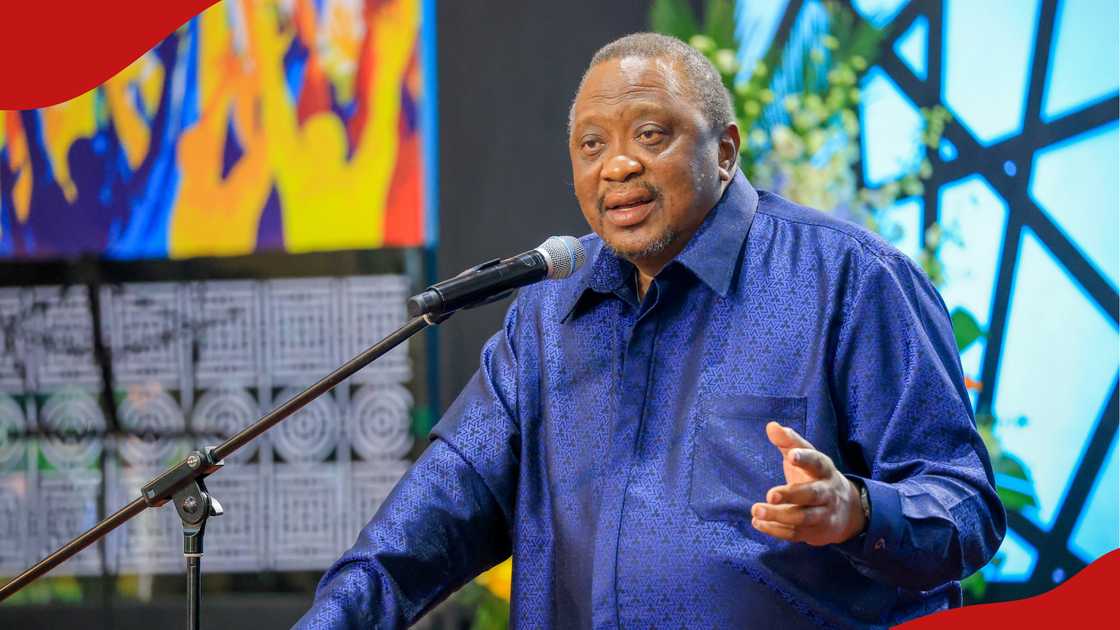
Former President Uhuru Kenyatta
Former president blasts tribal politics and Ruto’s blame games at fiery Kiambu Jubilee meeting, as 2027 war drums grow louder
By MKT Reporter
Former president Uhuru Kenyatta has launched a stinging broadside against what he termed rising tribal politics and political escapism by President William Ruto’s administration, warning that Kenya stands at a dangerous crossroads ahead of the 2027 general election.
Speaking during a Jubilee Party delegates’ meeting in Kiambu County, Uhuru cautioned politicians against promoting tribal tensions, warning that such rhetoric could push the country back toward past instability. His remarks were pointed and personal. The former head of state singled out UDA Secretary General Hassan Omar Hassan by name, accusing him and other senior government-aligned leaders of fuelling divisive ethnic narratives while failing to publicly denounce tribal sentiments — allowing such language to gain dangerous ground.
Uhuru referenced the 2007 post-election violence, warning that similar patterns of divisive language preceded that unrest — a chilling reminder of the 1,500 lives lost and 600,000 people displaced in Kenya’s darkest democratic chapter, according to Human Rights Watch records. That history, he made clear, must never be repeated.
The rebuke of Ruto’s administration was equally unsparing. “Do not talk about tribalism and other things. If you want us to help solve the problem, then reach out; we solve, but blaming others will not work. Let us sit together and solve. When the country has a problem, it involves all of us,” he said. It was a direct and deliberate challenge to a government that has frequently pointed fingers at its predecessors for the country’s economic woes.
Turning to the cost of living, Uhuru urged the current administration to urgently address rising fuel prices and transport costs, which he described as key drivers of economic strain on Kenyan households. He illustrated the burden facing low-income earners, noting that households earning around Sh20,000 spend nearly half of that on transport costs alone, with a further significant portion consumed by rent. “Kenyans will not eat words, education, or build roads with just talking. It does not have tribalism or anything else; it needs all Kenyans,” he said.
The meeting at Kiambu Golf Club drew significant political attention, not least because of what Uhuru’s re-emergence signals. He reminded residents of Kiambu and the wider Mt Kenya region of his 2022 warnings against electing the current administration. “I warned you in 2022, but you didn’t listen. Now you are crying,” he said, urging voters to prioritise leaders guided by facts, performance, and long-term impact rather than political rhetoric.
Despite the charged atmosphere, Uhuru insisted his involvement in Jubilee remains largely administrative and advisory, dismissing suggestions of a political comeback or plans to position himself for future political battles. Few in Kenya’s political establishment appear fully persuaded. Analysts at The Elephant describe the current moment as a rematch in the making — a second-season confrontation between Uhuru and Ruto, both men driven by a desire to control the levers of the state come 2027.
The response from Ruto’s allies was swift. Jubilee leaders in Nakuru had already hit back at Hassan Omar days earlier, accusing him of reviving tribal rhetoric and dragging Uhuru into unnecessary partisan exchanges. Nakuru Jubilee chairperson Charles Mburu described Omar’s remarks as reckless and poorly timed. “We are aware that some in government are anxious about the impact Uhuru Kenyatta may have on the 2027 political landscape,” he said.
That anxiety is not without basis. According to the Daily Nation, Uhuru continues to attract significant political attention, hosting allies at his Ichaweri home in Gatundu South and reportedly pulling strings behind the scenes to reposition protégés ahead of the next polls. His Azimio la Umoja coalition — which he chairs as patron — controls 173 of 349 National Assembly seats, 33 of 67 Senate seats, and 22 of 47 governorships, a parliamentary weight that no government seeking a second term can afford to ignore.
Meanwhile, the broader political environment is darkening. The Ruto administration has been accused of fostering political intolerance and targeting perceived critics, while matatu operators have launched a nationwide strike over fuel costs, deepening public anger at a government struggling to manage economic expectations ahead of a bruising election cycle. Mombasa Jubilee chairman Richard Barake warned that if the current administration fails to meet public expectations, voters will act accordingly at the ballot.
Uhuru’s message at Kiambu was ultimately as much a warning as a political declaration — to a government he believes is governing through division, and to a nation he fears may be sleepwalking back toward the ethnic fault lines that have defined, and at times devastated, Kenya’s political history. With 2027 drawing ever closer, his voice — however much he insists it is merely advisory — is growing harder to ignore.
Kenya has heard the drums before. The question now is whether its leaders have the courage, and the conscience, to silence them.
Similar Posts by The Mt Kenya Times:
- Wamunyoro Alliance Takes Shape; Gachagua, Kalonzo, Wamalwa unite
- Gachagua, Kalonzo, Wamalwa unite: Kenya’s 2027 opposition battle takes shape
- Beyond the rubble: Nairobi’s building collapses are a failure of systemic oversight
- Political alliances intensify ahead of Kenya’s 2027 elections
- The pressure to make it before thirty
About the Author