France hosts South Africa’s Ramaphosa for talks and war remembrance
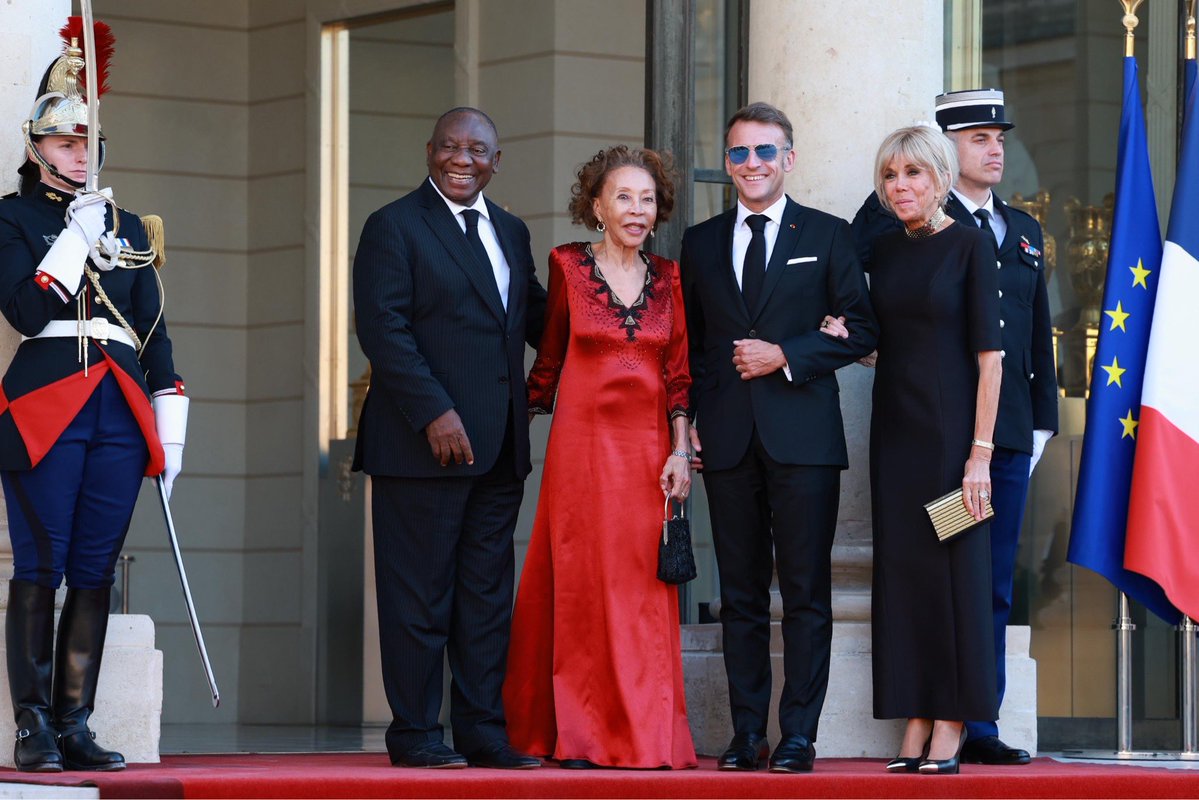
(From L) South Africa's President Cyril Ramaphosa, South Africa's President's wife Tshepo Motsepe, France's President Emmanuel Macron and France's President's wife Brigitte Macron pose on the steps of The Elysee Presidential Palace ahead of an official state dinner in Paris on July 10, 2026. (Photo/Courtesy)
Paris visit blends diplomacy, trade and a solemn tribute to South African war dead
By Diaspora Times Team
President Cyril Ramaphosa concluded a three-day official visit to France Sautrday that combined high-level diplomacy with a solemn act of remembrance, as South Africa and France pledged to deepen cooperation on global crises ranging from the Middle East to the eastern Democratic Republic of Congo.
The visit, which ran from 10 to 12 July, took Ramaphosa from the corridors of UNESCO headquarters in Paris to the battlefields of northern France, where he led South Africa’s delegation at the 110th commemoration of the Battle of Delville Wood — one of the deadliest engagements involving South African forces during the First World War.
Ramaphosa held bilateral talks with French President Emmanuel Macron in Paris on Friday. According to a French diplomatic source, the two leaders found what was described as a “broad convergence of views” on the crises in the Middle East and in the Democratic Republic of Congo. The source said the presidents shared the same assessment of the crisis in the Gulf and the economic fallout from disruption in the Strait of Hormuz, where shipping lanes have been affected by the ongoing confrontation between the United States and Iran.
On the Congo, the two leaders agreed on the need to encourage regional efforts toward peace and security in the war-torn eastern provinces, where, the source said, South Africa continues to play a stabilising role. Macron and Ramaphosa also agreed to establish an annual bilateral dialogue at the level of foreign ministers, formalising a channel intended to sustain momentum on shared priorities between the two governments.
The Paris leg of the visit was anchored by education diplomacy. At the invitation of UNESCO Director-General Khaled El-Enany, Ramaphosa co-chaired the Leaders’ Meeting of the UNESCO High-Level Steering Committee on Sustainable Development Goal 4, which focuses on quality education, followed by the Transforming Education Summit Stocktake. The gathering assessed global progress since the 2022 Transforming Education Summit and identified priority actions to accelerate progress toward the goal by 2030. According to the South African presidency, discussions centred on strengthening the teaching profession, advancing foundational and lifelong learning, promoting inclusive digital transformation and ensuring sustainable financing for education systems. Officials said South Africa’s role as co-chair reflects the country’s growing profile in global education governance and its bid to align its G20 presidency priorities with the wider international education agenda.
Macron hosted a dinner in Ramaphosa’s honour at the Élysée Palace on Friday evening, attended by families connected to figures of the anti-apartheid struggle — a gesture officials on both sides framed as a marker of the historical ties binding the two countries beyond the immediate diplomatic agenda. On Saturday, Ramaphosa turned to the commercial dimension of the relationship, meeting French business leaders for discussions expected to touch on energy, science and technology, trade and investment.
The economic backdrop to the visit is substantial. Bilateral trade between South Africa and France grew by 7.7 per cent in 2025 to approximately $2.7 billion, with South African exports to France rising by 42.2 per cent to about $790 million. French companies have invested more than $7 billion in South Africa since 2003, a figure officials say has helped create close to 16,000 jobs across sectors including renewable energy, business services, transport, and information and communications technology. France remains one of South Africa’s principal economic partners in Europe, and officials on both sides described the relationship as comprehensive, spanning defence, health, tourism, arts and culture, and higher education alongside trade.
The visit’s final and most symbolically weighted engagement came on Sunday, when Ramaphosa travelled to Longueval, roughly two hours from Paris, for the commemoration of the Battle of Delville Wood. The 1916 battle, fought over the course of six days, was among the costliest engagements of the First World War for South African forces, with several hundred soldiers killed and thousands more wounded or missing amid some of the fiercest fighting on the Western Front. The ceremony at the South African National Memorial included a wreath-laying in honour of those who died, alongside the unveiling of a UNESCO commemorative plaque recognising the memorial’s historical significance. The Delville Wood Museum, adjacent to the site, holds a Book of Remembrance recording the names of the fallen; the original memorial was unveiled in 1926, with the museum itself opened in 1986 to preserve the history of South Africa’s role in the war.
Ramaphosa was accompanied on the visit by First Lady Tshepo Motsepe and a delegation of ministers, including the ministers responsible for international relations and cooperation, defence and military veterans, public works and infrastructure, sport, arts and culture, and higher education and training. The presidency said the commemoration was intended not only to honour the fallen but to reaffirm South Africa’s commitment to peace, reconciliation and international cooperation, and to pass the memory of that sacrifice on to younger generations.
The trip proceeded against a backdrop of recent friction between Pretoria and Paris. South Africa announced in March that Ramaphosa had not been invited to the G7 summit hosted by France in Évian in June, a decision Pretoria initially attributed to pressure from Washington. French officials rejected that characterisation, saying the guest list had simply been trimmed to improve the effectiveness of discussions and that no pressure from US President Donald Trump had been involved. Neither side dwelt publicly on the episode during this week’s visit, with officials on both sides instead emphasising the breadth of the relationship and the new ministerial dialogue agreed in Paris.
With the commemoration at Longueval marking the close of the visit, attention now turns to how the newly agreed foreign-ministerial dialogue will translate into concrete coordination on the Gulf crisis and the Congo in the months ahead.
Similar Posts by The Mt Kenya Times:
- Mt Kenya Times ePAPER October 10-11, 2026
- Cabinet clears path for pending bills payout in relief for Kenya’s struggling suppliers
- Karanja quits UDA and targets Nakuru governorship on Gachagua’s DCP ticket
- Gachagua’s team plants DCP flag in Kiambu as 2027 battle lines harden
- A moment of recognition for service in energy
About the Author