Mbadi warns Kenya’s KSh3.6 trillion revenue target is out of reach
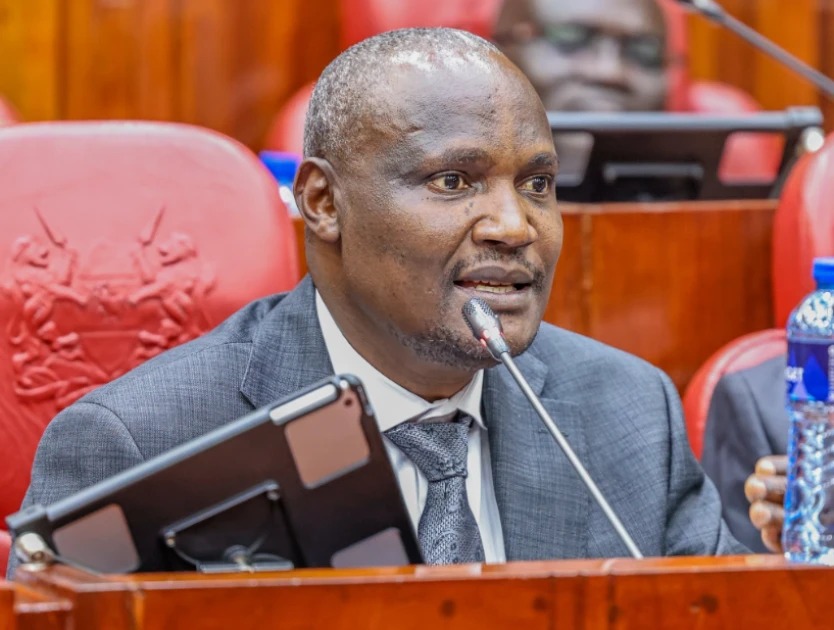
Treasury CS John Mbadi during a past Parliamentary committee appearance. PHOTO | COURTESY
The Treasury has built a KSh4.8 trillion budget it cannot afford to cut and may not be able to fund — and ordinary Kenyans will feel the consequences either way.
By Diaspora Times Team
Treasury Cabinet Secretary John Mbadi has publicly warned that Kenya’s projected KSh3.63 trillion revenue target for the 2026/2027 financial year may not be achieved, casting serious doubt over the sustainability of the government’s KSh4.82 trillion budget amid worsening global economic conditions and escalating geopolitical uncertainty.
The admission, delivered with striking candour, marks a significant departure from the confident fiscal messaging that has characterised the Treasury’s public posture in recent months. Mr. Mbadi has on several occasions defended the expansive budget as both necessary and achievable. His latest remarks suggest that position is becoming increasingly difficult to hold.
“Even the projection that we have for 2026/2027 is not looking very good,” Mr. Mbadi said. “If you look at the 2026/2027 budget, you’ll notice that in our projection of KSh3.6 trillion, which is rarely achievable, and with the dynamic economic shocks that we are facing as a country and globally, we are not even likely to collect the KSh3.63 trillion.” The statement carries significant weight. When a country’s chief financial officer publicly questions whether his own government’s revenue projections are attainable, the alarm bells it rings are not subtle.
The arithmetic behind the budget was already tight. Of the KSh3.63 trillion total revenue envelope, ordinary revenue — taxes and standard government receipts — was projected to account for KSh2.99 trillion, up from KSh2.78 trillion in the current financial year. That KSh210 billion increase was ambitious under the best of global economic conditions. Under the current ones — marked by sustained trade tensions, dollar volatility, weakened commodity prices, and the lingering drag of geopolitical disruption on Kenya’s export-dependent sectors — it is looking increasingly aspirational.
The shortfall, if it materialises, will force difficult choices. Kenya’s budget deficit is already set to be financed almost entirely through domestic borrowing, with the government expected to raise close to 90 percent of its financing needs from the local debt market. Economists warn that this level of domestic borrowing compresses the credit available to private businesses, raises the cost of capital, and slows the very economic activity that generates the tax revenue the government is counting on. It is a fiscal trap with no comfortable exit.
Mr. Mbadi acknowledges the bind — but argues that the budget’s structure leaves him with no room to manoeuvre. Debt servicing, public sector salaries, transfers to counties, and statutory social expenditures collectively consume most of the budget before a single discretionary decision is made. “You can hear teacher principals are still making noise,” he said, illustrating the political and contractual constraints boxing in the Treasury. “JSS is KSh31 billion, you have KSh7 billion for free primary. I can go on and on. That is why this budget — even if you shout at me that I should cut it down — I have nowhere to cut.”
It is a frustration that will resonate with anyone familiar with Kenya’s public finance architecture. Mandatory expenditures have crowded discretionary spending to the margins, leaving Treasury with limited flexibility precisely at the moment flexibility is most needed. But economists are pushing back on the claim that nothing can be done.
John Kinuthia, Deputy Executive Director of Bajeti Hub, offered a sharper framework. “Budgets are all about choices between choice A and choice B on the expenditure side as well as on the revenue side,” he said. “There is always room for a discussion on what trade-off we can make that will save us some money or reduce the pressure for the need for more revenue measures.” The argument is not that cuts are painless — it is that the alternative to deliberate, structured cuts is unstructured fiscal deterioration, which is considerably more painful.
Churchill Ogutu, Head of Research at Capital A Investment Bank, identified the most realistic area for reductions. “If you thought of areas of reducing the budget, it’s the discretionary items — the expenditures going to national government ministries, departments, and agencies,” he said. “That is an area where realistically the government can now be able to make reductions.” Kinuthia added a further target: “A third of our budget goes to state corporations, and there has been an effort to evaluate which of these corporations are just a burden to the taxpayer.”
The proposals on the table — halting non-priority capital projects, eliminating duplication across government ministries, and cutting travel and hospitality expenditures — are neither radical nor new. They have been recommended in successive budget reviews, parliamentary committee reports, and independent fiscal analyses for years. That they have not been implemented reflects not a lack of knowledge but a deficit of political will. The question Mr. Mbadi’s admission now forces is whether the combination of a credibility gap on revenue and a narrowing window on borrowing will finally generate the pressure needed to move from recommendation to action.
For Kenyans already navigating elevated food prices, a weakened shilling, and the residual effects of years of post-pandemic fiscal strain, the implications are direct. A government that cannot collect its projected revenues and cannot reduce its expenditures has only two levers remaining: borrow more, or tax more. Both carry costs that fall disproportionately on households that have already absorbed more than their share.
Kenya has managed tight fiscal positions before. What it has rarely managed is one this tight, this openly acknowledged, and this structurally constrained — all at once.
Similar Posts by The Mt Kenya Times:
- Mt Kenya Times ePAPER October 16, 2026
- Oburu marks birthday and brother’s death from Nairobi Hospital bed
- Natembeya and Orengo demand answers over security withdrawal
- Linda Mwananchi Movement: The brand that could reshape Ruto’s path to 2027
- ODM and Linda Mwananchi clash at Raila’s Bondo memorial
About the Author