THE SOCIAL AND ECONOMIC IMPACT OF THE CONSTITUENCY DEVELOPMENT FUND: A CASE STUDY OF KALUMBILA CONSTITUENCY, ZAMBIA
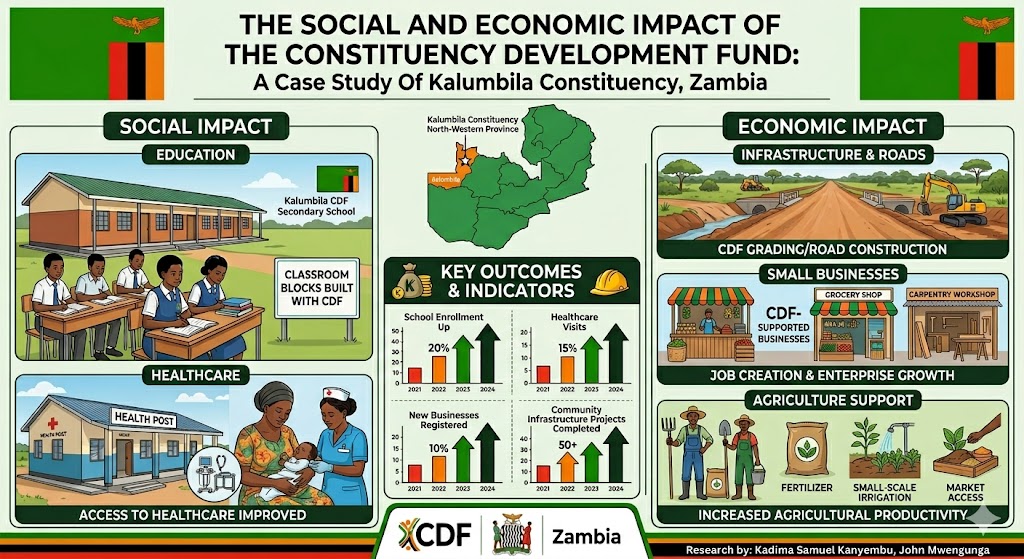
- Authors: Kadima Samuel Kanyembu, John Mwengunga
University: DMI St. Eugene University, Chibombo, Zambia.
Level: Master’s Degree in Education (Civic Education)
Date of Submission to University: December 2025.
Date of Publication: 10th June 2026.
Abstract
This study investigates the social and economic impacts of the Constituency Development Fund (CDF) in Kalumbila Constituency, Zambia. Since its inception in 1995, the CDF has served as a primary mechanism for fiscal decentralization, aimed at poverty reduction and community empowerment. Utilizing a mixed-methods approach—including quantitative surveys and qualitative interviews—the research identifies the types of projects funded, assesses community participation levels, and evaluates resident satisfaction. Findings indicate that while the CDF significantly impacts education and health infrastructure, challenges such as political influence, low technical capacity, and limited awareness of guidelines persist. The article concludes with recommendations for enhancing transparency and financial literacy to maximize the fund’s developmental potential.
1.1 Introduction
Poverty and unemployment remain significant threats to socio-economic development in rural Zambia. To address these challenges through decentralized governance, the Zambian government introduced the Constituency Development Fund (CDF) in 1995. The fund is designed to empower local communities by allowing them to identify and implement projects that address their specific needs, particularly in health, education, and water services. In 2023, the budgetary allocation for CDF rose to approximately US$ 1,200,000 per constituency, marking a significant shift in fiscal resources toward the grassroots.
1.2 Meaning of Constituency Development Fund
The definition of Constituency Development Fund (CDF) in Zambia is polysemic. It means various things to different people in different categories where it can be applied or implemented.
a) From the Legal point of view:
It is a fund established by article 162 of the Constitution of Zambia Amendment Act (No. 2) of 2016, that promotes citizen-driven and community participation through devolution of power to local authorities for projects and empowerment.
It is money that is from the National Budget allocated to constituencies by the Parliament utilized through a decentralization system in accordance with the CDF Act (No. 1) of 2024.
b) From the Civil Societies points of view:
It is a government initiative aimed at financing local projects, empower women, orphans, vulnerable children and youths with skills training, education and vocational training (ACA, 2022).
It is money established by the Constitution of Zambia Amendment Act (No.2) to ensure that development reaches the grassroots level and it is not concentrated only in urban areas (TIZ, 2022).
c) From the Economic Point of view:
It is the fiscal decentralization of financial resources that promotes citizen’s decision-making at grassroot level to empower them economically through grants, loans and projects fund for economic growth, poverty reduction and improved livelihoods at the Constituency or community level (Malama, 2012).
d) From the Monitoring and Evaluation point of view:
It is a fund, which is from the Zambia National Budget, established by articles 162 of the Constitution of Zambia Amendment Act (No. 2) of 2016 and implemented using CDF Act (No, 1) of 2024 which has to be distributed to all the constituencies with the following outcomes: improved living standard, stimulated local economic growth, enhanced access to basic services such as water, healthcare and improved infrastructure development (CPA, 2016).
From the various meanings established above, it becomes apparent that, Constituency Development Fund (CDF) is a financial allocation given by the Central Government, established under article 162 of the Constitution of Zambia Amendment Act (No. 2) of 2016, and implemented using CDF Act (No. 1) of 2024 in order to support community projects and empower people at the local level in Zambia.
1.3 Theoretical and Conceptual Framework
The study was grounded in Principal-Agent Theory and Social Capital Theory. The conceptual framework views the CDF through three main components:
- Inputs: Financial allocations, human resources, and regulatory frameworks.
- Processes: Project identification, resource disbursement, and monitoring and evaluation (M&E).
- Outputs/Outcomes: Social outcomes (infrastructure, community cohesion) and economic outcomes (job creation, poverty reduction).
1.4. Methodology
A mixed-methods research design was employed to capture a comprehensive view of the CDF’s impact in Kalumbila District.
- Quantitative: Cross-sectional surveys were conducted with community members to gather numerical data on perceptions and experiences.
- Qualitative: Semi-structured interviews, focus group discussions, and direct observations were used to gain deeper insights into participant motivations and social dynamics.
- Analysis: Content analysis was used to systematically review government policies and disciplinary records related to the fund.
1.5. Findings and Discussion
1.5.1 Project Identification and Distribution
The study found that the CDF in Kalumbila has prioritized education-related projects, such as building classroom blocks and laboratories, followed by health facilities.
1.5.2 Community Participation and Awareness
Participation levels are notably high, with 69.5% of respondents indicating they had participated in CDF-funded projects. However, the effectiveness of this participation is often hampered by a low understanding of the formal CDF guidelines. Awareness of the fund is generally “average,” with 50% of the sample falling into this category.
1.5.3 Resident Satisfaction
Approximately 80% of respondents expressed satisfaction with CDF-funded projects. The primary drivers of satisfaction are the tangible improvements in healthcare and education accessibility.
1.5.4 Challenges
Despite the positive impact, several barriers remain:
- Political Interference: The fund is sometimes perceived as a tool for political patronage rather than a neutral development initiative.
- Mismanagement: Embezzlement and misallocation of funds have been reported by watchdog organizations.
- Capacity Constraints: Local authorities often lack the human and technical resources to manage large-scale projects effectively.
1.6. Conclusion and Recommendations
The CDF is a vital tool for rural development, but its success depends on moving away from “top-down” mentalities. To improve outcomes, the study recommends:
- Financial Literacy: Conducting workshops to help local entrepreneurs manage start-up capital effectively.
- Enhanced Transparency: Implementing robust monitoring and evaluation systems and social audits to rebuild trust between the community and leadership.
- Inclusive Decision-Making: Ensuring that marginalized groups, including women and youth, are actively involved in project selection through community forums.
References
Alliance for Community Action (ACA), 2022 Report.
Chikoko, V. (2015). The Constituency Development Fund in Zambia: Challenges and prospects. Zambia Governance Foundation.
Constituency Development Fund Act (No. 1) of 2024.
Constitution of Zambia Amendment Act (No. 2) of 2016.
Government of the Republic of Zambia (2006). Constituency Development Fund Guidelines.
Malama, E. (2012). Local Government in Zambia . Lusaka: Zambia Educational Publishing House (ZEPH).
Mfula, C. (2017). Participatory Development in Zambia.
Ministry of Local Government. (2021). Councillors’ and Officers’ Manual. Lusaka: GIZ.
Mwenzwa, E. M. (2007). The Weaknesses of CDF Management in Zambia.
National Assembly of Zambia (2023). Budgetary Allocations for 2023.
TIZ. (2022). Constituency Development Fund: Issues Brief. Lusaka: Transparency International Zambia. Retrieved December 31, 2024, from https://tizambia.org.zm/wp-content/uploads/2022/08/Report_Constituency-Development-Fund-Issues-Brief.pdf
Similar Posts by The Mt Kenya Times:
- Mt Kenya Times ePAPER September 19-20, 2026
- Kenya joins US and UK to put citizens on the terrorism frontline
- Kenya’s parliament races to tame the AI frontier
- Kalonzo calls Ruto to order over Uhuru attacks
- Gachagua takes his 2027 campaign to America
About the Author