From rubble to resource: Why Kenya must embrace circular engineering
 The Mt Kenya Times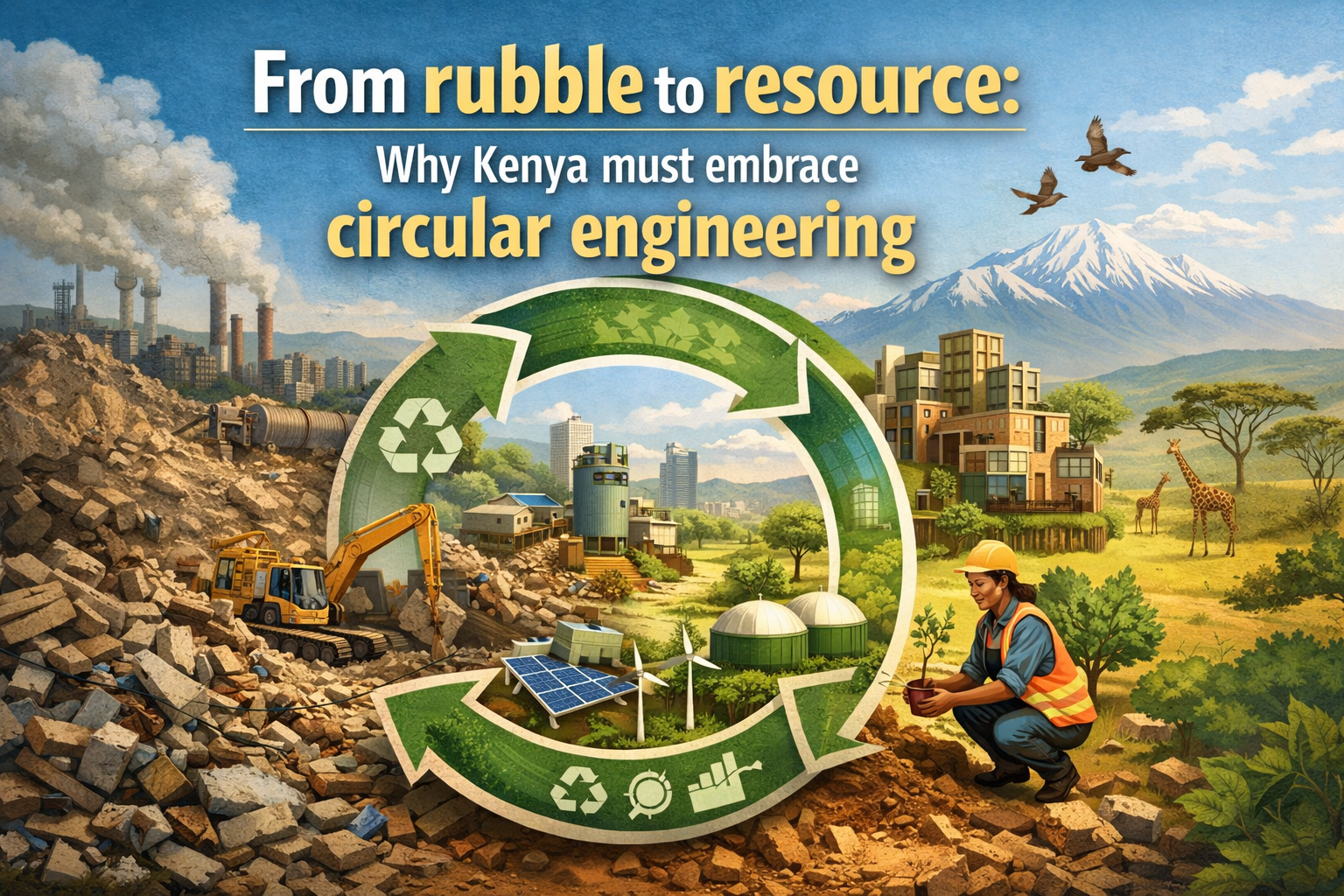
As the country’s building boom accelerates, engineers face a choice between old habits and a smarter, more sustainable way to build
By David Nyaga
Kenya is in the midst of a historic infrastructure boom, driven largely by the nationwide rollout of the Affordable Housing Programme and the rapid expansion of urban centres. As cranes dot the skylines of Nairobi, Mombasa and emerging urban nodes, the engineering profession finds itself at a critical turning point. For decades, the industry has operated on a linear “take-make-dispose” model: extracting raw materials such as sand and quarry stone, erecting structures, and eventually demolishing them with little thought given to material recovery. Today, this volume-based approach is proving both economically inefficient and environmentally unsustainable, making the pivot toward circular engineering an urgent one.
The traditional construction life cycle has long treated buildings as permanent, immovable fixtures until they reach the end of their utility, at which point they are reduced to rubble. In Kenya’s fast-growing metropolitan areas, construction and demolition waste already accounts for a significant share of municipal solid waste, clogging landfills and representing billions of shillings in lost material value. Beyond the waste itself, the environmental cost of material extraction is steep. Heavy reliance on cement and steel introduces vast amounts of embodied carbon into the atmosphere long before a building is ever occupied. In an era where climate resilience matters more than ever, the engineering sector can no longer treat environmental sustainability as a luxury or an afterthought; it must be a fundamental design requirement.
Moving away from this linear trap begins with integrating advanced technology and alternative materials directly into the design phase. A key driver of this shift is the move from traditional drafting to Building Information Modelling (BIM) and digital twin technology. By creating accurate digital replicas of physical buildings, engineers can predict material requirements with far greater precision, significantly reducing on-site waste. This digital oversight ensures that procurement is exact and offcuts are kept to a minimum.
Alongside this, a quiet renaissance in sustainable building materials is reshaping structural engineering across the region. There is a growing shift toward Interlocking Stabilised Soil Blocks (ISSB) and Compressed Soil Blocks (CSB), which can be manufactured on-site or close to it, drastically cutting the carbon footprint associated with heavy transport. Modern engineered timber and sustainable forestry practices are also proving that organic materials can meet the structural demands of contemporary development while actively sequestering carbon. Meanwhile, prefabrication and modular construction methods are gaining traction, allowing components to be factory-assembled with high precision and shipped to site, minimising waste and speeding up project delivery.
Despite the clear benefits of these innovations, the shift to a circular economy is far from straightforward. The most stubborn barrier is cultural: the deeply entrenched “concrete-first” mindset. Many developers and members of the public still assume that alternative materials or circular designs signal substandard or temporary construction. Engineers, and the journalists who cover them, face the task of demystifying these technologies and demonstrating that sustainability need not come at the expense of structural integrity or aesthetic appeal.
A skills gap compounds the challenge. A truly circular economy needs engineers who are skilled not just in construction, but in “Design for Disassembly” (DfD) — an approach that treats buildings as material banks, where beams, blocks and fixtures can be cleanly unbolted, extracted and repurposed at the end of a building’s life. Training the next generation of engineers to balance traditional structural mechanics with lifecycle material management will be essential to closing this gap.
Ultimately, as Kenya continues to build at an unprecedented scale, the role of the modern engineer must evolve from a purely technical designer to a genuine resource manager. Shielding builders from global price shocks in imported steel and clinker depends heavily on making better use of locally available, reusable materials. By embracing circular economy principles, Kenya’s construction industry can ensure that the infrastructure built today does not become the waste burden of tomorrow.
The pivot to circularity, then, is not merely an environmental mandate. It is a blueprint for economic resilience — one that can help the country’s housing and urban development drive deliver sustainable, long-term dividends for generations to come.
Similar Posts by The Mt Kenya Times:
- When young lives become disposable
- The day death refused to be scammed
- Statement win at the Gtech: Brentford outclass Chelsea to claim all three points
- When disability funds become a frontier for accountability: Kenya’s PWDs refuse to be invisible
- Public voices concerns over proposed education laws
About the Author