
Beyond welfare: Why Kenya must reimagine disability as a constitutional. Development and human rights imperative
 The Mt Kenya Times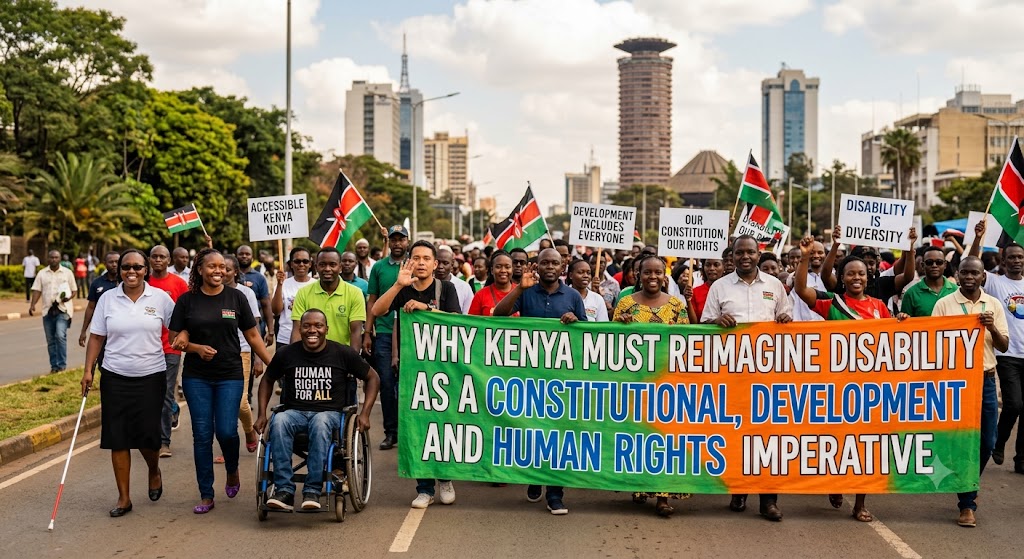
By Mr. Fredrick Kipchumba Chelimo PWD
Chairperson, Jiamini Disability network Community Based organization
Email: jiamini.network@gmail.com
“The world is enabled or disabled not by medicine or biology, but by the choices societies make”
As Kenya advances towards becoming a prosperous, inclusive and globally competitive nation, one profound national contradiction continues to demand urgent attention. While the country has enacted progressive constitutional and legislative protections for persons with disabilities, millions of citizens with disabilities continue to live between the promise of equality and the reality of exclusion.
This contradiction is not simply a failure of implementation, but a deeper policy misunderstanding. Kenya has mainly approached disability through the lens of welfare and social assistance rather than recognizing it as a constitutional right, development priority and a matter of economic justice. The time has come to rethink fundamentally that approach.
The Constitution of Kenya 2010, affirms that every citizen is equal before the law and intitled to inherent dignity, equal protection and freedom from discrimination and further requires affirmative measures to ensure PWDs have reasonable access to public education, transport, employment, information, communication and every sphere of public life. These guarantees are neither symbolic nor optional, but binding constitutional obligations.
In Kenya, these guarantees are reinforced internationally by ratifying the United Nations Convention on the Rights of Persons with Disabilities (UNCRPD) that recognizes disability results not only from physical or sensory impairments but also from environmental, institutional and societal barriers that prevent full realization of full potential on PWDs capabilities and abilities in the society. African Union has a similar protocol that stresses that disability is not a favour to be accommodated but a constitutional entitlement that demands practical implementation
Yet the lived experience of many Kenyans living with disabilities tells a different story. Government currently provides limited support to some PWDs through Inua Jamii social protection- programme and some assistive devices. While acknowledging the gesture, the monthly 2,000v shillings cannot realistically pay for a caregiver per month leave alone to compensate for economic consequences of disability. Disability imposes costs that citizens have to meet including transport, assistive devices, specialized communication technologies, medical costs, rehabilitative services, personal assistance, sign language interpreters, home modifications among others. These are not luxury expenses.
Consequently, disability support should not be viewed as poverty support, but should be understood as a compensation for disability-related barriers that prevent equal participation in the society. It is intended to narrow the gap between the disability limits and what constitutional equality promises. The measure of public support should be informed by the actual economic burden created by disability rather than arbitrary welfare allocations.
Equally important, disability support should not be discriminatory by pegging benefits to employment status or income status, but should be standardized to recognize disability and compensate the disability challenge. The compensation should be linked to disability-related costs rather than employment or income status. Poverty reduction and disability compensation serve different public purposes and should not be conflated.
Across political campaigns, government policy papers and development programmes, certain clusters of the society are frequented fronted as the principal vulnerable groups deserving affirmative action. While the group or cluster may be facing profound structural inequalities that requires deliberate policy response, the interventions must continue. However, such national conversations become incomplete when disability is treated as a secondary concern.
PWDs are not a separate constituency existing outside society’s other vulnerable group. They are men, women, youth, children and older persons from all sections of the society. Disability intersects with every category of vulnerability recognized in public policy. A woman with disability often experiences both gender inequality and disability related exclusion. A child with disability faces the ordinary vulnerabilities of childhood while confronting barriers to education, rehabilitation and social acceptance and other unique challenges to age, gender and nature of disability.
Disability should not occupy the margins of development planning but should become a central consideration in every programme designed to address vulnerability because disability cuts across every social category and every stage of life. A nation committed to leaving no one behind must recognize that addressing disability inclusion strengthens outcomes for men, women, childe and youth of the nation.
Unfortunately, implementation remains Kenya’s greatest weakness with numerous legal protections largely unfulfilled, The Access to Government Procurement Opportunities continues to record inconsistent participation especially by disability-owned enterprises despite clear policy intentions. Adverts on AGPO related tenders remain skewed to the disadvantage of PWDs and real actualization remains unaudited for conformity.
Many buildings remain inaccessible and for the few which are accessible other utilities remain hostile to disability long after enactment of legal and regulatory frameworks. Healthcare systems remain unsupportive of disability groups, while education, employment and public participation continue to remain exclusive. The challenge is no longer absence of the law; it is absence of accountability. This call for parliament to reassess both its understanding of disability and its oversight responsibility.
Disability related support should progressively move from symbolic welfare towards evidence-based compensation that enable equal participation. Parliament should purpose to undertake yearly national disability compliance audit across all public institutions, state departments, constitutional commissions, state corporations and compile a compliance report to measure accessibility, employment, procurement, education, healthcare, budget allocations and implementation of implementation corrective measures within defined timelines. Senate should equally strengthen its oversight and compliance surveillance in counties. It aim should be to ensure disability inclusion is integrated into all departments and sectors rather than being confined in social services alone.
Universities, professional bodies, financial institutions, media, and development partners should mainstream disability across all programmes rather than treating it as an isolated issue. Most importantly, persons with disabilities should occupy themselves the center of policy formulation, implementation, and evaluation, ensuring that sustainable solutions cannot emerge without leadership, knowledge and lived experience of those directly affected. The principle of Nothing about us without us” should become the standard governing every disability-related decision.
It should be noted that every inaccessible school leaves a talent undeveloped, hospital diminishes human dignity, workplace reduces national productivity, law left unenforced weakens constitutional governance and every capable citizen excluded from economic life represents lost national potential. Disability is not a burden carried only by individuals but a national development issue, a constitutional responsibility and a test of democratic maturity. Kenya possesses the legal mandate, constitutional mandate, and international commitment.
What remains is the political will and courage to transform those promises into lived realities. When this occurs, Kenya will not merely improve lives of PWDs, but strengthen its democracy, deepen social justice and demonstrate that true development is not measured by the majority alone, but by dignity, opportunity and inclusion afforded to every citizen.
“Throughout history people with disabilities have been institutionalized and segregated, which tends to make you think it’s a group in need of charity. It is NOT about charity; it is about EMPOWERMENT” Jay Ruderman
Similar Posts by The Mt Kenya Times:
- Mt Kenya Times ePAPER October 12, 2026
- Gachagua’s party storms Kikuyu from afar as 2027 countdown begins
- Counties caught: The KSh100B payroll scandal Kenya can no longer hide
- CS Ogamba: tree planting could generate carbon credit millions to fund education
- Farouk Kibet calls for unity and development as leaders rally behind Ruto’s 2027 re-election bid
About the Author

Kenya needs to rethink on matters inclusion if it is to rise above where it is currently💯
Kenya needs to rethink on matters inclusion if it is to rise above where it is currently💯