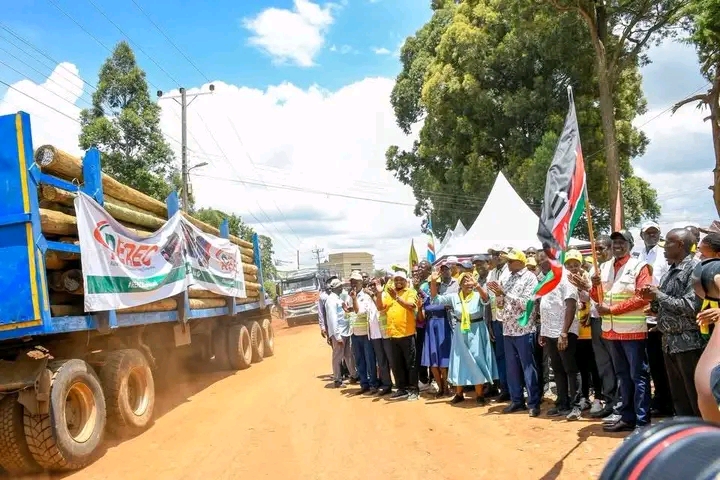
Government to roll out bold strategies to boost livestock feed manufacturing

House Farm Chief Executive Officer John Muhia (Left), AKEFEMA Chairman Joseph Karuri (Centre) and Newton Kariuki (Right) who is head of Animal Feed and Nutrition Section at State Department of Livestock.
…..with manufacturers agreeing to sign contracts with farmers
By Nicholas Waitathu
Government in conjunction with agriculture stakeholders is fast-tracking new strategies to stimulate production of more and affordable animal feed to increase livestock productivity and income to farmers.
At the same time feed manufacturers have expressed the need to sign contracts with farmers as part of ensuring their mills enjoy security of supply of raw materials and seeking for strategic investments.
During the just concluded two day Association of Kenya Feed Manufacturers (AKEFEMA) Feeds Exhibition and Conference (AFEC) Nairobi 2026 at a Nairobi hotel, the Government confirmed that the commercial feed deficit in the country currently stands at 60 per cent against an annual demand production of four million metric tonnes.
The industry currently produces about 2.5 million metric tonnes of animal feed annually, slightly above 60 per cent of the country’s installed capacity of four million metric tonnes, largely due to inadequate raw material supplies.
Head of Animal Feed and Nutrition section at state department of livestock Newton Kariuki Nyaga said local livestock farmers are struggling with acute shortage of feed as scarcity of raw materials escalates.
“As Government and other value chain players we are at different stages of discussion and implementation of various initiatives to spur high production of animal feed. The initiatives include the Sh460 billion 10 year National Feed Strategy, Livestock Master Plan, National Strategic Feed Reserve and subsidies,” said Mr. Kariuki.
Over 200 local and international feed manufacturers are in Nairobi for a two day conference to discuss current challenges facing the industry in addition to recommending new strategies to enhance investment.
The national feed strategy he explained targets 14 value chains with a view to increasing fodder and pasture production. Key value chains include sunflower, cotton maize, soybean, canola, sorghum and edible oils. To stir high feed production, Kariuki encouraged the manufacturers to adopt new technologies and stronger quality assurance in addition to ensuring the workforce is highly skilled. Further the Government is fast tracking one ward one fodder initiative targeting production of 300,000 metric tonnes of dry matter annually, by 2028 in 1450 electoral wards.
AKEFEMA National Chairman Joseph Karuri acknowledged the industry potential though the same is threatened by a myriad of challenges including multiple taxes, regulatory charges, and lack of finance, climate change and supply chain resilience and narrow range of available materials. “The industry’s fastest growing segments include poultry, dairy, pig production and aquaculture. Poultry is Kenya largest feed market accounting 60 per cent and dairy subsector at 29 per cent,” said Mr. Karuri.
He welcomed government plans to allow duty-free importation of feed ingredients under the Duty Remission Scheme (DRS), saying the move is expected to lower production costs and eventually reduce feed prices for farmers.
”If we produce these raw materials locally, feed prices will reduce significantly because raw materials account for between 70 and 80 per cent of production costs. Going forward, value chain players need to adopt artificial intelligence and digital formulation, undertaking automation and smarter feed mills and real time quality monitoring and rapid laboratory diagnostics,” he added.
House Farm Chief Executive Officer John Muhia said technological innovations are helping manufacturers detect aflatoxins and other mycotoxins before the same reaches the market thus improving safety and protecting livestock health.
AFEC being held in Nairobi for the second time has attracted more than 200 local and international feed companies, government representatives from 27 countries, researchers and development partners.
Contract farming
The animal feed manufacturers Karuri confirmed are exploring sealing contract farming with maize growers to address shortages of key raw materials that continue to limit production capacity.
The feed processors plan to work with farmers through structured supply agreements to improve access to locally produced inputs for commercial animal feed production.
“Currently, we are not able to produce enough commercial feed for the country’s livestock largely due to lack of key raw materials,” said Karuri.
The proposed contract farming model will target maize farmers by providing a more predictable market for their produce while helping feed manufacturers secure reliable supplies.
Key concern by the feed value chain players is how to increase production of commercial animal feeds and more so the need to tackle challenges hindering investment.
The millers further plan to take advantage of Government efforts to lease idle land held by various corporations, for example, Agricultural Development Corporation (ADC).
Adoption of GMO
Durinv the conference scientists urged the Kenyan government to allow the use of biotechnology-derived feed ingredients, saying the move would ease chronic shortages of raw materials, lower feed production costs and improve livestock productivity.
International Service for the Acquisition of Agri-biotech Applications (ISAAA) AfriCenter, Director, Dr. Margaret Karembu said reliance on imported feed ingredients was undermining the competitiveness of the livestock sector.
Countries with competitive livestock industries she addedrely heavily on genetically modified (GM) maize and soybean for feed.
“For a long time, we have had challenges accessing raw materials to produce animal feed. More than 80% of feed ingredients traded globally are now biotech products,” said Dr Karembu.
”Further, we are seeking support from researchers to enable farmers to grow yellow maize which is a key component of raw materials. We are optimistic that undertaking by the Government in various agriculture sub-sectors like edible oil, cotton and soybean farming will help in producing other ingredients like cotton cake and sunflower to boost proteins in the feeds,” Karuri added.
AKEFEMA chief executive officer Paul Kamau said during the upcoming conference stakeholders will seek to deepen value chain actors learning from leading international experts in the feed and food industries.
”The conference will help us discover global trends shaping animal nutrition, feed manufacturing and food systems. Build strategic partnerships with industry leaders from around the world and explore innovative products, technologies and solutions from exhibitors and experience Kenya’s renowned hospitality, culture and business environment,” said Mr. Kamau.
Similar Posts by The Mt Kenya Times:
- Kenya as a global nation
- Hardship and peer pressure in universities
- Laikipia students swap lectures for Ingwamiti Hills
- We told our children to study, but where are the jobs?
- Kenya’s research reactor: A bet on knowledge and self-reliance
About the Author