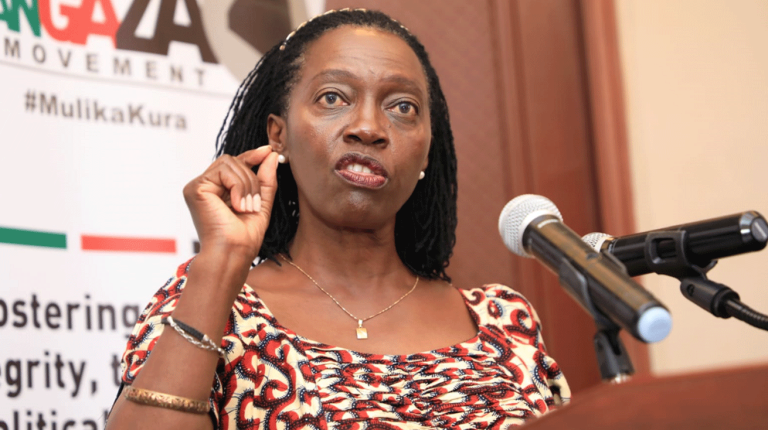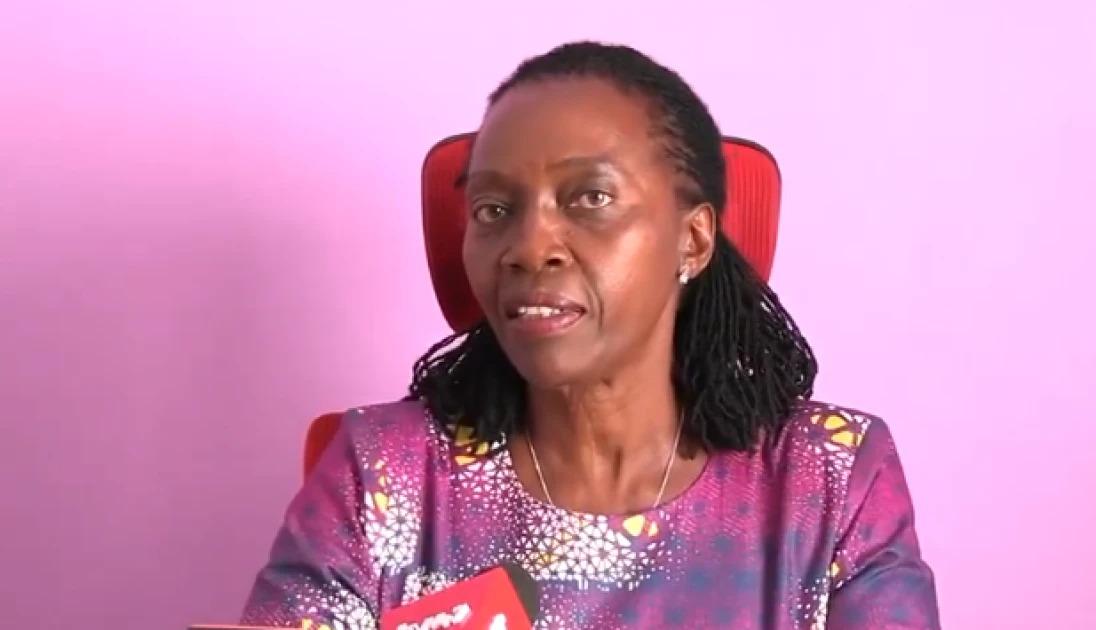
People's Liberation Party leader Martha Karua
PLP leader rules out deputy president role, vows to back united opposition flag bearer or run herself
By Daisy Njeri
People’s Liberation Party leader Martha Karua has declared she will not accept the deputy president position under any united opposition arrangement, saying she will either contest the presidency herself or throw her full weight behind whoever the coalition selects as its flag bearer.
Speaking on Citizen TV’s The Explainer on Tuesday night, Karua was unambiguous. The rules of the alliance would determine the candidate, and she would honour that process — but the running mate slot was categorically off the table, regardless of who emerged at the top of the ticket.
“I will support the one who is chosen in accordance with the rules we have set. The only thing I will not do is be a running mate. That one I say. I’ve no wish to be a running mate. I did a good run with Raila Odinga. That’s just about enough. But it’s all or nothing,” she said.
The declaration carries considerable political weight. Karua served as Raila Odinga’s running mate in the 2022 general election under the Azimio Coalition, becoming the first woman to contest the deputy presidency on a major party ticket in Kenya’s history. That experience, she made clear, was sufficient. She has no appetite for a repeat, regardless of the stature of the principal.
“If I am not the flag bearer, I will support one hundred per cent. But I won’t be a running mate,” she added, leaving no room for ambiguity or negotiation on the point.
The position reshapes the arithmetic of the emerging united opposition coalition in ways that will take time to fully compute. With Karua removing herself from contention for the deputy slot, attention now turns to who fills that space. The coalition’s current principals form a crowded and formidable field: Wiper Party leader Kalonzo Musyoka, Democracy for the Citizens Party leader Rigathi Gachagua, Jubilee’s Fred Matiang’i, former Chief Justice David Maraga, and Nairobi Senator Edwin Sifuna of Linda Mwananchi are among those whose names now feature more prominently in conversations about the deputy president position. Each brings a different regional calculus and a different set of political expectations to the table, and the task of assembling a ticket that satisfies all factions while maximising the coalition’s electoral reach will test the alliance’s internal cohesion well before a single vote is cast.
Beyond the question of the ticket, Karua used the interview to lay out with unusual specificity what she would do if elected president. Her answer was not abstract. She reached immediately for the rule of law — not as a slogan, but as an operational priority — and gave a timetable.
“I will immediately enforce the rule of law; make sure that we adhere to the rules of the game that we have made as Kenya, safeguard Kenyans’ interests first, ensure that quality services are delivered in the critical areas of health, education, and service delivery,” she said.
She went further, committing to a functional state within 90 days — a bold claim that she grounded not in aspiration but in precedent. Karua was a minister in the National Rainbow Coalition administration that came to power in 2002 under Mwai Kibaki, an era widely remembered as a period of rapid early institutional renewal following decades of single-party stagnation.
“Within 90 days, you should have a functional state. And I say that with boldness because I saw it when we came in as the NARC administration. No law was changed, not even the constitution. And within a matter of days, things were running differently,” she said.
The argument is that transformation begins at the top, not in legislation. When leadership’s actions align with its words, Karua contended, the effect cascades downward through the public service and into the wider citizenry.
“When the top shows that their actions match their words, the people of Kenya take cue. Government employees take cue. And Kenyans are very good at assisting leadership in doing the work that is supposed to be done,” she said.
It is a governing philosophy built on accountability rather than structural overhaul — the premise that the institutions Kenya has are adequate, and that what has been missing is the will to make them function as designed. Whether that argument resonates with a public that has heard variants of it from successive administrations will depend heavily on Karua’s ability to project credibility over the course of a long campaign.
On the question of accountability, she was pointed. Lawbreakers, she said, would be dealt with regardless of their rank or political proximity to power — a remark that, in the current political climate, carries implications that most listeners will not struggle to decode.
“I would ensure that services, normal service delivery, resume, and that lawbreakers, whatever their position or rank, are dealt with. And that’s how you begin transformation,” she said.
The interview confirmed what many in opposition circles have suspected: Karua is not positioning herself as a kingmaker or a coalition asset to be deployed at someone else’s discretion. She is running — or she is stepping aside entirely. There is no middle ground, and she has made that plain with a clarity that is increasingly rare in Kenyan politics.
For the united opposition, the message is both a complication and a gift. Karua off the deputy ticket narrows one set of options. But Karua fully behind the coalition’s candidate, on her own unambiguous terms, is a different and potentially powerful proposition.
In a coalition where ambiguity has become a survival strategy, she has chosen the other path entirely.
Similar Posts by The Mt Kenya Times:
- Diaspora Times Global Sep 5 – Sep 11, 2026
- Mt Kenya Times ePAPER September 5-6, 2026
- Kenya secures AGOA extension to 2028, unlocking continued duty-free access to US market
- Kenya’s public wage bill set to hit KSh1.287T as county spending strains fiscal limits
- KRA waives all tax penalties in year-end amnesty
About the Author