The Mt Kenya Times
Controller of Budget Margaret Nyakang'o
With public debt at KSh12.82 trillion and 71 per cent of revenue consumed by loan repayments, the Controller of Budget warns the country is caught in a vicious cycle it may not escape
By Hadassah Karangu
Every Kenyan born today arrives in the world already carrying a debt of approximately KSh228,000 — money they never borrowed, spent or approved. It is a silent inheritance that grows by the second, and the ledger has never been heavier. Kenya’s public debt has reached KSh12.82 trillion, with 60 per cent held domestically and 40 per cent owed to external creditors. The question is no longer whether Kenya should borrow. The question is how much is too much — and who ultimately pays.
The answer, delivered with unusual bluntness by Controller of Budget Margaret Nyakang’o before the National Assembly’s Public Petitions Committee this week, leaves little room for comfort. “The total public debt stands at KSh12.82 trillion. The impact is that 71 per cent of the revenue collected goes to loan repayment, leaving us with only 29 per cent to finance government operations,” she told the committee. “We cannot survive. The impact is that we will continue borrowing for us to survive. We can mitigate it, but how we do that is upon us to figure out.”
.
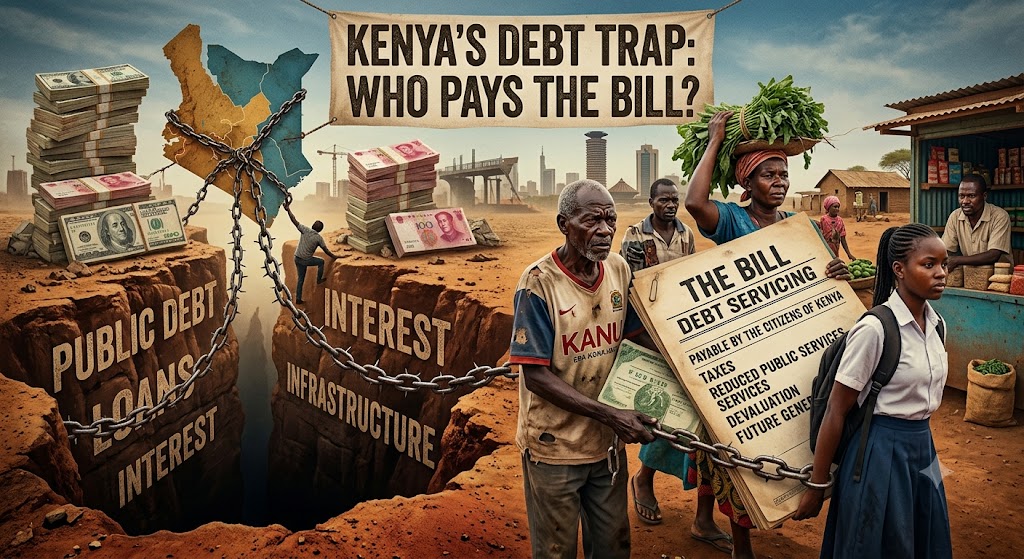
That 71 per cent figure is the one that should concentrate minds across government, Parliament and the public alike. It means that for every KSh100 the government collects in taxes and levies, KSh71 vanishes into debt repayment before a single teacher is hired, a hospital ward is stocked with medicine or a pothole on a county road is filled. The remaining KSh29 is all that stands between functional government and fiscal paralysis — and that margin is narrowing with each new borrowing cycle.
The composition of the debt reinforces the concern. Domestic debt, owed to Kenyan commercial banks, insurance companies and pension funds, accounts for the larger share of the KSh12.82 trillion total, having grown by KSh969 billion in 2025 alone to reach KSh6.84 trillion. The government is increasingly borrowing from the very institutions that manage the savings of ordinary citizens, creating a tight and dangerous loop between sovereign risk and household financial security. When the state defaults or struggles, it is not only taxpayers who suffer — it is the pension funds and insurance policies of the working Kenyans whose savings have been channelled into government paper.
External debt, owed to creditors including the World Bank, the African Development Bank, China and Eurobond holders, constitutes the remaining 40 per cent. China’s bilateral exposure has been contracting — falling to KSh606.05 billion as Beijing’s footprint in Kenya undergoes a measured retreat — but the relief that departure might have offered has been absorbed many times over by accelerating domestic borrowing. The government has not reduced its appetite for credit. It has simply shifted where it shops for it.
In the first nine months of the 2025/26 financial year, more than four out of every ten shillings received by the government went toward servicing this debt, with repayments totalling KSh1.35 trillion against total receipts of KSh3.21 trillion. That is money that did not build a hospital wing, employ a public health officer, fund a bursary or repair a rural road. It serviced the past — and an expensive past at that. Interest payments alone account for 54 per cent of total debt servicing, meaning that for every two shillings Kenya pays toward its obligations, barely one shilling reduces what it actually owes. The rest simply covers the cost of having borrowed in the first place. The principal, as Nyakang’o noted in an earlier appearance before Parliament’s Committee on Public Debt and Privatisation, is not reducing. Kenya is running to stand still.
The problem does not end at the national government’s door. Nyakang’o used her committee appearance to level sharp criticism at county governments, accusing them of systematically diverting funds released specifically to settle supplier obligations — redirecting approved payments to unauthorised expenditures and leaving contractors and service providers unpaid. “When releasing the funds, they go and do different things with the money,” she said. “We are handling a lot of complaints from suppliers who have not been paid. Their details are used to source funds, but when the funds are released, they are redirected by counties to do something else.”
The Controller of Budget was pointed in her frustration. “I am becoming helpless. Counties requisition money for a particular matter; when I approve and release the funds, they are channelled to other uses not authorised,” she told the committee. The Central Bank of Kenya and her office are reportedly working on a formula to address the diversion of supplier funds, though no timeline has been confirmed. What has been confirmed is Nyakang’o’s intention to tighten oversight before the next electoral cycle closes the current administration’s window of accountability. “Pending bills are being left year after year. This year is the final year before the next administration comes in, and we will be very strict on pending bills,” she said.
On transparency, Nyakang’o defended her office’s record, noting that expenditure reports are published online in downloadable formats and regularly analysed by the media. “We publish and publicise. I agree that we need to increase our digital presence and become more active to inform our young people as well,” she said. It was a rare moment of candour about the gap between institutional output and public awareness — a gap that matters enormously when citizens are being asked, through taxes and service cuts, to bear the cost of decisions made without their meaningful participation.
The external picture adds further pressure. The IMF’s April 2026 Regional Economic Outlook projects Kenya’s debt-to-GDP ratio rising to 71.6 per cent in 2026 and 72.4 per cent in 2027, approaching the 2023 peak of 73.4 per cent on the back of persistent fiscal deficits. The World Bank has separately flagged a decline in tax performance — collections have fallen from 16.2 per cent of GDP in 2016/17 to just above 14 per cent — shrinking the fiscal space available for investment in infrastructure, education and health at precisely the moment when demand for those services is growing fastest. Makueni County was singled out by Nyakang’o as a rare bright spot, having received a clean audit report — a distinction that underlines how far most of the country’s 47 counties remain from acceptable standards of financial management.
The generational burden is the dimension least discussed and most consequential. A child born in Nairobi, Kisumu or Eldoret today owes approximately KSh228,000 before drawing a first breath — for debts accumulated across administrations they will never vote for or hold accountable. Young Kenyans now entering universities and job markets will spend their most productive years servicing obligations incurred before many of them were adults. The critical question that no government has answered satisfactorily is whether today’s borrowing is genuinely building their future or simply deferring today’s failures and passing the invoice to those with the least power to contest it.
The path forward demands more than better borrowing. Kenya must grow its economy with genuine intent, strengthen local industries, eliminate wasteful public expenditure and confront corruption with a resolve that successive administrations have so far failed to sustain. Parliament must subject every loan to honest scrutiny — not rubber-stamped approval driven by political convenience — and test each borrowing decision against one straightforward question: will this investment improve the lives of Kenyans sufficiently to justify the burden it places on the public purse?
Nyakang’o offered her own measured assessment of what progress looks like. “Success is not a destination; it is a journey. We have focused on how we are going to improve things,” she said. It was a characteristically careful statement from an official who has been careful throughout — but the urgency beneath it is unmistakable.
At KSh12.82 trillion and climbing, with 71 cents of every revenue shilling already spoken for before government opens for business, Kenya must begin that journey in earnest. The bill will arrive. It always does. The only question that remains is whether this country will be in any position to pay it.
Similar Posts by The Mt Kenya Times:
- Kenya joins US and UK to put citizens on the terrorism frontline
- Kenya’s parliament races to tame the AI frontier
- Kalonzo calls Ruto to order over Uhuru attacks
- Gachagua takes his 2027 campaign to America
- Uhuru owns “sponsor” — and Ruto should be worried
About the Author