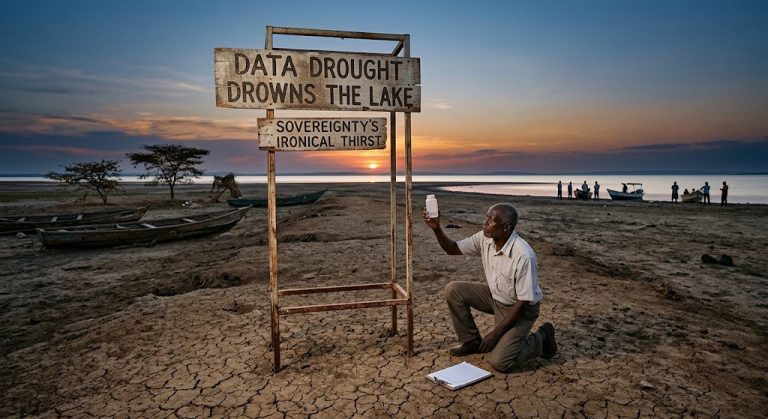
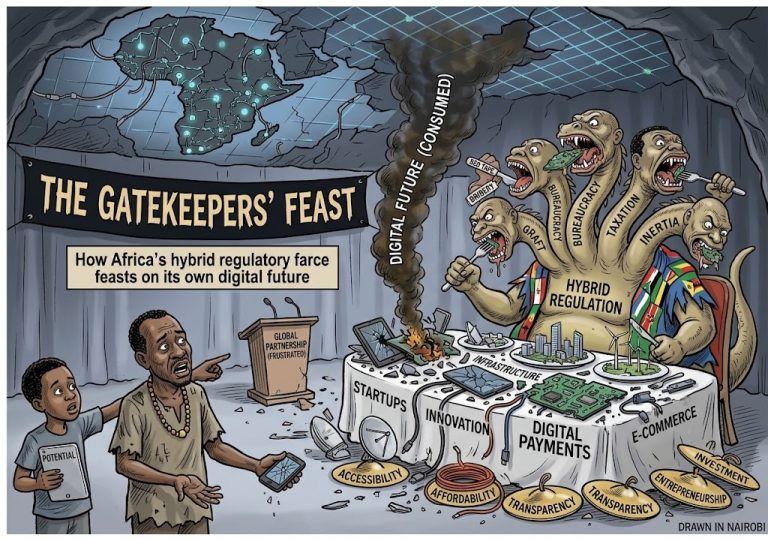
The thirst of technology: When innovation’s chorus drowns the rivers
 The Mt Kenya Times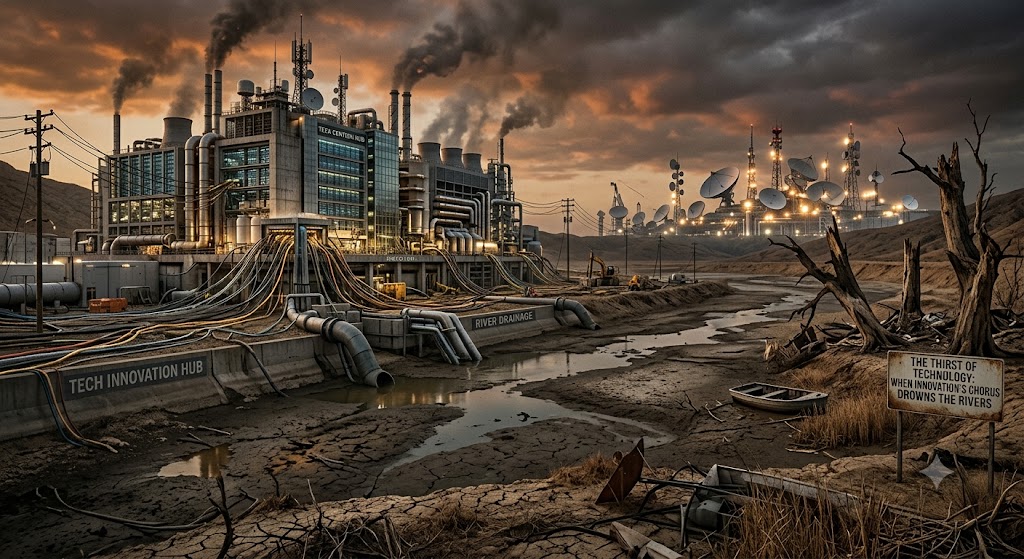
By Jerameel Kevins Owuor Odhiambo
In 2023, United States data centers alone consumed 17.4 billion gallons of water directly for cooling roughly the annual household use of 160,000 American homes while their indirect water footprint through electricity generation added another 211 billion gallons. Globally, data centers accounted for an estimated 560 billion liters that same year. Training a single large language model like GPT-3 has been calculated to evaporate around 700,000 liters of freshwater on-site, with total operational footprints reaching several million liters. These are not projections whispered in academic footnotes; they are measured and estimated realities of the machines already humming. Nevertheless, the public conversation remains almost entirely about speed, capability, and market disruption. Innovation is celebrated as destiny. Water is treated as an afterthought.
This asymmetry is not accidental. It is a failure of imagination and priority dressed up as progress. We have become fluent in the language of breakthroughs parameters, tokens, agents, multimodal leaps while remaining nearly mute on the evaporative cost of keeping those silicon minds from melting. The servers do not think in metaphors; they generate heat. Heat demands cooling. Evaporative cooling systems, still widely used, turn clean water into vapor that does not return to the local watershed. Up to 85 percent of the water drawn for many facilities simply vanishes into the atmosphere. In arid basins and drought-stressed regions, that disappearance is not abstract. It is aquifers drawn down, municipal supplies strained, and communities competing with hyperscale facilities for the same finite resource.
Consider the correlation that should trouble anyone who claims intellectual honesty. The same decade that produced generative models capable of drafting legislation, diagnosing disease patterns, and generating photorealistic imagery has also seen corporate water consumption by major technology firms climb steeply Google’s data-center water use rising from roughly 4.3 billion gallons in 2021 toward figures exceeding 6 billion and, in later reports, higher still; Microsoft recording double-digit percentage increases in consecutive years. Efficiency metrics improve in isolation (lower liters per kilowatt-hour at individual sites), yet absolute consumption rises because demand for computation grows faster than efficiency can compensate. This is the classic rebound effect wearing a silicon mask. We celebrate the cleverness of the algorithm while ignoring the thermodynamic bill paid in water.
Literary devices are not ornament here; they are diagnostic tools. The data center is a modern Leviathan vast, opaque, and thirsty whose appetite is measured in megawatts and megalitres. Innovation is the bright carnival that draws the crowd; the rivers and aquifers are the quiet stagehands whose labor is never applauded. We speak of “training” models as if they were athletes being coached, when the more accurate image is of furnaces being stoked. Each query, each image generation, each fine-tuning run is a small sip that, multiplied across hundreds of millions of daily interactions, becomes a river diverted. Estimates vary widely some corporate statements claim fractions of a teaspoon per average query, while independent analyses have placed medium-length exchanges in the range of hundreds of milliliters when both on-site cooling and power-generation water are counted but the direction of travel is unambiguous. Scale transforms the trivial into the consequential.
Why the silence? Part of the answer is narrative capture. Technology discourse has long privileged carbon over water because carbon fits the existing climate narrative and is easier to offset with certificates and renewable power purchase agreements. Water is stubbornly local. A megawatt of renewable electricity in a wet region carries a different water intensity than the same megawatt in a desert. Optimizing solely for carbon can worsen water stress, a trade-off that single-metric sustainability reports conveniently obscure. Another part is opacity. Model cards routinely list energy or carbon estimates; water withdrawal and consumption figures remain scarce, inconsistent, or aggregated beyond usefulness. Without transparent, facility-level data, public accountability is impossible and internal innovation toward water-sparing designs is under-incentivized.
There is also a deeper cultural reason. We have internalized the myth of dematerialization—the idea that digital services float free of physical constraint. The cloud is imagined as ethereal rather than as rows of servers in concrete halls that must be cooled continuously. This myth is intellectually lazy. Every bit processed has a thermodynamic cost. Every model trained or inferred has an embodied and operational water footprint that includes not only cooling but the water used to generate the electricity and, upstream, to manufacture the chips. Ignoring that chain is not sophisticated; it is willful blindness.
Original insight demands we refuse the false binary. The choice is not innovation versus environment. The choice is whether innovation will be defined by raw capability alone or by capability achieved within planetary boundaries. Water is not a soft externality. Freshwater suitable for human use is already under pressure from population growth, climate-driven drought, and aging infrastructure. By 2030, global freshwater demand is projected to outstrip supply by roughly 40 percent in many assessments. Placing rapidly expanding, water-intensive infrastructure into stressed basins without rigorous local accounting is not progress; it is extraction wearing the costume of the future.
Call the silence what it is: a failure of intellectual and moral seriousness. Boards and engineers who can optimize matrix multiplications to the edge of physical possibility somehow cannot, or will not, treat water as a first-class design constraint equal to latency or cost. Policymakers who draft AI safety frameworks that emphasize bias and existential risk often omit water and energy intensity from the core requirements. Journalists and analysts who produce breathless coverage of model releases rarely demand water-usage disclosures with the same intensity they demand benchmark scores. The result is a public square filled with talk of intelligence and almost empty of talk about the rivers that make the intelligence possible.
Deep insight requires correlation across domains. The same computational intensity that enables medical breakthroughs and scientific discovery also concentrates environmental burden in the places where data centers are sited often regions already facing scarcity. Benefits are diffuse and global; costs are concentrated and local. That asymmetry is political as much as technical. Communities in water-stressed areas have begun to push back, not because they oppose technology, but because they recognize that infinite digital expansion collides with finite hydrological reality. Treating their concerns as Luddite is itself a failure of acuity.
There are technical paths forward: air-side economizers, liquid cooling loops that recirculate rather than evaporate, higher operating temperatures, siting decisions that match climate and power-generation water intensity, and genuine water-positive commitments that restore more than they consume. Some operators have begun publishing better metrics and designing for near-zero evaporative loss. These are necessary but insufficient without cultural change. As long as the dominant narrative frames every new capability as an unqualified good and every environmental question as a secondary constraint to be managed later, absolute consumption will continue to climb.
The words we choose shape the future we build. When we speak only of innovation, we license expansion without reckoning. When we insist on speaking of water with the same precision and urgency we apply to parameters and performance, we force the design space to enlarge. True mastery is not the ability to make machines that answer every question. It is the wisdom to ask whether the answers are worth the rivers they cost and then to engineer systems that do not force that choice. The servers will keep running. The question is whether the aquifers will.
The writer is a social commentator
Similar Posts by The Mt Kenya Times:
- Uhuru owns “sponsor” — and Ruto should be worried
- Sengwer youth: When will Kenya stop treating a minority like an afterthought?
- When young lives become disposable
- The day death refused to be scammed
- Statement win at the Gtech: Brentford outclass Chelsea to claim all three points
About the Author