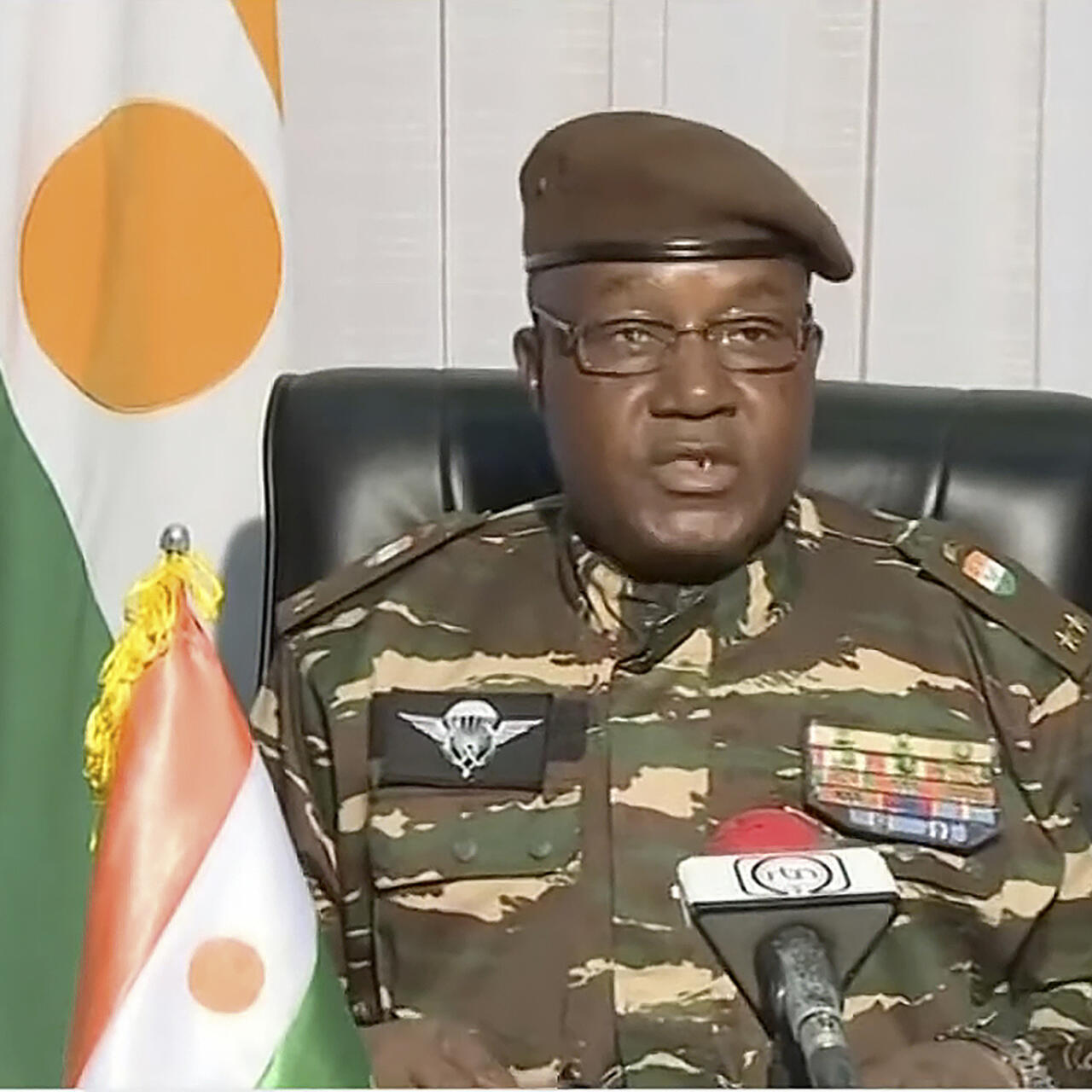
General Abdourahamane Tchiani
Niger’s mutiny reveals a military government undone by the very crisis it promised to end.
By Levis Wangamati
The most critical question emerging from Saturday’s attempted mutiny in Niger is not simply why soldiers attacked strategic installations in Niamey. It is why members of the armed forces turned against the very military government they helped install — a regime that seized power promising to restore security, rebuild the army and reclaim national sovereignty.
That question strikes directly at the heart of the crisis now confronting General Abdourahamane Tchiani’s government.
Niger’s military junta seized power in July 2023 after overthrowing President Mohamed Bazoum, framing the coup as a necessary response to deteriorating security and civilian mismanagement. Three years on, however, the very security crisis used to justify military rule is now applying unprecedented pressure on the military itself.
The security promise is wearing thin
Security was intended to be the junta’s strongest justification for remaining in power. Instead, jihadist violence has persisted across Niger, forcing frontline security forces to absorb staggering casualties. Although the regime severed ties with traditional Western security partners and aligned with Russia, this strategic pivot has failed to dismantle the insurgency.
For soldiers deployed in combat zones, anti-imperialist rhetoric matters far less than whether they have the resources, tactical support and command leadership required to survive. This creates a dangerous disconnect between the government’s official narrative and the brutal realities facing troops in the field. A government can temporarily persuade citizens that victory is near; it cannot easily deceive exhausted soldiers who face an unrelenting enemy every day.
When the army begins to lose confidence
Reports indicate that mutinous troops were drawn from units stationed in high-risk areas such as Ouallam, Tera and Dosso — zones where Nigerien forces have suffered heavy losses against al-Qaeda and Islamic State affiliates. Repeated tactical setbacks have bred deep frustration within frontline units, and that frustration provides the vital key to understanding Saturday’s unrest.
Military discontent rarely begins as an abstract political dispute. It begins with physical and operational exhaustion. It stems from the perception that command leadership is failing, that sacrifices are proving futile and that political elites in the capital no longer understand the operational reality on the ground. Once that frustration reaches a tipping point, an internal institutional grievance rapidly escalates into a political crisis.
Saturday’s events were therefore not an isolated breach of discipline. They were a symptom of a profound rift between the junta’s political elite and the military base on which its survival depends.
The junta’s central contradiction
A fundamental contradiction lies at the core of Niger’s crisis. The military seized power on the premise that the civilian political order could not protect the nation. Yet the junta now finds itself trapped by exactly the same problem: persistent, unchecked insecurity.
This failure creates an existential credibility crisis. If a military government cannot deliver the basic security improvements that justified its takeover, its legitimacy evaporates. While any regime suffers under such conditions, for a junta the consequences are immediate and dangerous.
Military regimes rely fundamentally on the image of an undivided, highly capable armed force. The moment soldiers begin turning their weapons on their own commanders, the regime’s primary source of authority becomes its greatest vulnerability.
The symbolism of the targets
The specific sites targeted during Saturday’s unrest underscore the political ambition of the mutineers. Attacks focused on Base 101 at Diori Hamani International Airport and key areas surrounding the presidential palace. The airport complex is not merely a civilian transit point — it houses vital military installations and air assets. The presidential district, meanwhile, is the epicentre of state authority.
By striking these targets simultaneously, the mutineers signalled a challenge that extended far beyond grievances with local commanders. They struck at the dual symbols of the regime’s political and military control. Even if contained, the attack exposes deep structural fragility.
The Sahel’s larger military trap
Niger’s predicament reflects a broader and troubling trend across the Sahel. Military governments now dominate Niger, Mali and Burkina Faso. All three assumed power on a wave of public anger over rising insecurity, subsequently expelling Western forces in favour of non-Western security partnerships.
Yet a hard lesson is emerging across the region: removing civilian leaders does not eliminate the root causes of insurgency. Altering geopolitical alliances does not automatically yield tactical victories on the ground. Replacing political figures cannot cure deep-seated institutional weaknesses overnight.
A military can capture the presidential palace in a morning. It cannot capture victory over a complex insurgency simply by changing who sits inside it.
The airport attacks tell their own story
Saturday’s mutiny carries additional weight because it follows two prior assaults on the same airport complex this year. Diori Hamani International Airport and Base 101 were struck in January by an Islamic State affiliate and again in June by a group linked to al-Qaeda. That Niger’s most critical strategic military infrastructure has now been targeted by both external jihadist groups and internal mutineers reveals an alarming vulnerability.
A regime can readily frame external insurgents as a common enemy. It is far more difficult to explain away armed rebellion originating from within the very forces tasked with defending the state.
The real test for Tchiani
Tchiani faces a crisis that extends far beyond securing the streets of Niamey. He must repair shattered confidence within his own military ranks.
Restoring stability requires more than suppressing mutineers. It demands addressing the underlying operational grievances that drove soldiers to take up arms against their own leaders. If those frontline realities remain unaddressed, Saturday’s violence will prove to be a prelude rather than an isolated incident.
The junta came to power precisely because the previous state structure failed to deliver security and confidence. Three years later, the regime faces the harsh reality that the very pressures that brought it to power are now eroding its foundation from within.
The ultimate test for Niger’s leadership is no longer simply whether it can defeat insurgents in the field. It is whether it can maintain unity within its own barracks.
Similar Posts by The Mt Kenya Times:
- Mt Kenya Times ePAPER October 16, 2026
- Oburu marks birthday and brother’s death from Nairobi Hospital bed
- Natembeya and Orengo demand answers over security withdrawal
- Linda Mwananchi Movement: The brand that could reshape Ruto’s path to 2027
- ODM and Linda Mwananchi clash at Raila’s Bondo memorial
About the Author