Kalonzo becoming a movement: The quiet storm that is scaring Ruto
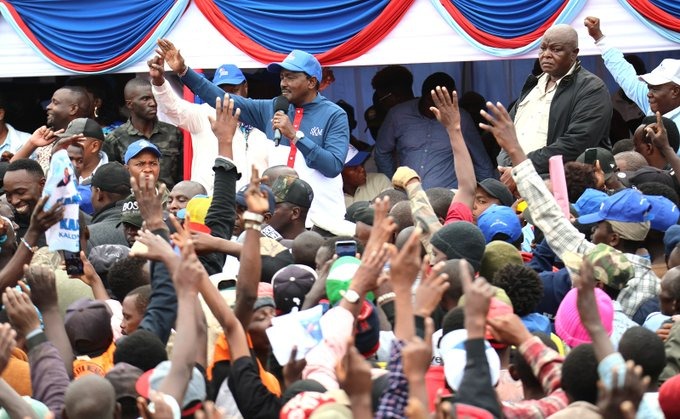
Wiper Patriotic Front leader Kalonzo Musyoka in a rally yesterday
While rivals hold rallies and trade insults, Kalonzo Musyoka is building something more durable — a multiregional coalition stretching from Ukambani to the Coast and into Maasai country that is reshaping Kenya’s 2027 presidential race
By David Kimani
Wiper Patriotic Front leader Kalonzo Musyoka has quietly assembled one of the most geographically diverse opposition coalitions in Kenya’s recent political history, anchoring his Eastern Kenya base, cracking open the Coast through high-profile defections and making deliberate inroads into Maasai country — a combination that is beginning to unsettle President William Ruto’s re-election calculations in ways that no single opposition rally has managed to do.
The strategy is methodical, almost old-fashioned in a political season dominated by caravans, teargas and social media jousting. While Nairobi Senator Edwin Sifuna fills streets with the Linda Mwananchi movement and former Deputy President Rigathi Gachagua battles to own Mount Kenya, Musyoka has been doing something different: consolidating ground that was always his, acquiring ground that was never his, and building the structural machinery of a presidential campaign. The Wiper Patriotic Front has formally advertised for a Presidential Campaign Manager under its “Komboa Kenya” banner — a signal that this is no longer a mobilisation exercise. It is a campaign.
The foundation remains Ukambani — Machakos, Kitui and Makueni — where Musyoka’s grip, though tested, has not broken. In April, the united opposition stormed Machakos County in a series of rallies at Masinga, Matuu, Mbiuni, Kangundo, Mwala, Masii and Machakos Town. Musyoka was unambiguous about the message: “It is coming home.” Gachagua, standing beside him at Masinga, was equally blunt, urging the region to vote only Wiper candidates in 2027: “You need to vote Wiper six-piece.” The combined appearance — two of the country’s most powerful opposition figures on the same platform in Musyoka’s home region — was designed to project the kind of unified force that had been missing from the opposition for years.
The challenge from within remains real. Ruto’s allies in Ukambani have pushed back, accusing Musyoka of running a closed party and denying aspirants fair access to tickets. Some local leaders have openly embraced UDA, and the government has made targeted infrastructure visits to Kitui to chip at Wiper’s dominance. Ruto visited Kitui in July specifically to outline development projects for the region. But Musyoka’s response has been characteristically direct. “Those who have chosen to walk with Ruto have politically sold out the Kamba people,” he told a rally in his stronghold, warning that betrayal of the party line would be punished at the ballot box.
The more striking development has been at the Coast. Here, Musyoka has recruited strategically rather than campaigned broadly, and the results have been significant. His team — comprising Nyali MP Mohammed Ali, Wundanyi MP Danson Mwashako and former Gender Cabinet Secretary Aisha Jumwa — brings together politicians with influence in Mombasa, Taita-Taveta and Kilifi, in what Musyoka described as the beginning of a broader effort to reclaim the Coast for the opposition. The significance of Jumwa’s crossing cannot be overstated. Once a loyal UDA figure who served as Cabinet Secretary for Gender in Ruto’s government, she has not merely changed parties — she has declared a counter-mobilisation. “We are the ones who registered UDA members in Kilifi, and we are embarking on a grassroots campaign to deregister them from UDA and join Wiper,” she said at her Kakuyuni residence.
Musyoka has rewarded the defection generously. He has proposed Jumwa as Wiper’s deputy party leader and endorsed her for the Kilifi governorship. Ali, already serving as the party’s deputy leader, has been endorsed for the Mombasa gubernatorial seat. The architecture is clear: Jumwa owns Kilifi’s grassroots machinery, Ali brings Mombasa’s urban weight and Mwashako anchors Taita-Taveta. Together they cover three of the Coast’s six counties — a beachhead that, if held, transforms the region from an assumed government stronghold into a contested battleground.
Musyoka was direct about his intentions, speaking in Kakuyuni: “We want to unite this country and oust the current administration. Even residents of Baringo and Bomet want Dr Ruto to serve only one term.” The claim about Ruto’s own backyard is provocation as much as analysis, but it signals a Musyoka who is no longer campaigning defensively.
Equally significant has been the opposition’s foray into the Maa nation — Kajiado, Narok and Samburu — a region containing more than 1.4 million registered voters whose political direction has been scrambled by the death of Raila Odinga in October last year. The scramble by various political camps is significant given the region’s voting strength, and for years Maa politics was largely shaped by veteran politician William Ole Ntimama, following whose death in 2016 the region remained largely aligned with Raila — leaving a vacuum that various political players are now seeking to fill. Musyoka has been pictured receiving a delegation from Narok and Kajiado counties at his Yatta home in a consultative meeting — patient, quiet diplomacy rather than headline-seeking rallies.
It is in Taita-Taveta that the coalition’s most recent intervention has been both pointed and politically consequential. Yesterday, Musyoka led a high-powered delegation to Mkocheni, Taveta — a short distance from Ruto’s Eldoro farm — where dozens of families evicted in disputed land seizures continue to live in makeshift shelters. The opposition used the visit to accuse senior officials of presiding over evictions that rendered hundreds homeless. “Not even the children have been spared: the land on which their schools stand has also been grabbed, locking them out of their right to an education guaranteed under Article 43 of the Constitution. This will not go unanswered,” Musyoka said. The delegation included Democratic Party leader Justin Muturi, DAP-Kenya leader Eugene Wamalwa, Jumwa and more than 20 MPs. Taking the fight to the President’s own backyard and framing it as a land-rights issue was politically deliberate — and it landed in a country where land grievances run deep.
All of this unfolds against a backdrop of intensifying personal exchanges between the President and the opposition. Ruto’s use of the phrase hauna akili — “you have no sense” — directed at political rivals drew a response that was swift and scathing. From Busia, Sifuna fired back: “Wewe ndio hauna akili” — “You are the one with no sense.” Musyoka’s camp has framed the insults as evidence of a president under pressure. Political analysts have noted that presidents spend the most political energy attacking opponents they consider genuine threats — and the frequency of Ruto’s criticism of Musyoka has reinforced the perception that he remains among the opposition’s strongest prospects.
Musyoka has, at various points, been dismissed as a perennial also-ran — a man who has contested the presidency three times without success, whose moment, critics argue, has passed. That narrative is being tested. “There is no other formula,” he has said simply. “Unity is the only path to victory.” In Tseikuru, he hosted Gachagua, Karua, Wamalwa, Muturi and others for a closed-door strategy session that insiders described as the most serious opposition planning meeting since Raila’s death. The gathering signalled something important: the opposition’s various components — Linda Mwananchi, DCP, Wiper, PLP, DAP-K — are moving, however fitfully, towards the single-candidate model that is the only realistic path to defeating an incumbent.
Whether Musyoka emerges as that single candidate remains the central open question of Kenya’s 2027 race. His coalition’s geography — East, Coast, and growing Maasai inroads — is formidable on paper. The test will be whether it translates into disciplined votes on election day, and whether the opposition’s assembled personalities can subordinate their individual ambitions to a shared ticket.
What is not in doubt is that the quiet, methodical campaign Musyoka has been running is scaring the right people. A president who insults his rivals by name is a president who is watching them closely.
Kalonzo Musyoka is no longer just a candidate. He is becoming a movement.
Similar Posts by The Mt Kenya Times:
- Araujo sidesteps Liverpool permanency question as Anfield stint gathers momentum
- CAS to rule on Senegal’s AFCON title fight by end of November
- Let students reward their teachers with excellence, not expensive gifts
- The emperor’s new markets: How cartels in fertilizer, cement and steel still rule the regional kingdoms of SADC, COMESA and the EAC
- Kenya’s missing link in the war against corruption: Why government must invest in grassroots social audits
About the Author