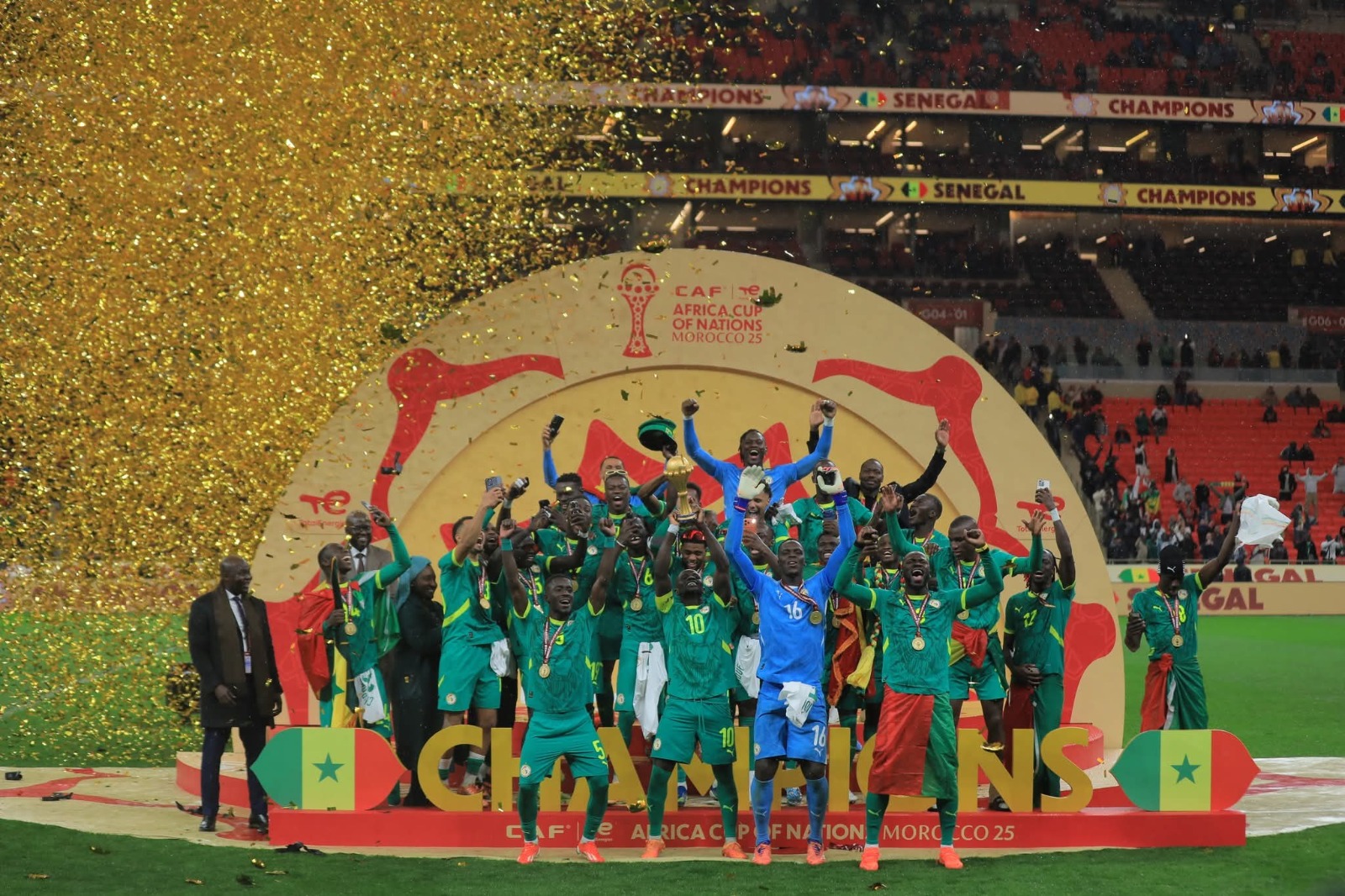
CAF Africa Cup of Nations - Morocco 2025 - Final - Senegal v Morocco - Prince Moulay Abdellah Stadium, Rabat, Morocco
The fate of African football’s most coveted trophy hangs on arbitrators in Switzerland as a landmark verdict draws near.
By Martin Weche
The Court of Arbitration for Sport announced yesterday that its ruling on Senegal’s appeal against the decision to strip the West African nation of the Africa Cup of Nations title and award it to Morocco is expected by the end of November, setting the stage for one of the most consequential verdicts in the history of African football.
The Switzerland-based body, which serves as the supreme court of international sport, confirmed that a closed-door hearing took place at its Lausanne headquarters on October 8, and that a panel of arbitrators is now deep in deliberations. “The CAS arbitrators have decided to issue a complete ruling which includes legal grounds, known as a CAS Award,” the organisation said in a statement. “This process will require several weeks, with the CAS Award expected at the end of November 2026.”
The dispute traces back to a night of extraordinary drama at the January 18 final in Rabat. Senegal appeared to have won the tournament when Pape Gueye scored in extra time to seal a 1-0 victory over the host nation. But the match had already descended into chaos long before Gueye’s decisive strike. Late in normal time, with the score still goalless, referee Maguette Ndiaye awarded Morocco a penalty — a decision that prompted Senegal’s players to walk off the pitch in protest. Sections of the Senegalese support attempted a pitch invasion, and play was suspended for nearly 20 minutes before the players returned to complete the match.
Senegal ultimately prevailed on the night, but the celebrations proved short-lived. In March, the Confederation of African Football overturned the result, awarding Morocco a 3-0 victory by default and handing the Atlas Lions the continental title. CAF cited the abandonment of the pitch by Senegal’s players as the basis for its ruling, a decision that provoked fierce controversy across the continent and prompted Senegal’s football federation to lodge an immediate appeal with CAS.
The case has since become a lightning rod for broader tensions within African football governance. Critics of CAF’s ruling argue that punishing Senegal for protesting a questionable refereeing decision sets a troubling precedent, effectively penalising players for responding to what many observers considered an injustice on the field. Supporters of the decision counter that no team can be permitted to abandon a match mid-play without consequence, regardless of the grievance.
For Senegal, the stakes could scarcely be higher. The Lions of Teranga have long been one of the continent’s most celebrated footballing nations, and the January final in Rabat represented a rare opportunity to claim AFCON glory on foreign soil. Gueye’s extra-time goal had appeared to deliver exactly that. Should CAS rule in Senegal’s favour, the title would return to Dakar and the match result would be restored. A ruling against them would confirm Morocco as the rightful champions and close one of the most contested chapters in the tournament’s modern history.
Morocco, for their part, have conducted themselves with characteristic restraint throughout the proceedings, making few public pronouncements while the legal process runs its course. The Atlas Lions, who have risen dramatically in global football standing since their historic run to the semi-finals of the 2022 FIFA World Cup in Qatar, would regard an AFCON title on home soil as a fitting addition to that legacy.
The CAS panel’s decision to issue a full award with legal reasoning, rather than a summary ruling, signals that the arbitrators regard the matter as one of significant institutional importance. Such awards typically carry detailed analysis of the governing rules, the conduct of officials and the proportionality of sanctions — all of which will be scrutinised closely by football administrators, legal scholars and supporters across Africa.
With the verdict now weeks away, African football holds its breath. Whatever CAS decides, the ruling will reshape not only the record books but the standards by which on-field protests and referee decisions are managed at the continent’s most prestigious tournament for years to come.
Similar Posts by The Mt Kenya Times:
- Araujo sidesteps Liverpool permanency question as Anfield stint gathers momentum
- Let students reward their teachers with excellence, not expensive gifts
- The emperor’s new markets: How cartels in fertilizer, cement and steel still rule the regional kingdoms of SADC, COMESA and the EAC
- Kenya’s missing link in the war against corruption: Why government must invest in grassroots social audits
- Kenya’s weekly political weather: Mashujaa Day, Ruto’s re-election message and the storms gathering beyond Eldoret
About the Author