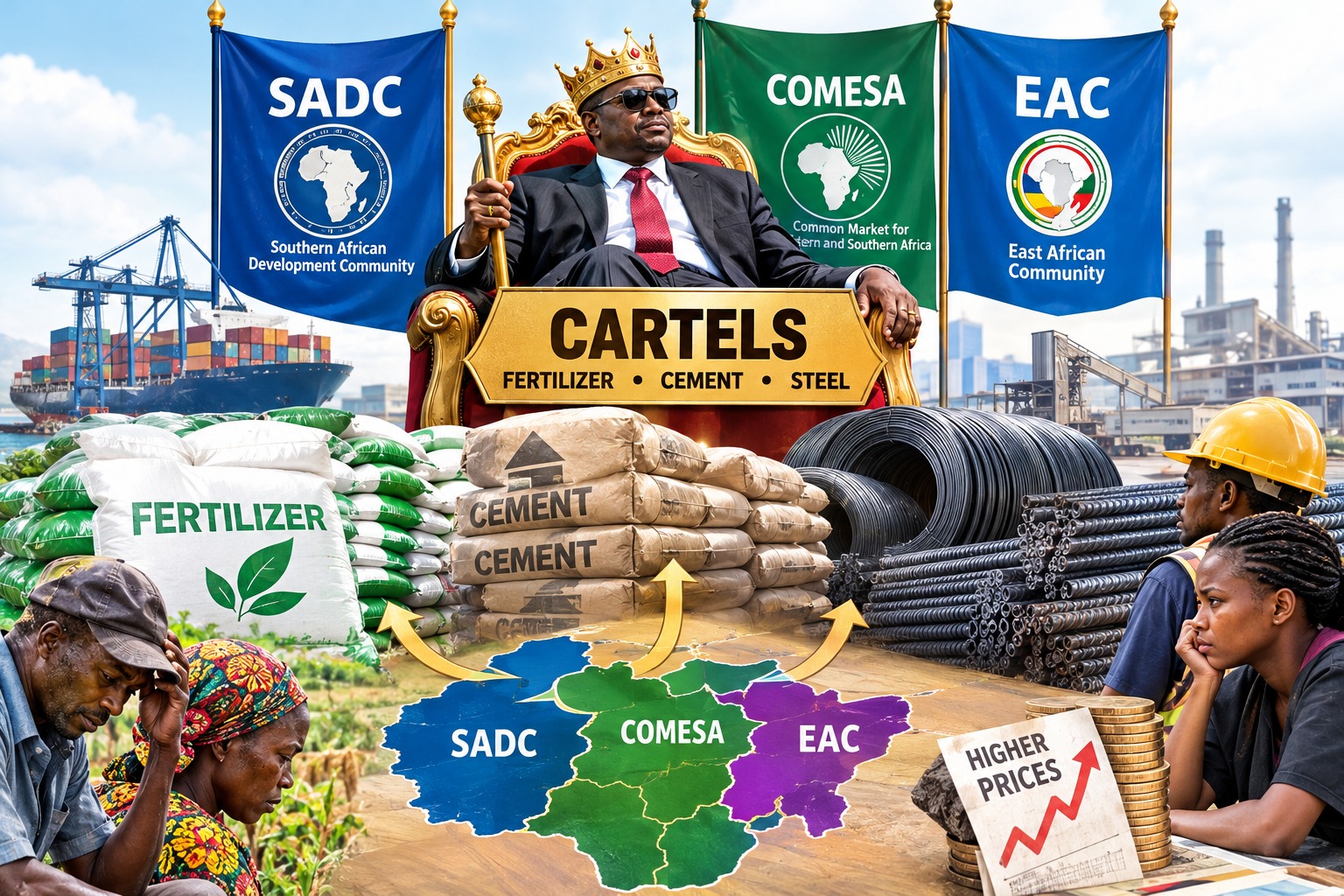
The emperor’s new markets: How cartels in fertilizer, cement and steel still rule the regional kingdoms of SADC, COMESA and the EAC
 The Mt Kenya Times
By Jerameel Kevins Owuor Odhiambo
In 2024 and into 2025, the COMESA Competition Commission publicly flagged two dominant fertilizer importers operating in Kenya Yara and ETG for applying mark-ups that reached as high as 142 percent even as global fertilizer prices fell. Kenyan farmers, already squeezed by drought, debt and delayed rains, continued paying inflated prices for the very input that determines whether their maize will stand or wither. This is not an isolated scandal. It is the latest public face of a deeper, older pattern: regional cartels in fertilizer, cement and steel that treat national borders as convenient lines on a map while their collusion flows freely across them.
These are not abstract market imperfections. They are organised extractions that reach into the soil, the foundations of houses and the steel rods that hold up bridges and schools. They operate across the Southern African Development Community, the Common Market for Eastern and Southern Africa, and the East African Community the very institutions created to dissolve barriers and deliver scale. Instead, the cartels have learned to use those institutions’ incomplete competition regimes as camouflage.
Consider the historical continuity. In the decades after independence, many African states liberalized trade and invited transnational capital under the banner of development. Industry associations emerged bodies that looked like forums for standards and logistics but functioned as clearing houses for information exchange, market division and quiet price discipline. In southern Africa the cement cartel that crystallized in the late 1990s inside the Southern African Customs Union divided territories, coordinated supply and kept prices high until South African authorities finally conducted dawn raids in 2009.
The overcharge estimates ranged from roughly 8 to 20 percent in South Africa itself and climbed higher in neighbouring markets where single suppliers ruled under the regional understanding. The same pattern appeared in fertilizer: bulk importers controlling ports, blending plants and inland logistics coordinated to keep margins elevated. Transnational firms presented themselves as development partners while leveraging infrastructure bottlenecks and regulatory favour to sustain oligopoly. What looked like market liberalisation often became a more sophisticated form of enclosure.
Kenya supplies a living laboratory. In fertilizer the market remains concentrated among a handful of bulk importers Yara, ETG and others who control the critical nodes from port to agro-dealer. When global prices dropped, local prices lagged. The COMESA Commission’s findings of excessive mark-ups were not surprising to farmers who had watched subsidized bags diverted, repackaged and sold at commercial rates. The East African Community Competition Authority has now opened an inquiry into the Kenyan fertilizer market precisely because high concentration, behavioural practices and barriers to entry keep prices sticky. The human cost is measurable in reduced application rates, lower yields and the quiet desperation of households that must choose between fertilizer and school fees.
Cement tells a parallel story. Across the EAC the East African Cement Producers Association facilitated the exchange of sales volumes until the Competition Authority of Kenya secured undertakings to stop the practice. Real prices in Kenya declined by around 11 percent between 2014 and 2018 once new entry and greater rivalry began to bite yet the earlier period of coordination had already extracted its premium. In Zambia, the entry of large-scale challengers drove real price reductions exceeding 40 percent in a short window, revealing how much excess had been built into the previous equilibrium. Regional cartels that allocate countries rather than compete across them convert the promise of a larger market into a collection of protected national fiefdoms. Trade statistics may rise, but the competitive pressure that should discipline prices remains artificially suppressed.
Steel follows the same logic of concentrated power and coordinated restraint. In 2023 the Competition Authority of Kenya imposed record fines totalling hundreds of millions of shillings on multiple manufacturers after uncovering evidence of price-fixing, output limitation and efforts to restrict certain imports. Electronic communications and meeting records revealed the everyday language of collusion routine business talk that treated the market as a shared asset rather than a contest. The fines were significant, yet the structural conditions that made coordination feasible capital intensity, limited alternative suppliers, and the ability of large players to shape distribution have not vanished.
The deeper insight is this: extraterritoriality is already practiced by the cartels. They coordinate across borders with ease. The law lags behind. National competition authorities can reach conduct that affects their domestic markets, but regional cartels exploit gaps in jurisdiction, information-sharing and political will. COMESA’s Competition Commission has developed merger control and has begun investigating restrictive practices, yet cartel detection remains thin. The EAC Competition Authority is still finding its operational footing. SADC lacks a fully-fledged regional competition regime capable of binding action. The result is a jurisdictional patchwork that rewards the sophisticated and penalizes the fragmented.
This is not merely inefficiency. It is a moral and developmental failure. Fertilizer cartels raise the cost of food production at the precise moment African populations are growing and climate volatility is intensifying. Cement and steel cartels inflate the price of housing, roads, schools and clinics. Every excess shilling extracted is a shilling denied to public investment or private accumulation by ordinary households. The correlation is brutal: the same oligopolistic structures that keep input prices high also weaken the industrial deepening that regional integration was supposed to unlock. New entrants capable of disrupting the equilibrium whether Dangote-scale cement plants or aggressive fertilizer traders have demonstrated that prices can fall and investment can follow. Where such entry is blocked or co-opted, the old equilibrium reasserts itself.
The call is therefore categorical. National competition authorities in Kenya, Zambia, South Africa, Tanzania and elsewhere must treat cross-border information exchange and market allocation as presumptively suspicious and pursue leniency, dawn raids and substantial penalties without apology. Regional bodies COMESA Competition Commission, EAC Competition Authority, and any emerging SADC mechanism must be given the resources, the investigative tools and the political cover to act against conduct that harms consumers across multiple member states. Governments must stop treating dominant firms as untouchable development partners and start conditioning infrastructure access, import licences and public procurement on genuine competitive behaviour. Civil society, farmers’ organisations and consumer groups must keep the pressure public and sustained; opacity is the cartel’s oxygen.
History has already shown what happens when market power is left unchallenged: the formal language of regional integration becomes a theatre in which private coordination continues behind the curtain. The fertilizer bag that costs too much, the bag of cement that prices a young family out of a house, the steel that inflates the cost of every public works contract these are not accidents of geography or temporary supply shocks. They are the visible results of arrangements that have been allowed to mature across borders while enforcement remained largely national and timid.
The emperor’s new markets are still the old markets, dressed in the rhetoric of free trade and regional solidarity. It is past time to strip the costume away and insist that competition law reach as far as the collusion already does. Anything less is complicity dressed as caution.
The writer is a social commentator
Similar Posts by The Mt Kenya Times:
- Let students reward their teachers with excellence, not expensive gifts
- Kenya’s missing link in the war against corruption: Why government must invest in grassroots social audits
- Kenya’s weekly political weather: Mashujaa Day, Ruto’s re-election message and the storms gathering beyond Eldoret
- My mother tongue: My identity, national pride, and future
- Mt Kenya Times ePAPER October 19, 2026
About the Author