The triple squeeze: how EPRA’s fuel price hike is reshaping the survival equation for the common mwananchi
 The Mt Kenya Times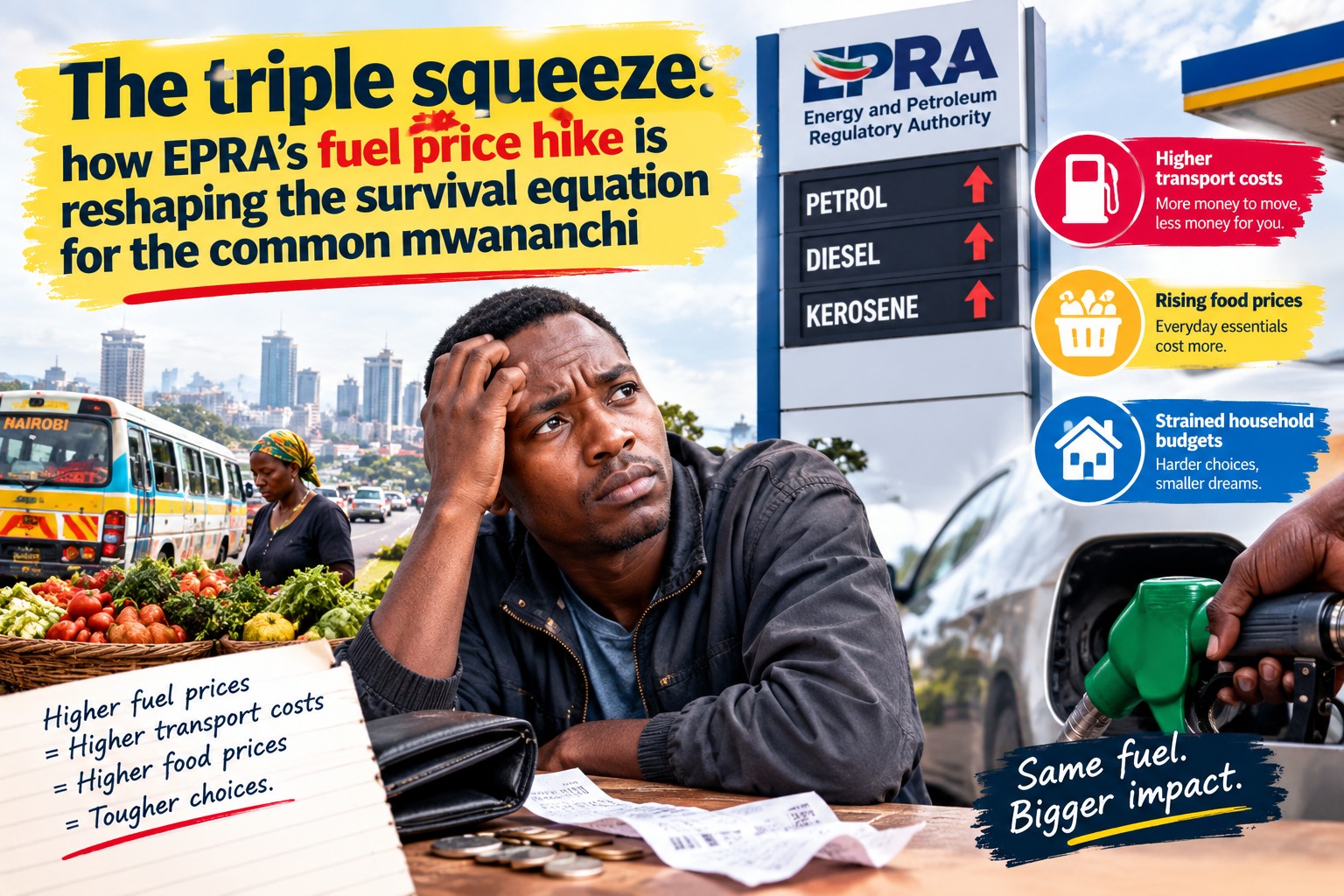
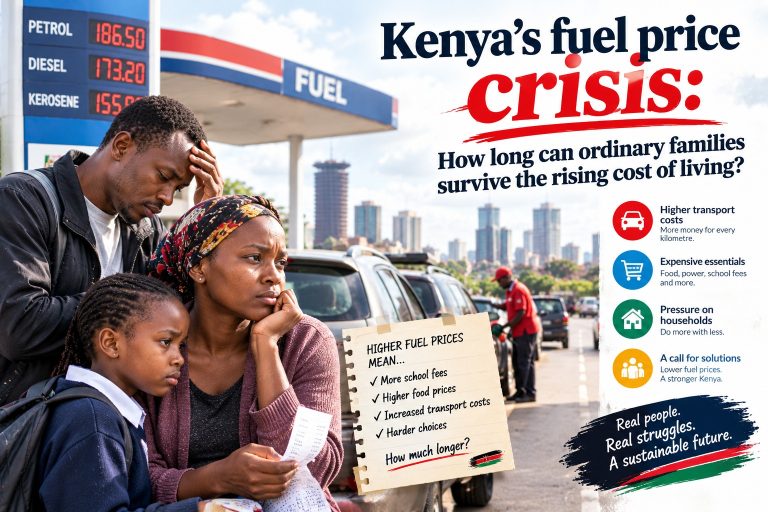
With petrol above KSh226, diesel near KSh228 and kerosene up a punishing KSh28 in a single month, the October price cycle is not just a number on a pump — it is a verdict on millions of Kenyan lives
By David Nyaga
For the average Kenyan, the monthly announcement from the Energy and Petroleum Regulatory Authority has quietly transformed from a routine regulatory update into something altogether more anxiety-inducing — a kind of economic barometer that most households now follow with the same dread they reserve for a hospital bill. When EPRA unveiled its latest pricing cycle on 14 October 2026, effective from midnight that day through to 14 November, the numbers were hard to absorb. Super petrol in Nairobi will now retail at KSh226.96 per litre, diesel at KSh227.76 and kerosene at KSh219.87 — increases of KSh12.93, KSh9.90 and KSh28.49 per litre respectively from the previous cycle.
Taken individually, those figures are striking. Taken together — and understood through the lived experience of the millions of Kenyans who depend on these three products not as a convenience but as a basic condition of daily survival — they represent something closer to a three-pronged assault on the livelihoods of ordinary citizens. This is not a story about macroeconomic adjustment or international supply chain dynamics, though those forces are real and relevant. It is a story about what happens at the bottom of a fuel price cycle, in the homes and markets and boda-boda stages where the numbers become consequences.
EPRA Director-General Edward Mwirigi Kinyua attributed the price increases to the escalating conflict in the Middle East, which has disrupted petroleum supply chains and driven up the cost of importing fuel. Kenya imports all of its fuel in refined form, and EPRA prices it from the landed cost — what a cargo costs once it reaches the Port of Mombasa — averaged across the cargoes in the review period. The international explanation is accurate as far as it goes. But it does not go far enough. For a Nairobi commuter paying a fare that has moved again, or a smallholder farmer watching freight costs absorb another bite of his margin, the geopolitics of the Middle East is an abstraction. The pump price is not.
Diesel and the food chain
To understand the true magnitude of what this pricing cycle means, it helps to start not at the petrol station but at the farm. Diesel, now retailing at KSh227.76 per litre in Nairobi, is the unseen backbone of Kenya’s agricultural and logistics network. The tractors tilling fields in the Rift Valley, the irrigation pumps serving smallholder farms in Meru and Kirinyaga, the heavy-duty trucks carrying cabbages, maize, potatoes and tomatoes to Wakulima and Gakoromone markets — all of them run on diesel, and all of them just got more expensive to operate.
The chain reaction that follows is both predictable and remorseless. Food prices are often the first to respond to fuel increases because Kenya’s agricultural supply chain relies heavily on road transport. Farmers also face higher irrigation, fertiliser and farm input costs whenever fuel prices rise. When transporters absorb a higher diesel cost, they pass it on in freight charges. When freight charges rise, wholesale prices at the market gate rise with them. When wholesale prices rise, the market vendors adjust their retail prices. And by the time a kilogramme of tomatoes or a bag of maize reaches a kitchen in Mathare or Kayole, the family purchasing it has effectively paid for the fuel price increase twice — once in transport costs and once at the till.
Kenya’s inflation climbed to 5.6 per cent in April 2026 from 4.4 per cent in March, driven largely by rising transport and food prices. Data from the Kenya National Bureau of Statistics shows food, transport and housing-related costs together account for more than 57 per cent of Kenya’s Consumer Price Index basket, meaning movements in these sectors significantly shape overall inflation trends. A fuel price hike of this scale, hitting all three products simultaneously, does not just nudge that basket — it tilts it.
Petrol and the urban hustle
The climb in super petrol to KSh226.96 per litre hits a different but equally vital part of the economy: human mobility. For millions of low-income Kenyans who commute daily from peripheral residential estates — Ruiru, Rongai, Kitengela, Umoja — to central business districts and industrial zones, the fare on a matatu is not an optional expense. It is the price of getting to work.
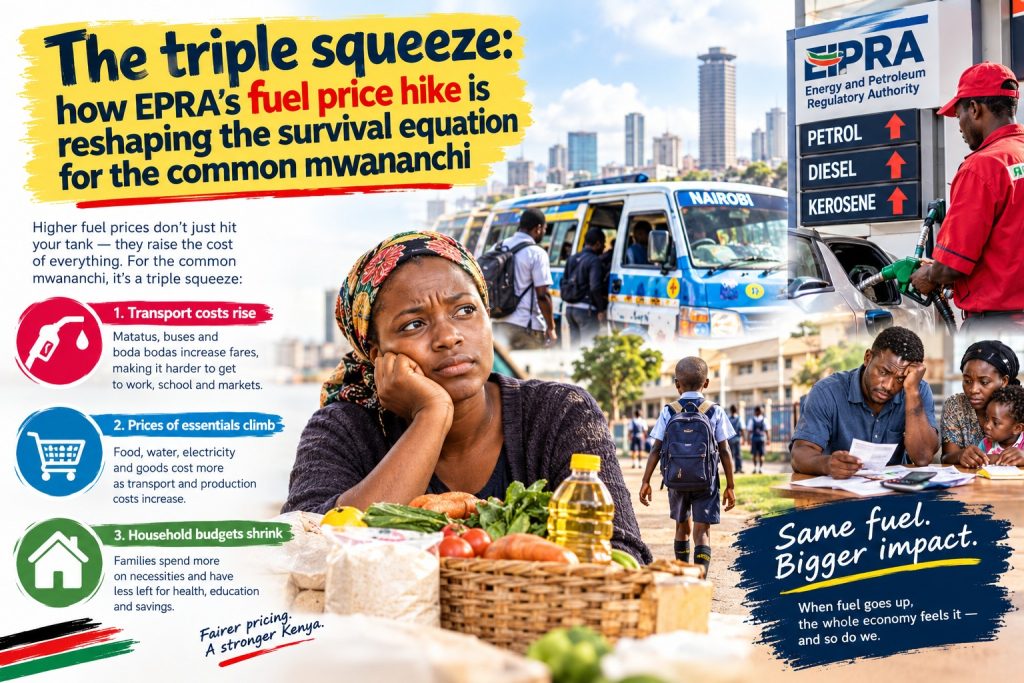 Matatu Owners Association President Albert Karakacha has confirmed that operators have begun consultations nationwide and will adjust fares to reflect rising operational costs, warning that the impact of the price hike will ultimately fall on ordinary Kenyans who rely on public transport daily. The Kenya Transporters Association notes that fuel constitutes approximately 55 per cent of total road freight transport operating costs, and estimates that the increase in fuel prices will push overall transport operating costs up by between 13 and 14 per cent. Previous cycles have seen fare increases of between 25 and 30 per cent imposed within days of a pump price rise, and there is no structural reason to expect this cycle to be different.
For the low-income commuter whose daily wage has not moved in proportion to the cost of living, a fare increase of even KSh20 on a return journey is not trivial. It is the difference between a full meal and a partial one. It is school fees delayed. It is a small emergency that cannot be covered. Economists warn that in many cases, fares remain elevated even after temporary fuel price reductions, creating what they call “sticky inflation” — a ratchet effect that compresses household budgets in one direction only.
Beyond passenger transport, the fuel hike strikes directly at the micro-economy of the urban hustle. The boda-boda rider making deliveries across Nairobi’s industrial estates, the tuk-tuk operator in Mombasa’s old town, the independent artisan ferrying materials from a hardware to a building site — all of them are running on petrol, and all of them will now find their operational margins tighter. For the millions who occupy this stratum of the economy — self-employed, uninsured, with no buffer between their daily fuel cost and their daily income — the adjustment is immediate and personal.
The kerosene catastrophe
If the diesel and petrol hikes are serious, the kerosene increase is in a category of its own. A rise of KSh28.49 in a single month — more than double the combined increases in petrol and diesel — does not simply squeeze a household budget. For the families who depend on kerosene, it attacks the fundamentals of domestic life.
The rise in kerosene prices is likely to hit low-income households that rely on the fuel for cooking and lighting hardest of all. According to data from the Central Bank of Kenya, 12-month inflation for low-income households in Nairobi stands significantly higher than for high-income households, and kerosene is one of the clearest illustrations of why: the faster jump in kerosene prices is a direct reflection of how poor households are affected more by inflation than their wealthier counterparts.
Kerosene has historically served as the fuel of last resort — the product that remained accessible when cooking gas and electricity were not. Data shows that charcoal prices are already at their highest level in 78 months, deepening the squeeze on poor families grappling with rising prices of alternative fuels such as LPG and kerosene, with the cost of both climbing in recent months, thus limiting households’ options in terms of affordability. EPRA has previously justified steep kerosene increases in part by the need to close the price gap between kerosene and diesel — a gap that incentivises the illegal adulteration of diesel with cheaper kerosene. By EPRA’s own analysis, kerosene rose by about KSh15 more than import costs alone would justify, with the regulator citing the need to prevent the blending of cheaper kerosene into diesel as a specific reason for the steeper adjustment.
The reasoning is technically defensible. Its human consequences are not easy. When kerosene and diesel retail at near-parity — with kerosene at KSh219.87 and diesel at KSh227.76 — the safety net it once provided has effectively ceased to exist. Kerosene is mostly used by low-income earners to power their stoves for cooking and lighting, and it is by far the least consumed of the three fuel products — meaning it is actually the least costly to stabilise through a subsidy if the political will existed to do so. That will, consistently, has not been there.
When keeping a lamp burning through a child’s study hour becomes unaffordable, and when cooking a simple meal requires a financial calculation that pits nutrition against transport costs, households do not simply tighten their belts. They make the kinds of compromises that compound over time — reduced nutrition, children missing study time, resort to biomass fuels whose health implications are well documented but routinely overlooked by policy. These are not theoretical risks. They are the lived texture of poverty under persistent fuel price inflation.
A system that does not protect the people it taxes
The broader structural picture is one that successive Kenyan governments have struggled to confront honestly. The maximum pump prices announced by EPRA include eight per cent Value Added Tax, in line with government policy to cushion consumers from the negative effects of high international prices. Yet the retention of VAT at any level on fuel products that are the primary input cost for the country’s most economically vulnerable households represents a structural choice — not a neutral technical adjustment. Heavy tax stacking on petroleum products turns local energy pricing into a punitive burden, one that is regressive in precisely the way that matters most: it takes a larger proportional bite from the budgets of those who can least afford it.
The National Taxpayers Association has raised concerns that matatu fare increases have at times gone beyond covering fuel costs, accusing operators of taking advantage of the situation to boost their earnings, and urging transport operators to act responsibly and adjust fares within reasonable limits, warning that unchecked increases could further strain households already grappling with economic pressures. The complaint points to a wider problem: when government sets a fuel price without a meaningful mechanism to limit the downstream price-setting behaviour of transport operators and food traders, the poorest consumers absorb not only the fuel cost increase but also whatever additional margin intermediaries decide to add.
The mwananchi, caught at the bottom of this chain, has historically demonstrated extraordinary resilience. Communal resource pooling, walking cultures, dietary substitution, innovative grassroots cost-cutting — these are the adaptive strategies that keep households functional when the formal economy fails to protect them. But adaptation of this kind is not free. It has a cost in dignity, in nutrition, in educational opportunity, in the slow erosion of the buffer that separates economic precarity from genuine destitution. And that cost compounds silently, month by month, with each new EPRA pricing cycle.
What structural reform would actually look like
The calls for intervention are not new, and they will not become new by being repeated. What they require is a different quality of political seriousness. Fast-tracking localized renewable energy transitions — solar for off-grid communities, cleaner cooking solutions for low-income urban households — would begin to reduce the dependence on kerosene that makes each price cycle so damaging. Optimising mass public transit through investment in infrastructure that reduces the stranglehold of the matatu cartel on urban commuting costs would create a structural alternative to fare-pass-through. Instituting targeted safety nets to protect baseline fuel consumption for the most vulnerable populations — the kind of mechanism that exists in various forms across the region — would ensure that a global supply disruption in the Middle East does not translate directly and immediately into a child eating less in Mathare.
None of this is beyond Kenya’s policy capability. The challenge is not technical. It is political. The question of who bears the cost of energy pricing — whether it is distributed across a tax base with the capacity to absorb it, or concentrated on households with no capacity to resist it — is ultimately a question of political will.
Until the answer to that question changes, every turn of the fuel pump will remain what it has been for too long: not a commercial transaction, but a tax on survival — collected monthly, without apology, from the people who can least afford to pay it.
Similar Posts by The Mt Kenya Times:
- Diaspora Times Global Oct 17 – Oct 23, 2026
- Is social media a blessing or a curse for university students?
- Light at last: How electricity is reshaping Nandi and Uasin Gishu
- Zelenskyy accuses Trump of rewarding Putin as Pope pleads for peace from a hospital bed
- Mashujaa Day 2026: What does Kenya owe the heroes it exports?
About the Author