Police reforms stall as Kenya’s uneasy march to August 2027 begins
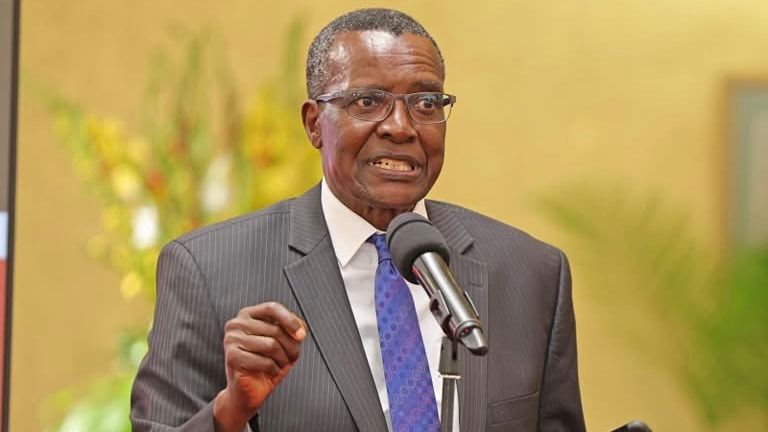
Former Chief Justice David Maraga
Unimplemented police reforms and ageing security chiefs set the tone for a tense election season
By James Mwangi
Former Chief Justice David Maraga yesterday accused President William Ruto’s administration of illegally retaining two senior security chiefs beyond the mandatory retirement age, reigniting a debate over police reform less than a year before Kenya’s next General Election.
Maraga, who chaired the National Taskforce on Police Reforms nearly three years ago, said Inspector General of Police Douglas Kanja and Director of Criminal Investigations Mohamed Amin had both crossed the 60-year retirement threshold set out in the Public Service Act, 2017, and were occupying their offices unlawfully. He argued that the exemption allowing contract extensions was intended for rare, specialised skills, not blanket retention of senior officers.
“The law on age was bent. Section 81 of the Public Service Act, 2017, retired public officers at 60. Section 82 allows a contract extension only for rare skills the service cannot find,” Maraga said. “What rare skills do they hold that other senior officers do not? Neither were they chosen by open competition. The result is that they both occupy their offices illegally.”
The intervention by Maraga, now co-leader of the United Green Movement Party and a declared presidential hopeful, is unlikely to be an isolated skirmish. It lands at the start of what analysts describe as the most consequential eighteen months in Kenyan politics since the disputed 2007 election, as the country edges toward an August 2027 vote already shadowed by economic strain, youth-led street protests and a fractured opposition.
At the centre of Maraga’s complaint is an argument that reaches beyond personnel matters into the machinery that will police the coming election itself. The taskforce he led was established to examine legal, policy and operational failings within the police service and the criminal investigations directorate, and to recommend a shake-up of recruitment, welfare and oversight. Maraga said its central findings — chief among them a call for the fresh vetting and appointment of officers from the rank of senior superintendent upward — had simply been ignored.
He linked that inaction to the 2014 Security Laws (Amendment) Act, which he said had stripped out safeguards designed to keep police appointments transparent and merit-based. “That is not reform, it is capture,” Maraga said, adding that the taskforce itself had termed the Act unconstitutional.
The former judge went further, alleging that a security apparatus insulated from independent vetting had allowed itself to be drawn into partisan contests. He cited incidents of political violence in Homa Bay and Ol Kalou, and disruptions at churches in Kisumu, Nairobi and Witima, as evidence of a security sector he said had drifted from its constitutional mandate. He called for the appointment of both the Inspector General and the DCI Director to be removed from the President’s direct purview, and for a broader overhaul of the security organs built on merit and open competition.
Government officials have not yet responded in detail to the specific allegations, though the administration has previously defended the tenure of senior security officials as lawful and necessary for continuity.
The dispute matters well beyond the fate of two officeholders. Kenya’s electoral history is punctuated by episodes in which the conduct of security agencies before and during polling has shaped both the legitimacy of the outcome and the willingness of losing sides to accept it. The 2007 election was followed by weeks of violence in which police conduct came under sustained international scrutiny; the 2017 contest saw the Supreme Court annul a presidential result partly over irregularities that touched on electoral and security institutions. Each cycle has produced its own taskforce, its own reform blueprint, and, according to critics such as Maraga, its own pattern of selective implementation.
The political terrain heading into 2027 is also more volatile than in the previous two cycles. Cost-of-living pressures and public anger over taxation triggered large youth-led demonstrations in 2024, testing the relationship between protesters and police and leaving a residue of distrust that has not fully dissipated. Opposition politics remains fragmented, with several figures, Maraga among them, positioning themselves as alternatives to the incumbent without yet consolidating into a single challenge. Ruto’s coalition, for its part, retains control of Parliament and the machinery of incumbency, advantages that historically have proven decisive in Kenyan presidential contests.
Against that backdrop, arguments over who commands the police and the criminal investigations service are not merely bureaucratic. They speak to a broader question that will dominate the run-up to August 2027: whether the institutions meant to guarantee a free and fair contest are seen by all sides as neutral, or whether they are perceived, fairly or not, as extensions of incumbency. Maraga’s intervention is best read in that light — as an opening argument in a longer contest over the rules and referees of the next election, rather than a narrow personnel dispute.
Whether his claims translate into legal challenges, parliamentary pressure or simply campaign rhetoric will become clearer in the coming months. What is less contestable is the timeline. With eleven months remaining before Kenyans return to the polls, the questions Maraga has raised about age limits, appointments and institutional independence are unlikely to be the last of their kind. They are, more probably, the opening exchanges of a campaign in which the neutrality of the state itself will be as fiercely contested as any single candidate.
Similar Posts by The Mt Kenya Times:
- Diaspora Times Global Oct 17 – Oct 23, 2026
- Is social media a blessing or a curse for university students?
- Light at last: How electricity is reshaping Nandi and Uasin Gishu
- The triple squeeze: how EPRA’s fuel price hike is reshaping the survival equation for the common mwananchi
- Zelenskyy accuses Trump of rewarding Putin as Pope pleads for peace from a hospital bed
About the Author