The Mt Kenya Times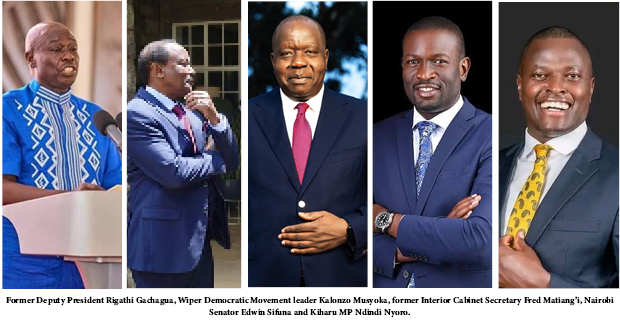
Kenya’s fractured opposition faces a harder question than whether to unite against President Ruto — it must first decide who among five competing presidential hopefuls will carry the flag.
By Hadassah Karangu
Kenya’s opposition is entering one of the most delicate phases of its 2027 General Election preparations, with the central challenge no longer simply whether its various parties and movements can unite against President William Ruto, but whether they can agree on who should carry the presidential flag.
At the heart of this emerging contest are five names that increasingly complicate the opposition’s arithmetic: former Deputy President Rigathi Gachagua, Wiper Democratic Movement leader Kalonzo Musyoka, former Interior Cabinet Secretary Fred Matiang’i, Nairobi Senator Edwin Sifuna and Kiharu MP Ndindi Nyoro. Each represents a different political calculation. Each commands a constituency that believes their preferred candidate can defeat Ruto. And each brings a distinct theory of how a winning coalition should be assembled.
That is precisely where the dilemma begins. Agreeing that the country needs a change of government is one thing. Agreeing on who should lead that change is another matter entirely.
Gachagua enters the contest with perhaps the most obvious regional calculation. As a former Deputy President and one of the administration’s most vocal critics, he has positioned himself as a commanding political force in the Mt Kenya region. His supporters argue that his ability to influence the mountain vote makes him indispensable to any opposition coalition serious about defeating Ruto. But the emergence of Nyoro has introduced a second powerful voice from the same political backyard, and the tension between the two camps is already visible. Nyoro’s departure from the ruling United Democratic Alliance and his subsequent takeover of the People’s Party of Kenya dramatically altered the region’s political arithmetic. He has declared his intention to seek the presidency while simultaneously suggesting that personal ambition should not prevent the opposition from settling on a single candidate — a position that is either admirably selfless or strategically calculated, depending on one’s reading of his motivations.
The question facing the opposition is therefore not merely whether Mt Kenya will support it. It is which politician will speak for Mt Kenya, and whether the region can remain united if more than one candidate courts its loyalty simultaneously. Should both Gachagua and Nyoro pursue serious presidential ambitions, the opposition risks fragmenting the very vote bloc it needs to consolidate.
Then there is Kalonzo, who carries perhaps the longest presidential résumé of the five. A former Vice President who has contested the presidency and participated in successive opposition coalitions, his supporters make a straightforward argument: experience, a national network and an established political profile. But longevity in politics can become as much a burden as an asset. After years of contesting for and coalition-building around the presidency, some voters may reasonably ask whether this is the moment for a familiar face or for a generational shift. Recent polling has placed Kalonzo among the leading opposition hopefuls, though figures vary considerably by methodology. His real challenge will be converting a well-known name into a convincing national argument — not merely that he deserves another opportunity, but that he is best placed to build the broadest possible winning coalition.
Matiang’i offers a different proposition. Unlike Gachagua and Kalonzo, his appeal rests not on traditional opposition credentials but on his record as a firm and decisive administrator, particularly during his tenure at the Interior ministry. His supporters position him as a fresh face with real executive experience — someone capable of offering the opposition a leadership style that breaks from the familiar cycle of coalition politics. Matiang’i has himself called for an objective, even scientific, process for determining the opposition’s candidate, and in doing so he has identified the opposition’s central structural problem with uncomfortable precision. If five politicians each believe they can win, who decides which of them actually has the strongest case? Political negotiations risk becoming a contest of egos. Opinion polls invite disputes over methodology. Delegate processes invite manipulation by individual parties. Whatever formula is adopted, those who lose must accept the outcome — and in Kenyan politics, that is rarely straightforward.
Sifuna adds a generational dimension that the others do not quite represent. His politics resonate with younger voters and with the growing demand for leaders who engage directly and plainly with the concerns of ordinary citizens. His possible presidential ambitions have already placed him within the broader opposition conversation, though his challenge is whether an energetic national voice can translate into the geographical breadth of support that a presidential campaign requires. His presence matters, however, for reasons beyond his individual prospects. The opposition is not merely choosing between personalities. It is choosing between political generations — and that is a choice with long consequences regardless of who emerges as the candidate.
Nyoro may ultimately be the most intriguing piece of this puzzle. For years closely associated with Ruto and regarded as one of the influential younger figures within the ruling establishment, his break with UDA represents far more than an ordinary political realignment. It places a politician who once helped construct Ruto’s electoral machinery on the opposite side of the battlefield. His supporters contend that this insider knowledge is an asset. His critics question whether his relatively recent transition provides him with sufficient political distance from an administration he once championed. Both arguments have merit, and how voters weigh them will say as much about the country’s political mood as about Nyoro himself.
The deepest danger facing the opposition, however, is not the number of presidential aspirants. Competition in a democracy is legitimate and healthy. The danger lies in what happens if no agreement is reached — if five candidates reach election day each convinced they are the one, splitting the anti-Ruto vote and handing an incumbent the kind of fractured opposition that is easiest to defeat. Kenya’s electoral history offers cautionary lessons on precisely this point.
The opposition’s greatest enemy in 2027 may not be the government it seeks to replace. It may be its own ambition.

Similar Posts by The Mt Kenya Times:
- Mt Kenya Times ePAPER October 21, 2026
- Kenya confirms ninth Ebola case as outbreak remains contained within single cluster
- Musk pledges SpaceX share for every American child in 2027
- Abiy calls for deeper Kenya-Ethiopia trade partnership at Eldoret ceremony
- Kenya’s oil moment: Promise, responsibility and the long road from Turkana to market
About the Author